The Floor
Researchers present Social Humanoid and a new 260-hour Human-Humanoid Interaction benchmark
The paper introduces Social Humanoid, a system that generates and executes socially responsive motion on a Unitree G1 robot, and a 260-hour benchmark built from five motion-capture datasets. Its approach combines adaptive motion retargeting, a shared representation for human and robot movement, and a policy designed to respond to a human partner.
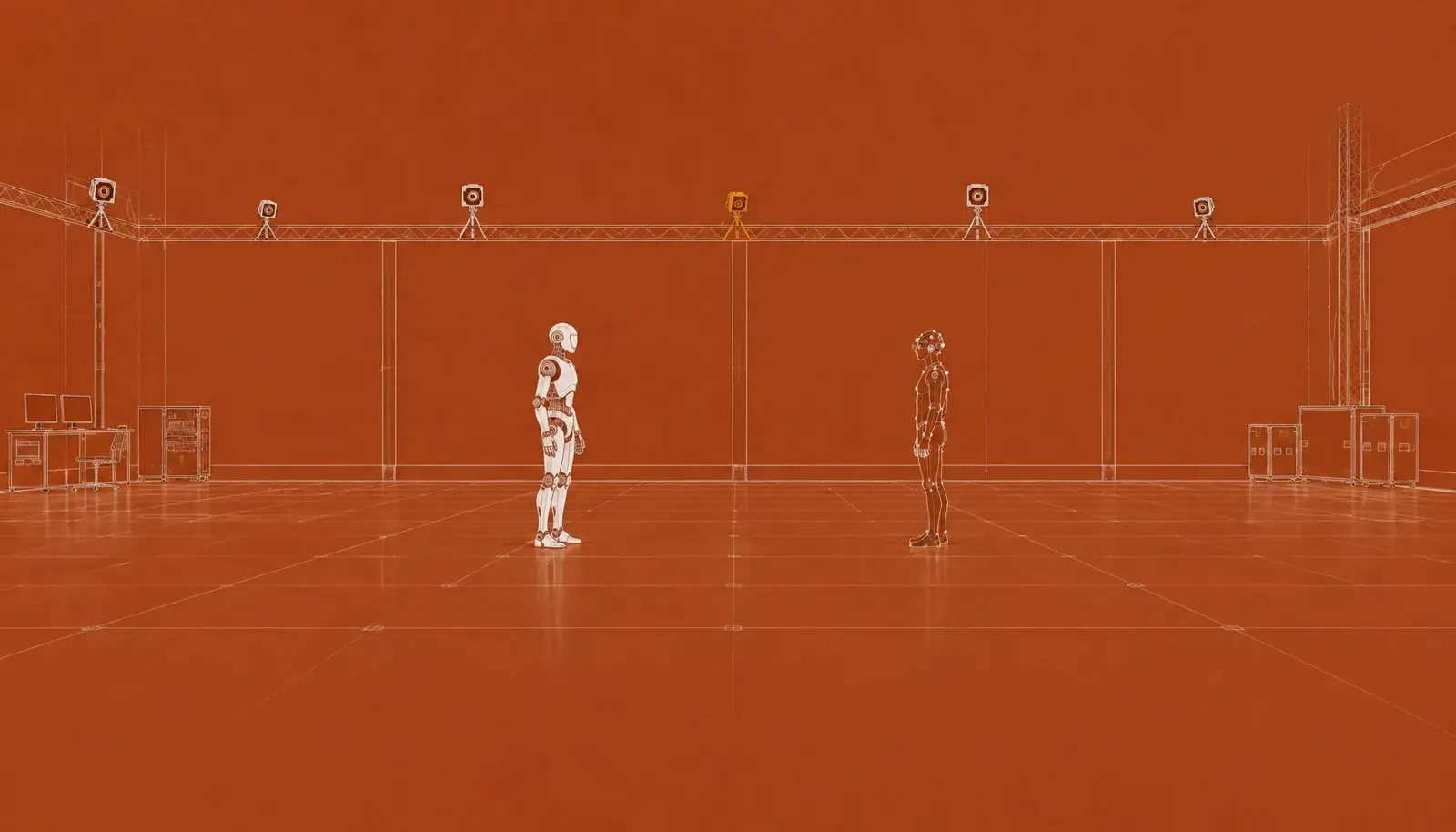
The authors apply a two-phase adaptive retargeting procedure across five motion-capture datasets to produce a new 260-hour Human-Humanoid Interaction benchmark
The preprint was submitted to arXiv on 5 Nov 2026. The authors introduce Social Humanoid, a hierarchical system for generating and executing socially responsive whole-body motion on a 29-degree-of-freedom Unitree G1 robot. The system conditions its motion on a human partner’s movement. The paper’s Human-Humanoid Interaction (HHI) benchmark contains 260 hours of interactions, produced by applying the authors’ procedure to Chi3D, Hi4D, Harmony4D, Inter-X and Embody3D. The benchmark includes both dyadic and polyadic interactions paired with the G1.
The authors introduce a two-phase adaptive retargeting procedure to preserve contact dynamics, reachability and relative body scale
The procedure retargets one interaction partner to the robot while morphing the other partner’s body pose. The aim is to preserve contact, reach and relative scale, rather than independently retargeting each person and losing the spatial relationships that make an interaction work. The paper identifies the lack of natural human-humanoid interaction data as a data gap: existing human-human interactions can be captured at scale, but the authors say that independently retargeting both participants destroys contact, reach and spatial structure.
The authors write, “Humanoid robots are typically trained as solitary agents, leaving them unable to coordinate physically with human partners who naturally anticipate and adjust to one another.” They frame the task as having a humanoid continuously generate and execute coordinated motion in response to observations of a human partner.
A shared motion representation connects human and humanoid movement
Human and humanoid motion occupy different spaces, which the paper describes as a representation gap. Social Humanoid uses a shared-codebook VQ-VAE to tokenize movement from both embodiments into one discrete vocabulary. The authors say this lets a single generative model reason jointly about human and humanoid motion, rather than focusing on differences between the two bodies. The shared vocabulary also supports real-time shadow teleoperation of the G1 without optimization-based retargeting.
The system generates responses and anticipates a partner’s motion
The high-level policy is a Diffusion Forcing Transformer that autoregressively generates humanoid responses using the shared vocabulary. It can produce reactive robot motion and anticipate a partner’s movement when the person is occluded or human input is missing. The paper presents this as a way to address the generation gap: instead of generating human motion first and then using optimization to retarget it to a robot, the policy generates humanoid motion directly. The authors describe optimization-based retargeting as brittle to noisy, discontinuous observations.
A low-level whole-body tracking controller executes the generated motion on the G1. The system uses NVIDIA SONIC as that controller, and generation and execution run asynchronously. The paper reports a median end-to-end latency of 308 milliseconds from camera frame to humanoid command. Its results, according to the authors, demonstrate coordinated, human-aligned behavior across diverse interaction types in simulation and real-world hardware experiments.
The system takes RGB-D observations of a human partner, reconstructs the observed human motion and uses it to predict future human movement as well as a humanoid response. The paper’s examples include a hug and a greeting followed by posing together for a photo. It presents the HHI benchmark, shared motion representation and direct response policy as connected parts of a system for interaction: the retargeting procedure supplies paired data, the shared representation lets the model process both bodies, and the policy generates motion for the robot to execute.
Sources
- Original source · Preprint arXiv arXiv:2611.08407
Related stories
- Researchers Present LumiTac, a Six-Axis Sensor With a 12 mm-Diameter Sensing Head
- JBNU Researchers Test Gesture-Controlled Drone With Tactile-Only Feedback
- Researchers Present Multi-Agent Reinforcement Learning for Planar Tangram Assembly
- Amap Opens λ₀ Humanoid Model Built on 500 Hours of Human Data
- Hong and Zhang Use Human Motion Data to Train Dexterous Robots