The Floor
Researchers report swarm learning transfers to hardware
A study reports that a swarm-learning method trained in simulation worked on physical robots across five missions. The evaluation used 20 e-puck robots and 250 real-robot runs.
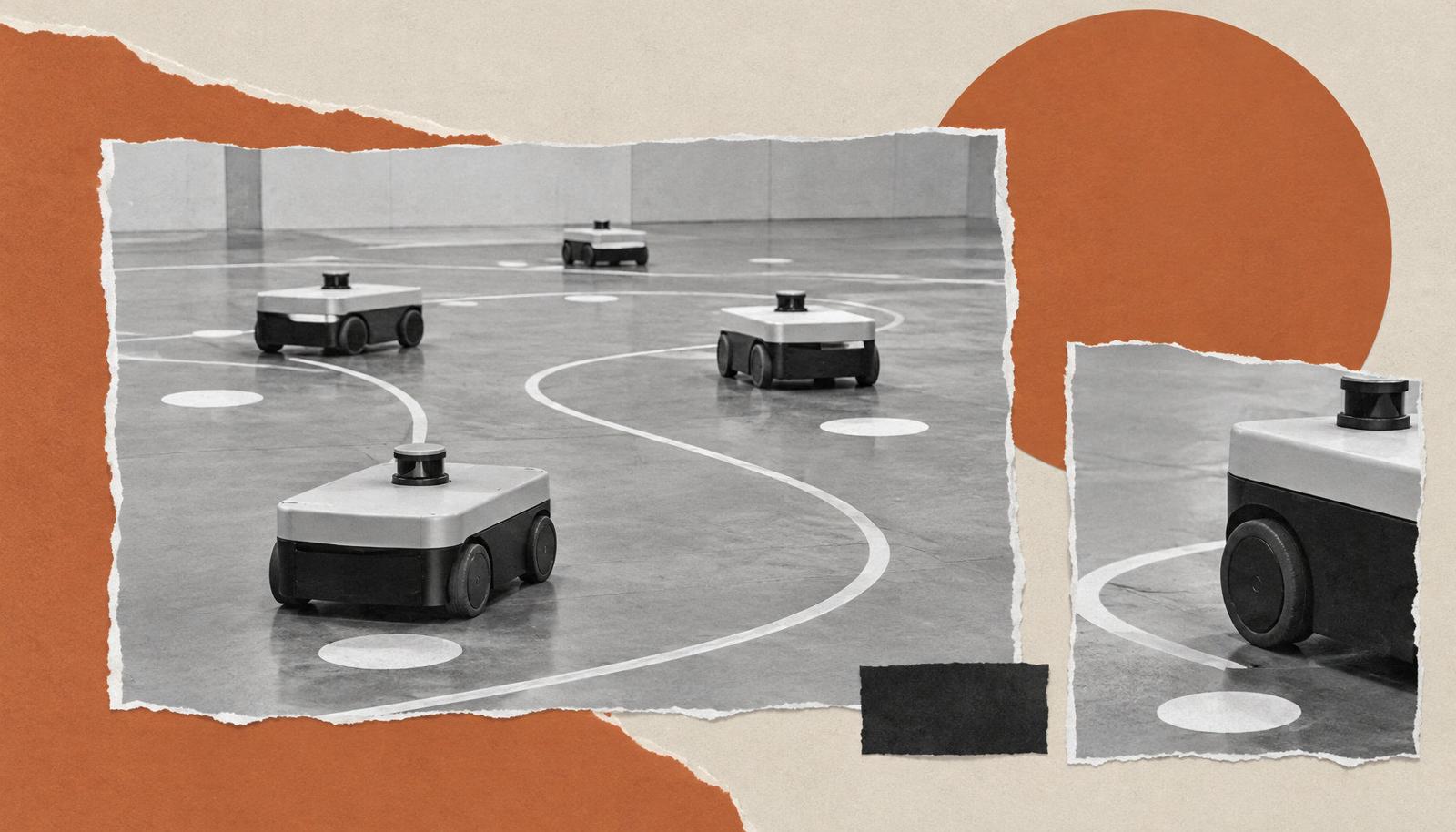
A tighter learning policy
A swarm-learning method trained in simulation worked on physical robots across five collective missions, according to research published in Science Robotics. In a report published November 17, IRIDIA, the artificial intelligence laboratory at Université libre de Bruxelles, described the work, which tested the method on 20 e-puck robots in 250 real-robot runs.
The system, called SwarmACB, uses reinforcement learning to select among predefined behavior routines. Instead of learning to issue low-level motor commands, each robot learns when to activate a routine, such as moving toward a light source, gathering with other robots or exploring. The approach restricts the policy’s options, the paper says, to reduce the chance that it will learn to exploit quirks in the simulator that do not apply to physical robots.
Tests on physical robots
The research team evaluated SwarmACB and several versions of it against a continuous-action baseline, in which the controller directly produces actions rather than selecting from predefined behaviors. The paper reports that the learned modular policies transferred from simulation to real robots and substantially outperformed that baseline. The IRIDIA project page says the modular policies matched established modular design methods, while the continuous-action baseline struggled on the physical robots.
The researchers also tested policies with progressively tighter limits on their architecture, inputs and capacity. They report that smaller, more structured policies transferred more reliably than larger, less constrained ones. The result does not show that every policy trained this way will work across robot types or missions; the reported hardware evaluation used e-puck robots and five collective missions.
What the method learns
SwarmACB combines reinforcement learning with a modular design approach in which behaviors are built from simpler routines. The IRIDIA page gives moving toward a light, aggregating with peers and exploring as examples of behavior modules. Learning focuses on choosing among these routines, rather than generating motor commands directly.
IRIDIA’s November 17 report says the researchers plan to test the approach with larger swarms, other robot platforms and less controlled environments. Those are future tests, not results included in the reported evaluation.
Sources
- Original source · Paper Science Robotics science.org
Other pages read
- IRIDIA, Université libre de Bruxelles iridia.ulb.ac.be
- Robohub robohub.org
Related stories
- Preprint uses human video priors to train bimanual robot policies
- LoRN steers frozen robot policies through low-rank noise
- Study finds action-expert tuning best steers VLA hand policies
- Virtual-joint method reuses humanoid locomotion training across three robots
- Hub releases first 10,124 hours of skilled-work video for robot learning