The Floor
ToFTouch Pairs Proximity and Tactile Sensing on a Robot Gripper
A research team introduced ToFTouch, a gripper-mounted sensor combining time-of-flight distance readings with optical tactile sensing. Tests covered anticipatory grasp closure, extraction from clutter and insertion into a tight space, with sensor overheating and limited trials among the paper’s stated caveats.
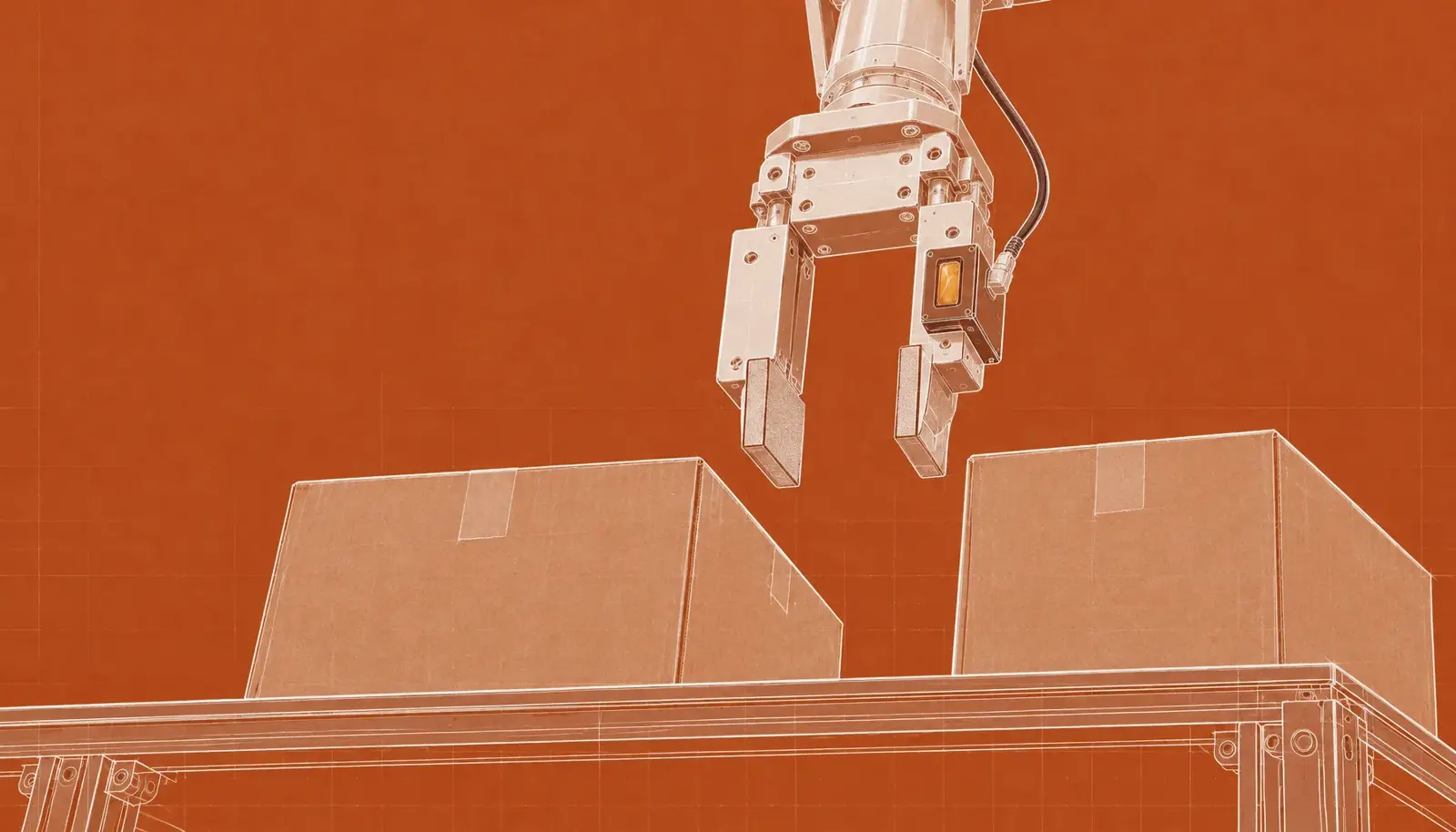
ToFTouch senses before and after contact
Tactile feedback begins when a robot touches an object; proximity sensing can give it information before that moment. ToFTouch combines both on a gripper-mounted module, aiming to let a robot respond to nearby surfaces before contact and monitor forces once contact occurs. The paper was submitted to arXiv on Nov. 2, 2026, by Eric T. Chang and nine co-authors.
The module combines three multizone time-of-flight (ToF) sensors, each with a 4-by-4 depth array, and an optics-based pressure-sensing patch. The sensors report proximity at 60 Hz, while the tactile array samples at 300 Hz. The complete unit measures 45 by 30 by 10 millimeters, and its tactile patch covers a 3-by-3-centimeter area.
ToF feedback starts the grasp earlier
In the pre-grasp test, the researchers used a cuboidal box and compared gripper closure with and without ToF feedback. Without the sensor, the gripper waited until it reached the known pick depth to close. With ToF, it began closing when a sensor detected the table at a threshold distance of 130 millimeters, overlapping closure with the approach.
Across ten trials per condition, the mean cycle time was 3.533 seconds without ToF and 3.271 seconds with it. The authors report a 7.4% reduction. The test assumed a known pick point and object geometry, so it measured the timing benefit of anticipatory closure in that setup rather than performance across unknown objects.
Depth correction helped, but overheating hurt
For extraction, the team varied the object’s depth in 1-centimeter steps around a nominal pick point and ran ten trials at each offset. With ToF feedback, the gripper achieved 9 successful picks out of 10 at both the minus-2-centimeter and plus-2-centimeter offsets. Without ToF, neither extreme produced a successful pick: one condition missed the object, while the other caused a collision with the environment.
The results also expose a hardware and calibration issue. The authors say sensor overheating produced corrupt readings and was the main failure mode when ToF feedback was enabled. They also report that measured depth corrections did not match the set offsets, attributing the discrepancy to the absence of calibration and to sensor misalignment on the gripper.
A tight insertion test, with limits
For insertion, the gripper carried an oblong cardboard box toward a narrow opening among neighboring boxes. ToF readings tracked nearby surfaces and the available cavity during the approach; the tactile patch registered contact as the box was nested into place. The study also compared tactile signals with force measurements from a sensor mounted between the arm and gripper.
The authors write: “We view this work as an initial characterization of fingertip-mounted multizone ToF and tactile sensing rather than a complete evaluation.” They identify limited trials per condition and call for larger studies, statistical analysis and additional sensor baselines. Calibration and thermal characterization are also listed as work needed to address the observed depth offsets and overheating.
Sources
- Original source · Preprint Exploring Proximity and Tactile Sensing for Robotic Manipulation arXiv:2611.03489
Related stories
- HuG Trains One Policy for Humanoid Whole-Body Grasping
- LAGR preprint reports 93% success in tabletop grasp trials
- CoRA-VTLA preprint adds tactile memory to robot manipulation
- FORTH preprint pairs robot learning losses with force measurements
- Researchers Present LumiTac, a Six-Axis Sensor With a 12 mm-Diameter Sensing Head