The Floor
TUM says robot system can pause when it is unsure
A Technical University of Munich research team has developed a system that assesses whether a robot can handle a task and targets uncertain situations for additional training. A related preprint tests an uncertainty measure in simulation and on a physical robot.
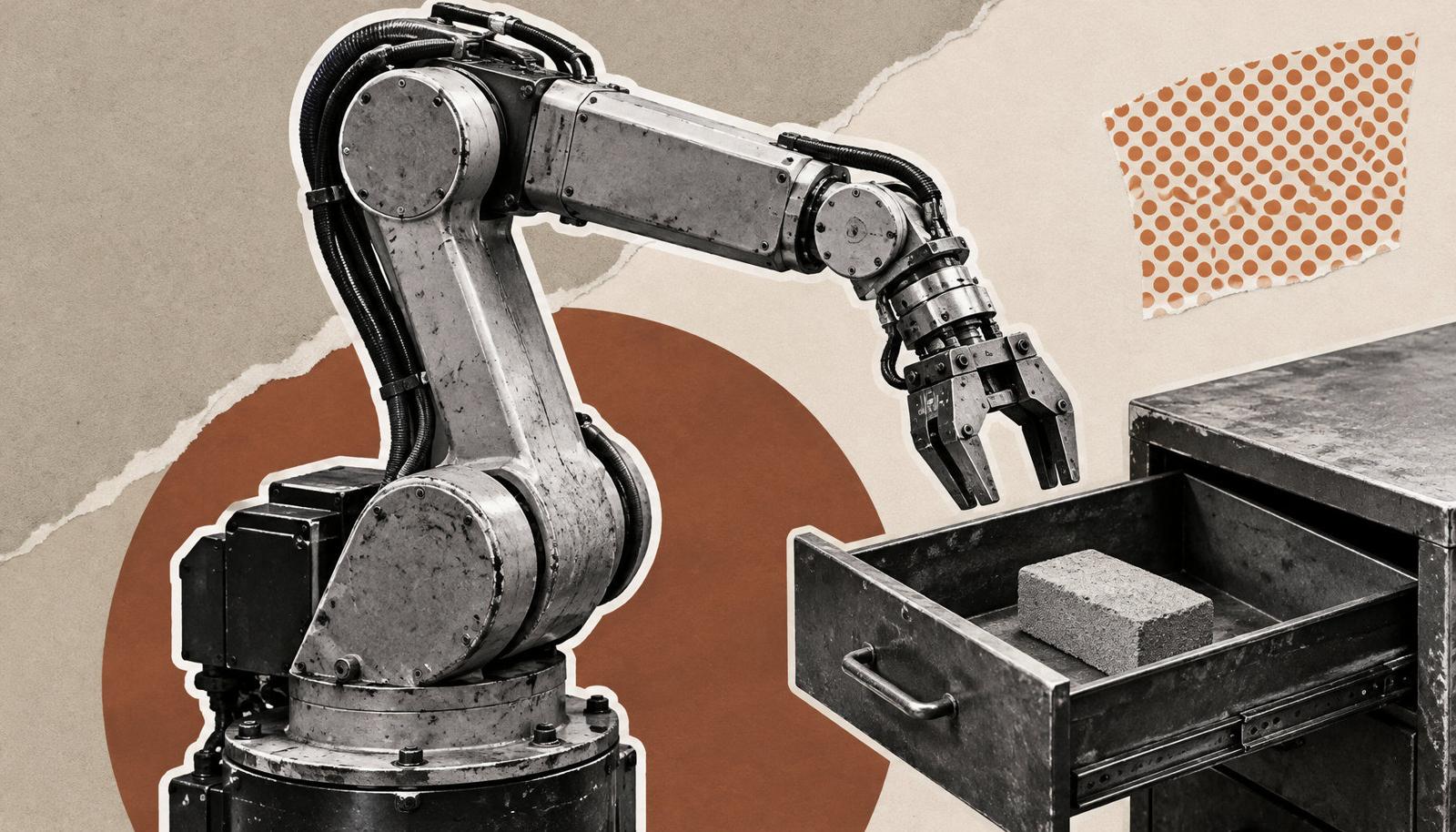
A robot can stop and wait for help when it is unsure how to proceed under a system developed by researchers at the Technical University of Munich. The university says the approach also identifies situations for targeted training so the robot can learn how to handle them.
Source dx.doi.org
The team is led by researcher Ralf Römer and Professor Angela Schoellig and uses a vision-language-action model, which translates verbal instructions and camera images into robot actions. In a related preprint, researchers test an uncertainty measure for robot policies in simulation and on physical hardware.
Training around uncertainty
When the robot is uncertain, stopping gives a researcher an opportunity to work through the unfamiliar movement with it and generate additional training data. The university says targeted retraining can reduce the amount of training required by up to 20%.
The approach also addresses what happens when a model learns a new manipulation skill. Schoellig says AI models can forget previously learned information as they change during further training.
To address that problem, Römer adds an adapter when the model needs to learn something new. The university says newly generated data is stored as additional information in the adapter, and the system selects the adapter needed for a task.
Measuring what a policy does not know
The preprint describes a method for estimating uncertainty by measuring disagreement among a small ensemble of flow-based models. The researchers call their measure velocity-field disagreement, or VFD, and use it both to monitor for failures and to guide the selection of further training demonstrations.
For training, the authors propose a method called SAVE, which uses uncertainty to decide where to request expert demonstrations. It prioritizes uncertain tasks and, within a selected task, uncertain starting situations.
In tests across three real-world tasks with a fixed demonstration budget, the authors report that SAVE raised final average success from 39% to 47%. The tests used a physical robot as well as simulated environments; the paper also evaluates both vision-language-action and world-action models.
Tests and limits
The physical tests used an FR3 robot for three tasks: placing a bowl on a plate, stacking a bowl on three other bowls, and putting a Lego brick in a drawer before closing it. The researchers awarded partial credit for completed portions of the tasks.
For failure detection, they added unfamiliar background objects, such as fruit or a pan, to the real-world setup. In simulation, the tests included changes to object layouts and camera viewpoints. The authors report that VFD detected failures with 8 percentage points higher overall accuracy than existing methods.
The preprint also identifies a limit in using uncertainty from the initial observation as a guide to task difficulty. The authors caution that some situations may look simple but still be challenging for a policy, including because of complex contact dynamics.
Sources
- Original source · Paper arXiv dx.doi.org
Other pages read
Related stories
- Researchers propose CoMP to track uncertainty in robot policies
- FoRe preprint reports gains in robot grasp recovery
- FORTH preprint pairs robot learning losses with force measurements
- HermiteTwin models robot grasps separately from sheet deformation
- Preprint reports gains from training robot policies on action gaps