The Floor
UCLA’s PhoneBot Uses Android Phones to Control a Walking Humanoid
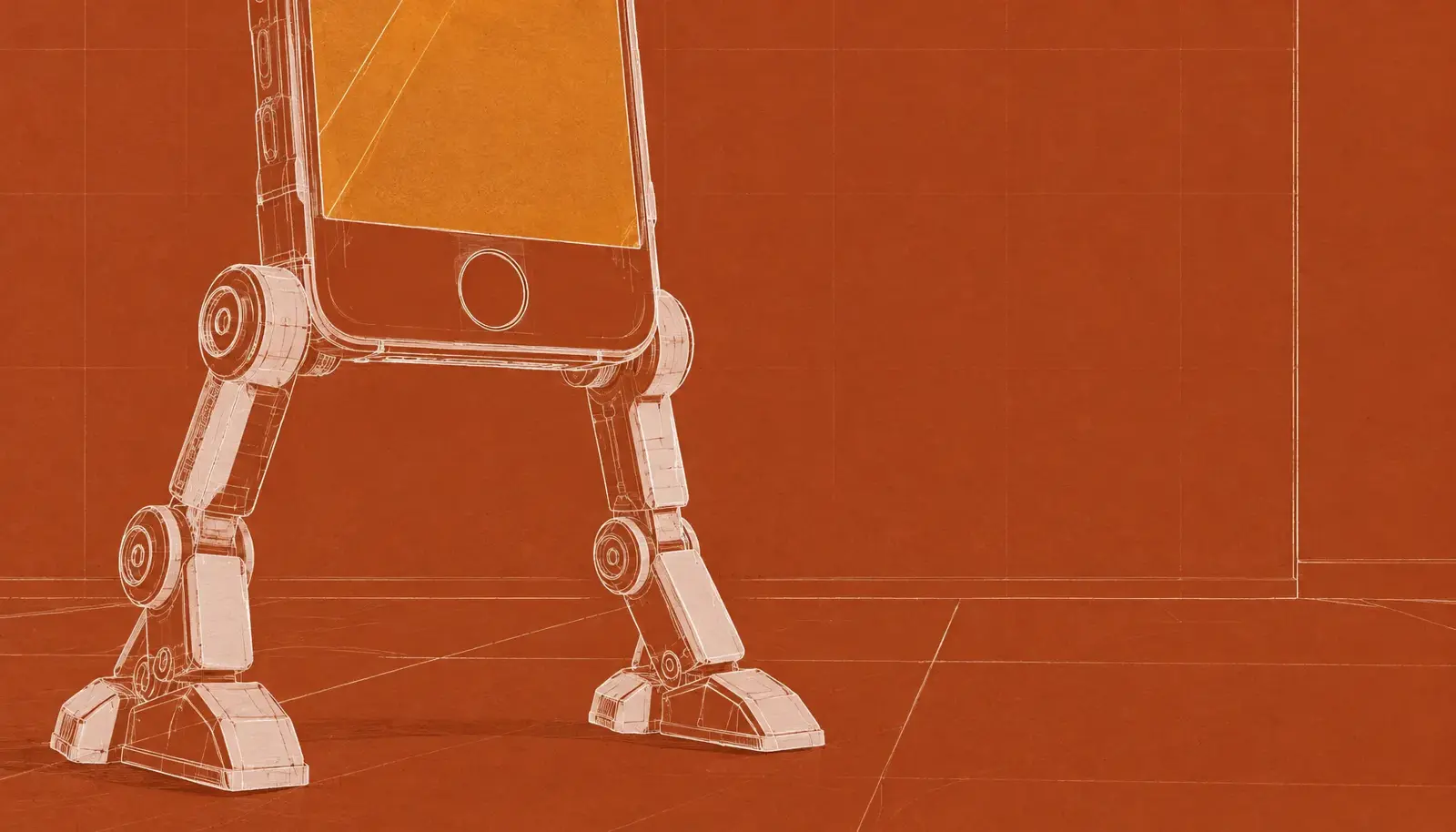
UCLA researchers describe PhoneBot, a 48.3-centimeter biped that uses an Android smartphone for sensing and locomotion control. The team reports tests on four phones and estimates the robot’s hardware cost at about $400, excluding the handset.
“The smartphone has no physical electrical connection with the robot hardware.”
Ruochen Hou, Quanyou Wang, Daniel Koh and Dennis W. Hong, PhoneBot: A Low-Cost Open Humanoid Robot Platform Reusing Smartphones
UCLA researchers’ PhoneBot puts a consumer Android handset where a humanoid’s torso would be, using its camera, motion sensors and processor for perception and walking control. The team’s paper, posted to arXiv on October 6, describes a 48.3-centimeter biped with 13 actuated joints and a listed hardware cost of about $400, not including the phone.
A phone handles sensing and walking control
The handset reads its inertial measurement unit, processes camera input and runs the walking policy. It sends joint targets over Wi-Fi to a small computer in the robot’s lower body; that computer relays commands to the motors and returns joint data. Keeping the phone electrically separate from the robot, the authors say, lets users switch among compatible handsets without rewiring the body.
Six motors drive each leg, and a thirteenth turns the torso so the phone’s camera can track a person without rotating the robot’s feet. The researchers demonstrate walking, following a person through camera-based tracking and rising from a face-down position. The phone also runs vision functions and, on supported devices, visual mapping through ARCore.
Four Android phones, including a 2017 Honor
The team tested the application on a 2017 Honor 9 and three inexpensive prepaid phones: a moto g 2025, a Galaxy A16 5G and a moto g 2024. The paper lists the prepaid models at roughly $50 to $80 in its September 2026 price data. All four ran the core functions, including motion sensing, motor communication, walking-policy inference and on-device vision.
There was a compatibility exception: the Honor 9 could not run ARCore mapping because Google services were unavailable on that Huawei device in the United States. The paper says the current application is CPU-bound, and reports that the other three handsets ran SLAM with measured CPU use between 25.2% and 34.3%. Those tests make the phone more than a camera bolted onto a robot: it performs the main sensing and high-level control work, while the separate onboard computer remains responsible for actuator communications.
Simulation training targets cheap servos
PhoneBot’s walking policy is trained in simulation using reinforcement learning and a model of the servos’ limits, including their torque, speed and mechanical backlash. The researchers also mirror training examples across the robot’s left and right sides. In their five-seed simulation evaluation, that approach reduced the reported joint-angle symmetry error from 0.254 to 0.003 radians and lowered left-right torque imbalance from 0.205 to 0.034.
Those figures describe simulated gait comparisons, not a measured improvement in the robot’s real-world walking speed or endurance. The paper says the resulting policies were also run on the physical robot, where the team demonstrated walking and recovery. The walking policies were trained on flat terrain, and the authors identify uneven ground as work still to be done.
The $400 estimate leaves out the phone
The roughly $400 estimate covers the robot hardware but excludes the handset. The team’s project website provides a bill of materials, CAD files, printable parts and assembly resources under a Creative Commons Attribution-NonCommercial 4.0 license; commercial use requires separate permission. The paper presents the design as a platform for education and research, where reusing a phone could avoid separate camera and inertial-sensor hardware.
PhoneBot’s limits matter as much as its parts list. It has no arms, so it cannot manipulate objects, and the authors say low-cost servos constrain payload and dynamic motion. Dialogue also is not fully handled by the phone: speech recognition and the language model run on a nearby laptop, with the reply played through the phone. For now, the recycled handset supplies the robot’s eyes, balance sensing and walking computation, but not an all-in-one route to general-purpose autonomy.
Sources
- Original source · Preprint PhoneBot: A Low-Cost Open Humanoid Robot Platform Reusing Smartphones arXiv:2610.08737
Other pages read
- PhoneBot project website phonebot.dev
Related stories
- Humanoid Controller Uses Its Torso to Reposition Objects in 45 of 50 Trials
- Georgia Tech Study Finds No Best Humanoid Steering Strategy
- NVIDIA Adds Isaac OS, Lab 3.0 and an Agile Robots Humanoid
- Noetix Humanoid Averages 7.14 m/s in a Timed 100-Meter Sprint
- SUSTech Team Builds Humanoid Skin With More Than 10,000 Sensors