The Floor
SUSTech Team Builds Humanoid Skin With More Than 10,000 Sensors
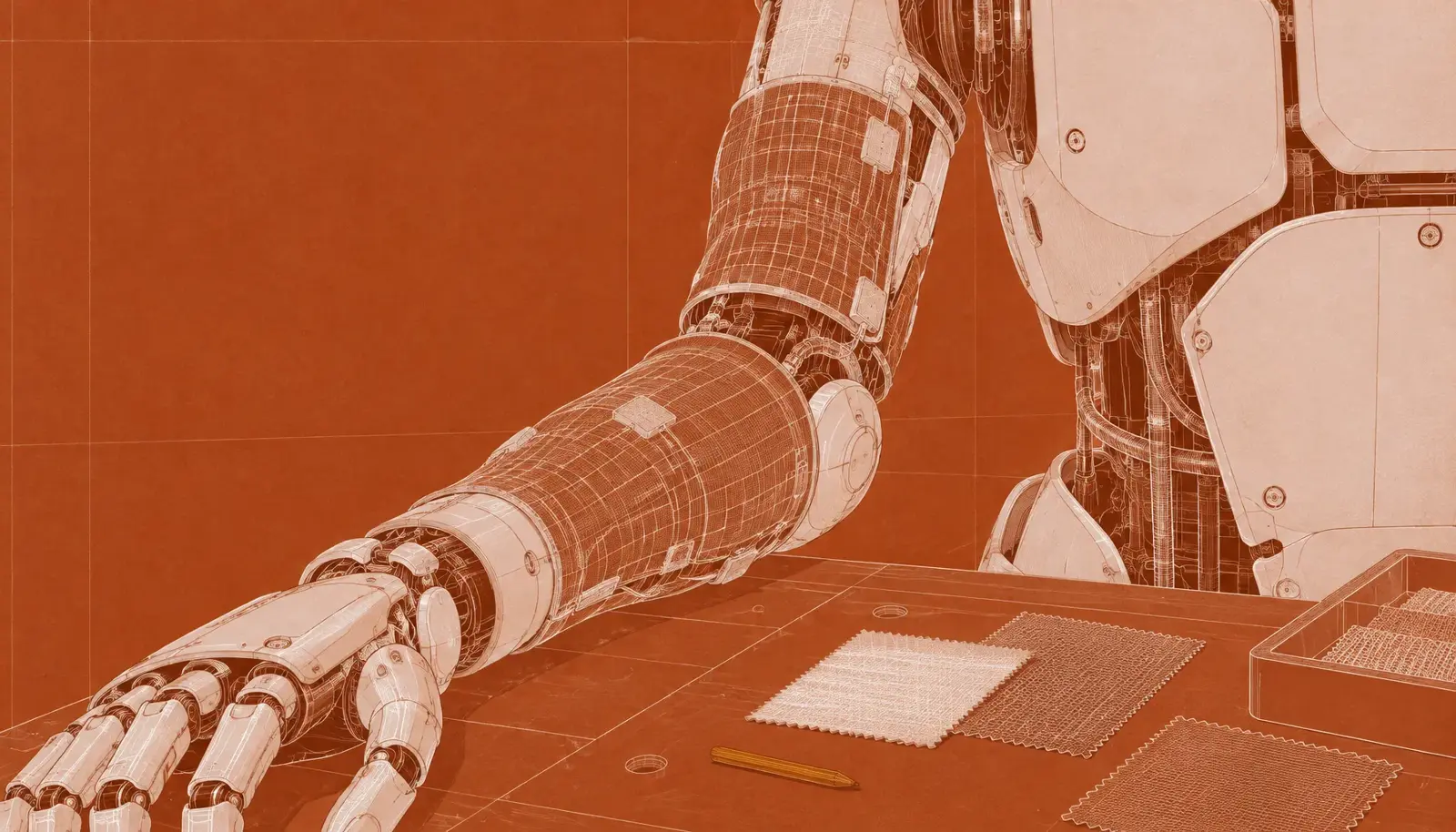
A team led by Chuan Fei Guo at Southern University of Science and Technology has developed an iontronic skin with more than 10,000 touch sensors for humanoid robots. The system reads signals at 100 frames per second and demonstrates fine tactile sensing and protective responses to harmful contact.
More sensors, more data to move
Covering a humanoid robot with touch sensors creates a systems conflict: more sensing points can give the robot richer contact information, but they also produce more signals to read and transmit. Conventional serial readout can add latency and crosstalk as arrays grow, while the resulting data load strains bandwidth. A team led by Chuan Fei Guo at Southern University of Science and Technology says its new iontronic skin tackles that bottleneck with parallel signal encoding and layered processing.
Source nature.com
The paper, published in Nature Machine Intelligence on October 16, 2026, describes an array with 1,110 sensing units per square centimetre and more than 10,000 units overall. The researchers mounted the skin across a robot’s hand, arm and torso. Their design takes cues from the human sensory system, organizing tactile processing into stages of signal encoding, convergence and cognitive modelling.
Frequency coding carries touch in parallel
Each sensor’s position is encoded through its frequency, letting signals travel in parallel rather than being read one after another. The authors report a readout rate of 100 frames per second, with crosstalk suppressed. Backend processing then converges and compresses the signals, reducing bandwidth consumption by hundreds of times, according to the paper’s abstract.
“The human skin gathers and encodes signals from over 200,000 mechanoreceptors, enabling high-spatiotemporal-resolution tactile perception and instant injury prevention,” write Zhibin Li et al. in Nature Machine Intelligence. The figure describes the biological reference for the work; the paper’s robot demonstrations test specific tactile tasks rather than establishing human-equivalent touch.
Texture sensing and delicate grasps
The researchers report that their system distinguished surface features as small as 300 micrometres and detected harmful mechanical stimuli that triggered self-protective responses. Supplementary demonstrations show a robotic gripper holding a 0.5-millimetre pencil lead and a soft solder wire 0.2 millimetres in diameter. Those tests put the sensor to work during contact, rather than limiting the result to a bench measurement of sensor density.
The paper also describes large-area sensing on an embodied robot, where the skin records tactile responses across the body. That matters because a hand-mounted array alone cannot tell a robot about contact on its arm or torso. The authors’ approach aims to handle the resulting stream without requiring every sensor to send its raw reading through a single serial channel.
A research demonstration, not a finished product
The results address several engineering obstacles at once: dense sensor integration, fast readout, reduced interference and smaller data transfers. But the demonstrations establish laboratory capabilities, not a production-ready skin or routine deployment on commercial humanoids. The paper reports tactile perception and protective responses; it does not show that the system can manage every type of contact a working robot would encounter.
That distinction defines the next test for the design: whether its sensing and processing can keep working as the skin is fitted over more complex moving surfaces and used through repeated physical interaction. For now, the concrete result is a robot skin with more than 10,000 sensing units, reading touch at 100 frames per second and demonstrating fine-feature detection, fragile-object grasping and responses to harmful stimuli.
Sources
- Original source · Paper Nature Machine Intelligence nature.com
Other pages read
- National Natural Science Foundation of China nsfc.gov.cn
Related stories
- HKUST’s EmArm Spreads Touch Sensing Across 71,000 mm² of Its Arm
- Astribot Prices Its T1 Humanoid at $18,000 in North America
- Meta Builds Fourier Humanoid and Starts a Second Version
- UCLA’s PhoneBot Uses Android Phones to Control a Walking Humanoid
- Humanoid Controller Uses Its Torso to Reposition Objects in 45 of 50 Trials