The Floor
UMD’s Mu Zero Posts 91.7% Success on Three Robot Tasks
University of Maryland researchers say Mu Zero averaged 91.7% success on three real-world robot-arm tasks by predicting 3D motion traces from video. The model’s pretraining uses no robot action labels, but its task-specific action expert still learns from robot demonstrations.
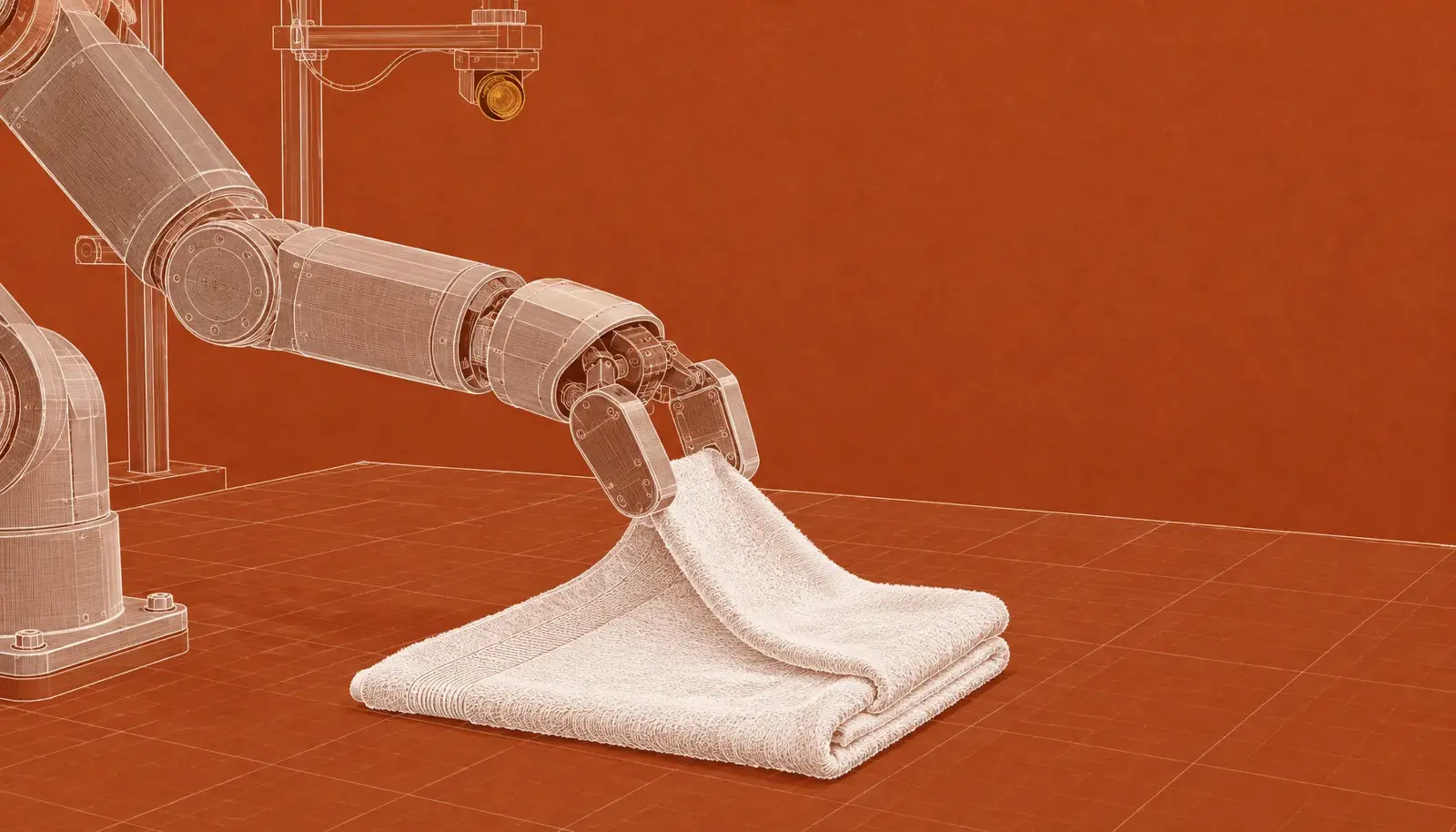
Three robot tasks, 91.7% average success
University of Maryland researchers report that their Mu Zero system achieved a 91.7% average success rate on three real-world manipulation tasks with a UR3 robot arm. The tasks were picking objects into a sink, pouring almonds into a container and unfolding a towel. Across those tests, the result exceeded the paper’s π0 baseline by 20 percentage points and π0.5 by 11.7 points.
The experiments used a fixed-base UR3 with a two-finger gripper. The team collected 90 demonstrations for picking, 80 for pouring and 50 for towel unfolding, then evaluated each task over 20 rollouts. The demonstration counts matter: Mu Zero’s video pretraining needs no robot commands, but the separate component that turns its predictions into robot movements still learns from robot demonstrations.
Mu Zero predicts paths, not motor commands
Mu Zero, written μ₀, is a world model: given an image and a language instruction, it predicts how selected points on hands, tools and objects will move in three-dimensional space. Rather than generate future video frames or output robot commands directly, it represents motion as smooth 3D traces. Those paths can capture object movement and contact while leaving much of the scene’s appearance out of the prediction.
The researchers built TraceExtract to turn human and robot videos into training examples. It selects meaningful points, tracks them in 3D, separates object motion from camera motion and pairs motion segments with language descriptions. Mu Zero learns from those traces; a separate action expert then adapts the motion information to a particular robot. The world model stays fixed during that adaptation, allowing its learned motion predictions to be reused.
The authors write, These results establish 3D traces as a scalable and transferable representation for cross-embodiment manipulation. Seungjae Lee, Yoonkyo Jung, Jusuk Lee, Jonghun Shin, Amir Hossein Shahidzadeh, Yao-Chih Lee, H. Jin Kim, Jia-Bin Huang and Furong Huang, authors of “μ₀: A Scalable 3D Interaction-Trace World Model”
Simulation exposes a gap between tasks
Results in simulation were less decisive. Across eight kitchen tasks, Mu Zero averaged 30.25% success, beating π0’s 25.25% but trailing π0.5, which reached 42%. The paper cautions that this is not a data-matched comparison: π0.5 benefits from large-scale action-labelled pretraining, while Mu Zero’s pretraining uses video without robot action labels.
The physical results also cover a limited test: three tasks on one robot configuration, with task demonstrations used to train the action expert. The University of Maryland release identifies further limits, including errors in tracking or captioning and the model’s lack of explicit force or touch reasoning. Performance across a wider range of robots and tasks has not been tested.
Recognition at IROS, broader tests still ahead
The paper received the second-place Best Paper Award at the IROS 2026 RoBoWoMo workshop in late September, according to the university. The release also said the work had been accepted for presentation at the Conference on Robot Learning in November. Those milestones add visibility, but they do not expand the scope of the reported robot trials.
The central practical question is whether the trace representation transfers beyond the tested UR3 tasks without extensive new demonstrations for each robot. Mu Zero’s results show a separation between learning what should move from video and teaching a machine how to move it. The reported evaluations do not yet show how far that separation carries across different robot bodies, contact-heavy work or tasks that depend on sensing force.
Sources
- Original source University of Maryland Institute for Advanced Computer Studies umiacs.umd.edu
Other pages read
- University of Maryland research paper obj.umiacs.umd.edu