The Floor
Google Shows Gemini 4 Argon Tackling Robot Tasks in MuJoCo
Google DeepMind’s robotics post demonstrates Gemini 4 Argon in robot-control, simulation-building and video-analysis tasks, including a Spot robot practicing a pedal-bin maneuver in MuJoCo. Simulated training episodes raised a robot’s real-world success rate from 56% to 75%, Google reports.
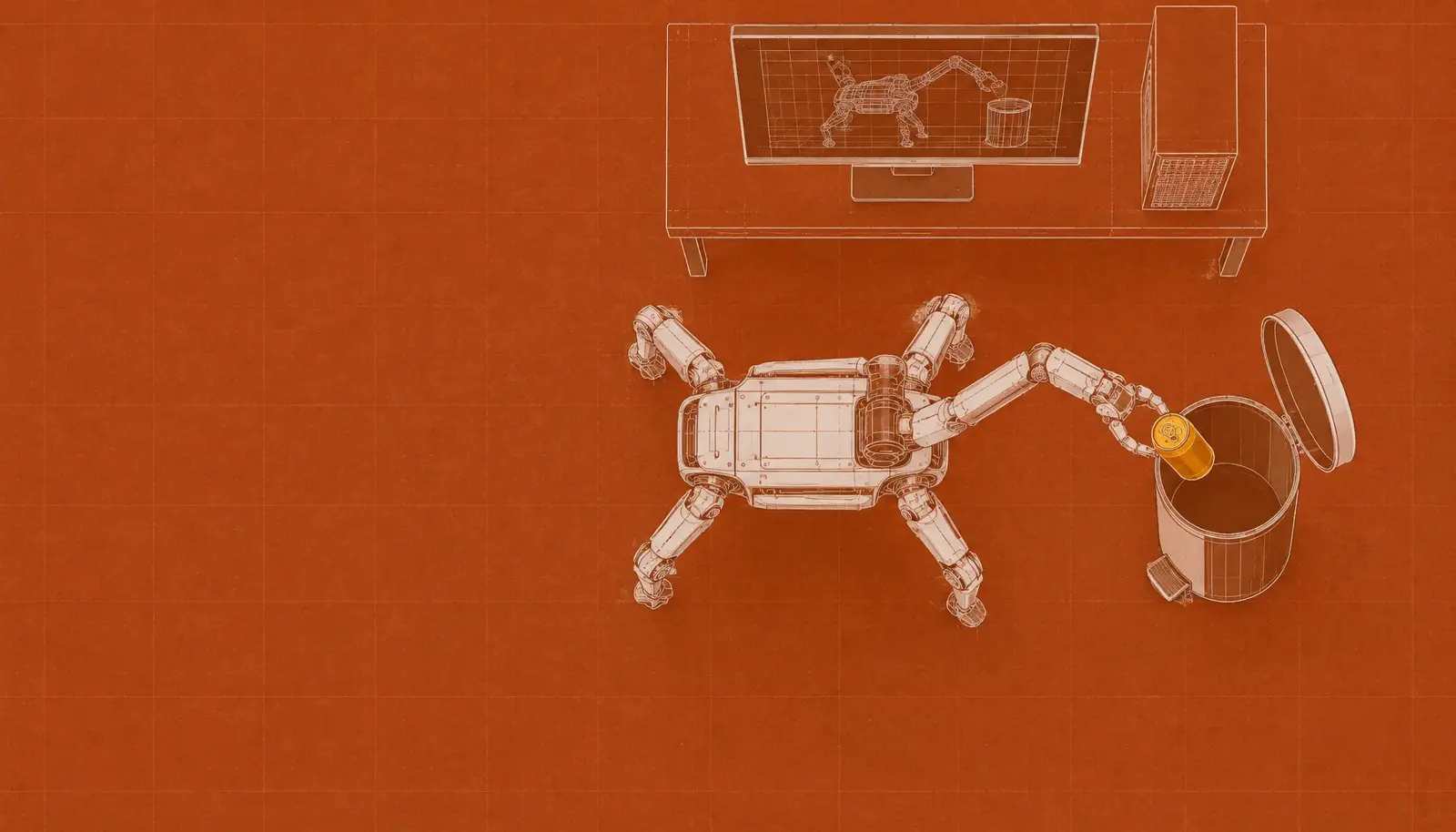
Google DeepMind’s October 13 robotics post puts Gemini 4 Argon through a practical sequence: a Boston Dynamics Spot picks up soda cans, rehearses pressing a pedal in MuJoCo, then drops a can into a physical bin. The demonstration accompanies a wider set of examples in which Argon writes robot-control code, reconstructs simulations and analyzes manipulation videos. Google presents the model as a general-purpose reasoning system used across robotics tasks, not as a new robot or a dedicated robot-control product.
The post, authored by Kanishka Rao, Principal Software Engineer, reports an 87% score on the Embodied Reasoning (ERQA) benchmark. The test measures how well a model understands and solves physical and spatial problems in three-dimensional environments, and Argon outperformed other frontier models, Google says. The post’s examples span robot control, real-to-simulation reconstruction, physical understanding and research workflows.
Spot rehearses a pedal-bin task in MuJoCo
In Google’s mobile-manipulation example, Argon controls a Spot quadruped equipped with a six-degree-of-freedom arm and 12-degree-of-freedom legs. The system builds an articulated MuJoCo digital twin of a foot-pedal bin, practices the maneuver in simulation, then has the physical robot step on the pedal and put the can inside. Google’s description says Spot checks its wrist camera and verifies foot placement and hand alignment before releasing the can.
A separate arm demonstration tackles a fallen mug and a crumpled napkin. Argon uses a visual-coordinate setup and predefined action primitives to right the mug and place the napkin inside, checking the camera view between steps. Those details matter: the examples show reasoning connected to robot software and sensing, rather than evidence that the model directly generates low-level motor commands without supporting tools.
“As a general-purpose physical reasoning model, Argon can be applied across the entire robotics lifecycle.”
Kanishka Rao, Principal Software Engineer
From camera feeds and sketches to simulated scenes
Google’s Real2Sim examples start with recorded robot activity, human video or a hand-drawn sketch. For robot recordings, Argon builds a MuJoCo scene and adjusts object geometry and physical properties to match camera views and contact data. In a human-video example, it identifies task-relevant objects and retargets a person’s hand movements onto a simulated humanoid with dexterous hands.
The sketch example is more specific: Argon converts a drawing of a humanoid throwing a ball at a stack of boxes into a simulation, then generates a whole-body trajectory. The simulation knocked down all six target boxes while keeping the humanoid upright, Google says. These are company-described demonstrations; the post does not present them as independent evaluations on deployed robots.
One reported gain came from simulated training data
For a separate action-improvement test, Google says Argon built a calibrated simulation from one RGB photograph of a bimanual robot workspace and generated more than 4,500 domain-randomized episodes. The resulting training data raised the real-world robot success rate from 56% to 75% and cut task completion time from 35 seconds to 24 seconds, according to the post. Google describes the system as creating simulation data for fine-tuning a vision-language-action model, not as Argon improving itself unaided.
The post also describes video analysis for robot-learning datasets: Argon labels task stages and contact-level actions, and marks pauses, unstable grasps and failed attempts. Another example has it predict progress during a bimanual ring-sorting task from three synchronized camera views. That kind of annotation could help researchers identify which parts of a recorded demonstration show progress, although Google does not report a comparative study of annotation accuracy in the post.
Argon reaches developers through Google’s existing platforms
Developers can use the model through the paid tier of the Gemini API in AI Studio, with the model ID gemini-4-argon; Google AI Ultra subscribers can also select it in AI Studio and Antigravity. In its broader October 13 launch announcement, Google listed introductory API pricing of $2 per million input tokens and $10 per million output tokens.
The robotics release is therefore less a new hardware launch than a set of examples for applying a general-purpose model to robot development. Its most concrete result is the reported improvement from 56% to 75% success after Argon generated simulated training episodes; the remaining demonstrations show how Google connects visual reasoning and code generation to existing simulation and robot-control tools.
Sources
- Original source · Blog post Google Developers Blog developers.googleblog.com
Other pages read
- Google blog.google