The Floor
Veloxity Brings Rust Memory Safety to UAV Autopilot Firmware
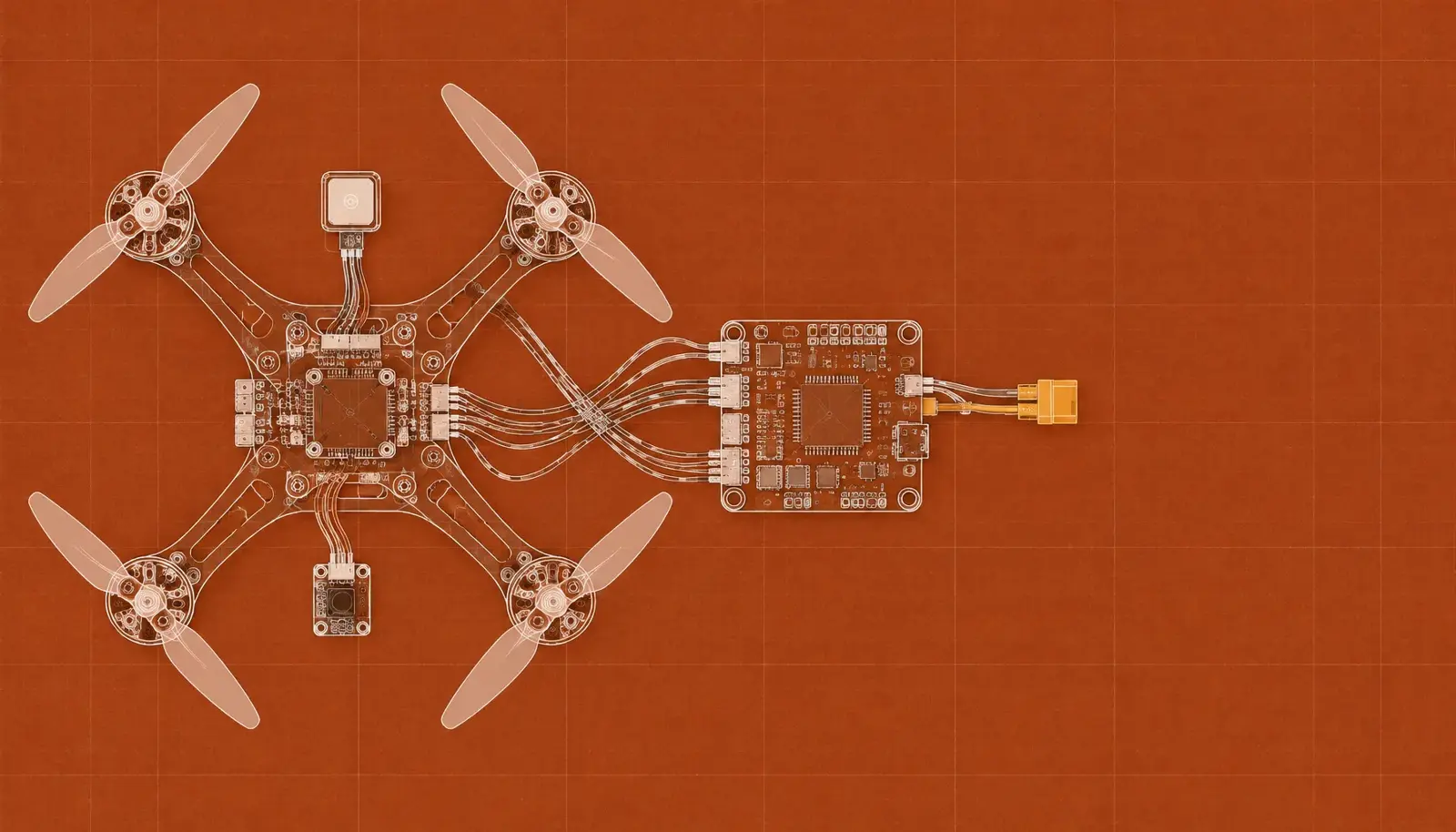
Researchers present Veloxity, an open-source Rust autopilot integrated with the ROSflight and ROS 2 autonomy stack. Tests on a Pixracer Pro compare its memory footprint, command timing and waypoint tracking with C++ firmware and PX4.
“These results provide evidence that Rust is a practical alternative to C and C++ for resource-constrained, safety-critical flight firmware.”
Derek Ward, Brian Bascom, Tyler Larsen, James Usevitch, Phil Tokumaru and Tim McLain, authors of “Veloxity: Towards Memory-Safe UAV Embedded Firmware using the Rust Programming Language”
The researchers introduce Veloxity in a paper submitted to arXiv on October 29, 2026. Their open-source autopilot runs on embedded flight hardware and fits into the ROSflight 2.0 ecosystem, allowing it to use the existing ROS 2-based ROScopter autonomy stack rather than requiring researchers to replace the surrounding system.
The work targets a specific layer of UAV software: the firmware that processes sensor data, estimates vehicle state, controls the aircraft and sends commands to its actuators. Much existing open-source flight-control software uses C or C++, where developers must rely on coding practices and analysis to guard against memory errors. Veloxity uses Rust’s ownership and type systems to have the compiler reject many unsafe memory-access patterns in its flight-control core.
Rust inside the ROSflight stack
Veloxity keeps the broad modular structure of the ROSflight C++ firmware but changes how the software shares state. A central structure, called World, owns long-lived resources such as sensor processing, state estimation and the flight controller. Rather than giving each subsystem unrestricted access, Rust’s borrowing rules limit which resources a subsystem can use and modify during a given operation.
The autopilot also uses fixed-capacity event queues for some communications and service requests. That bounds memory use without dynamic allocation, while a priority-based scheduler handles sensor processing and flight-control updates ahead of less time-sensitive service work. The authors note that a full queue still needs runtime handling and can result in an event being logged and discarded; these mechanisms do not guarantee that every message gets through.
Rust’s protections have boundaries, too. Veloxity confines explicitly unsafe operations mainly to device drivers and a small number of supporting structures, while the control stack retains Rust’s compile-time guarantees. In simulation, a C++ adapter passes sensor records into the Rust firmware and returns actuator outputs; the paper says Rust’s checks do not extend across that boundary, where compatible layouts, valid pointers and correct lifetimes remain integration responsibilities.
Comparable flash footprint, faster command echoes
The team deployed both Veloxity and ROSflight firmware on the Pixracer Pro’s STM32H743II microcontroller. The release-build Veloxity image occupies 412,352 bytes of flash, compared with 415,640 bytes for ROSflight—3,288 bytes, or 0.79%, less. The similar total footprint conceals a different distribution: Veloxity’s read-only code and data take 396,672 bytes, against 271,336 bytes for ROSflight.
A separate timing test sent offboard commands at 400 Hz from a Raspberry Pi 5 to a Pixracer Pro and measured the time until each firmware echoed them. Across 71,999 commands per firmware, Veloxity’s mean round-trip time for first responses was 0.738 milliseconds, versus 0.974 milliseconds for ROSflight. Veloxity echoed every command exactly once; ROSflight missed five and returned 417 duplicates. The measurement includes serial communication and firmware processing, but not ROS 2 delivery before the command callback, and it does not measure when the actuator applies the command.
One outdoor mission, different speed settings
For the flight evaluation, the researchers flew a Holybro X650 quadrotor with Veloxity running on its Pixracer Pro controller and ROScopter on a Raspberry Pi 5. The firmware sustained a measured control rate of 399.8 Hz, close to ROSflight’s 399.7 Hz. The test followed a three-waypoint route, with the companion computer closing the position-control loop while the flight controller handled attitude estimation, inner control and actuator output.
Across four waypoint circuits, the paper reports a total position-error RMSE of 0.252 meters for Veloxity, 0.517 meters for ROSflight and 0.450 meters for PX4. Those figures need context: Veloxity’s configured mission speed was 4 meters per second, compared with 3 meters per second for each reference flight, and the authors use a path-distance metric that does not penalize a vehicle for lagging the time-based command. They describe the results as comparable tracking, not a general performance win; the outdoor comparison covers one mission on specific hardware, not a broad set of vehicles or conditions.
A firmware result, not a whole-aircraft safety claim
Veloxity’s main contribution is a tested Rust flight-control core that slots into an existing research autonomy system. The paper compares the C++ and Rust implementations in hardware timing tests, software-in-the-loop simulation and outdoor flight, while reporting that controller and mixer outputs closely match under identical inputs. In simulation, the authors find mean tracking error statistically equivalent within a margin of 1.3 centimeters.
The results do not establish that a complete UAV system is memory-safe or certified for safety-critical service. The companion computer, ROS 2 nodes, communication boundary and hardware-specific unsafe code sit outside the core’s compile-time guarantees, and the paper identifies extending memory safety to the companion-computer autonomy stack as future work. For now, Veloxity’s evidence is concrete and bounded: Rust firmware on a Pixracer Pro, operating at roughly 400 Hz and following a waypoint mission through the existing ROScopter stack.
Sources
- Original source · Preprint Veloxity: Towards Memory-Safe UAV Embedded Firmware using the Rust Programming Language arXiv:2610.41053