The Floor
VerifLM Checks Edited Robot Goals in 27 Simulated Worlds
VerifLM uses physics simulation to check and refine robot goals proposed through edited images. In tests across nine household manipulation tasks, its predefined-mesh configuration achieved a 71.8% physical-execution success rate.
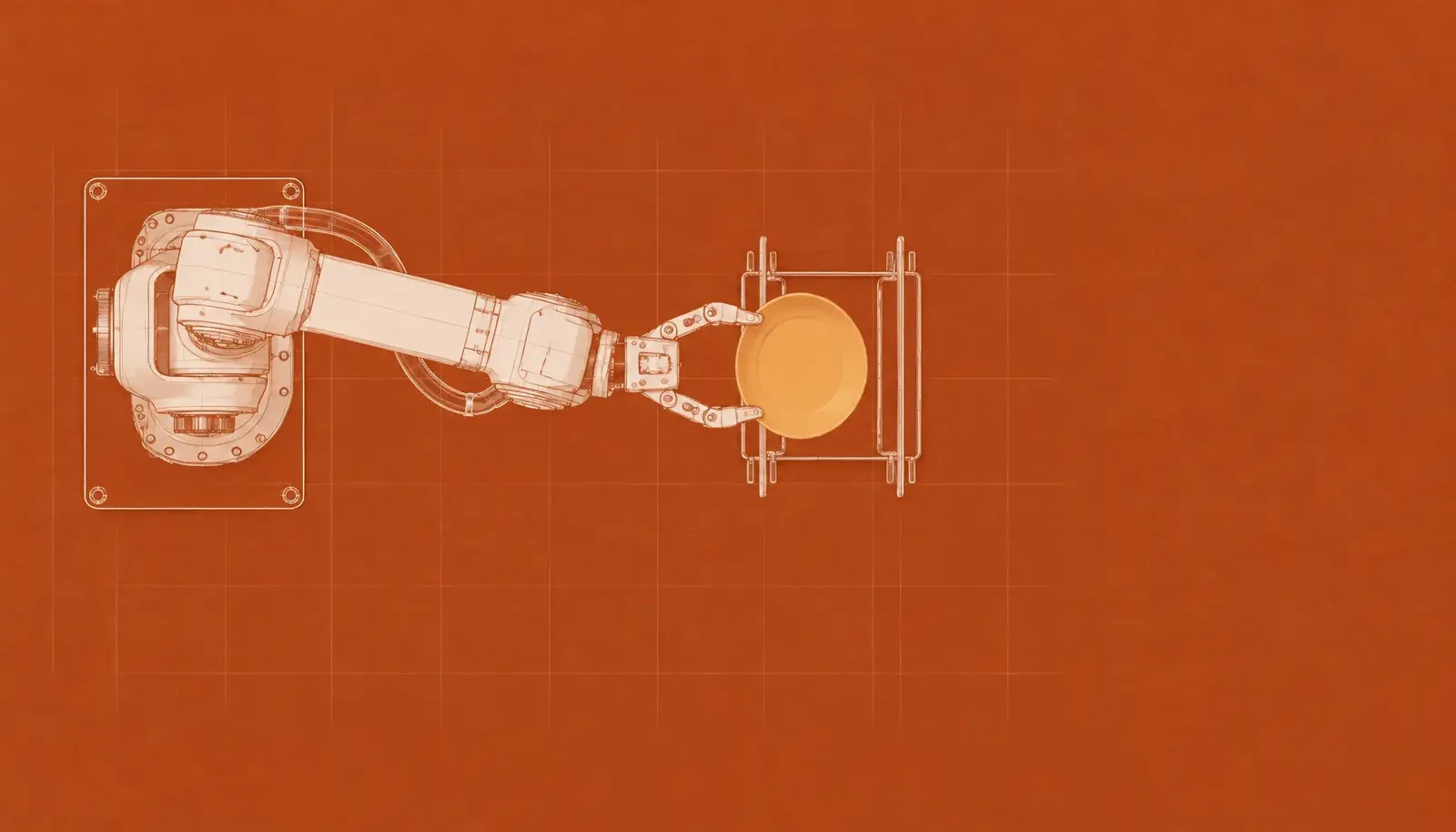
From an edited image to a robot goal
VerifLM’s strongest reported configuration completed 155 of 216 physical execution trials, a 71.8% success rate, across nine household manipulation tasks. The Georgia Institute of Technology researchers submitted their paper to arXiv on November 2, 2026, describing a pipeline that treats an edited image as a proposal—not a reliable final instruction—for a robot’s target pose.
The setup addresses a gap between how people describe a desired arrangement and what a robot planner needs. A person can picture a plate seated in a stand or a mug hanging from a rack, but a robot needs a precise position and orientation, along with valid contact relationships. VerifLM translates an image-edited goal into a six-degree-of-freedom object pose, then checks whether that pose holds up in simulation.
Simulation corrects the image’s guesses
The pipeline starts with an RGB-D observation and an instruction. An image-editing model generates a picture of the desired arrangement; perception software estimates the active object’s pose relative to a stationary object. A vision-language model then identifies which position and rotation axes need adjustment, sets the search ranges, and generates task-specific checks for contacts, object relationships and movement during settling.
VerifLM tests candidate poses in MuJoCo. In its mesh-free mode, it reconstructs object geometry from the RGB-D image and evaluates each candidate in 27 simulated worlds: three scale assumptions for each object, crossed with three hypotheses for physical properties. Candidates that pass in more worlds rank higher; the model then selects among the retained options. A planner generates a collision-free trajectory to carry out the chosen pose.
“These results reinforce that the edited image provides a useful initial task specification, but its recovered pose cannot be trusted without simulation-based verification, which VerifLM provides.”
The VerifLM paper by Xuanyou Chen, Jinyu Chen and Glen Chou, Section V-D
Results favor precise contact tasks
The team tested VerifLM on a KUKA iiwa 7 R800 arm with an Intel RealSense D415 camera. The nine tasks included placing, hanging, inserting, pouring and stacking objects, with 24 trials per task. The paper reports separate measures for task-planning success and execution by the physical robot.
With predefined object models, VerifLM reached 160 of 216 trials, or 74.1%, for task planning and 155 of 216, or 71.8%, for physical execution. The strongest overall baseline, Goal-VLA, achieved 102 of 216 planning successes, or 47.2%. VerifLM led the planning results on eight of the nine tasks; pouring tea was the exception.
The mesh-free version, which must estimate geometry and physical properties rather than start with predefined models, recorded 146 of 216 planning successes (67.6%) and 130 of 216 execution successes (60.2%). In a separate comparison, testing candidates across the 27 simulated worlds raised mesh-free execution success from 92 of 216 trials with a single simulated world to 130 of 216.
Reconstructed geometry still sets a limit
Those comparisons point to the system’s main trade-off: image-based goals can express fine arrangements, but the quality of the simulation depends on the quality of the reconstructed objects. The authors describe cases where estimated cup sizes prevented stacking, and where small geometric or pose errors changed whether a teapot lid settled in place or slid off. Multiple simulated worlds helped, but did not eliminate those errors.
VerifLM also depends on the image editor and vision-language model for its proposals, sampling constraints and validation rules. The researchers say distorted contact features can undermine the digital twin, while inconsistent model reasoning can produce poor checks or search ranges. In their mesh-free tests, that gap showed up as a 60.2% execution success rate, compared with 71.8% when the system used predefined object models.
Sources
- Original source · Preprint arXiv arXiv:2611.03268
Related stories
- Preprint models how imitation policies discount noisy object readings
- Library of Hands more than doubles simulated success, preprint reports
- MIT HAN Lab releases PEAR robot-training infrastructure
- Preprint puts robot control policies inside 3D route planning
- TouchTwin uses tactile recordings to build simulated hand demonstrations