The Floor
Verne Releases V0.5 Open Weights for Industrial Robots
Verne Robotics has released V0.5, an open-weight world action model pretrained on more than 1.7 million demonstrations. The company is launching a fine-tuning platform for the model and offers bespoke deployment services for industrial robot tasks.
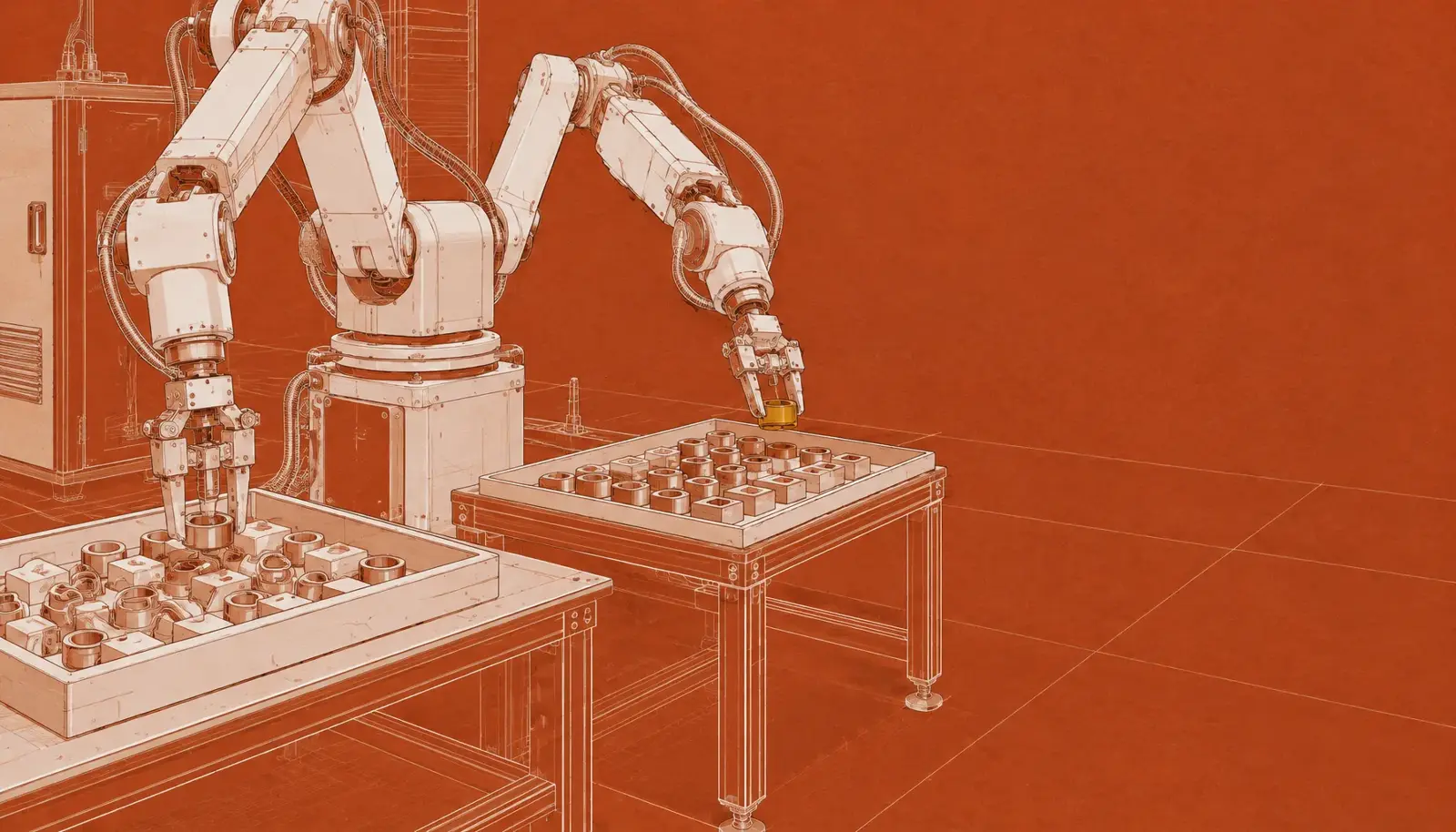
Verne pretrained V0.5 on over 1.7 million demonstrations from data vendors, open-source datasets and its own collection. The company describes V0.5 as an open-weight world action model built to accelerate general-purpose robot deployments in industrial settings. V0.5 is the leading open-weight model developed by a US company on the LIBERO and RoboTwin 2.0 benchmarks at the time of publication, Verne says.
Training V0.5 for new tasks
Verne’s pretraining corpus focuses primarily on teleoperation data and data from handheld grippers similar to the UMI gripper. The company records additional post-training data using teleoperation and handheld grippers it co-designed with its robot’s end effector. Task-specific post-training on Verne’s robots uses Verne data only.
Verne’s stack can learn a new task, or a new step in a longer task, from under two hours of demonstrations and human corrections, the company says. The company is also launching a fine-tuning platform that it says lets teams adapt V0.5 to their own tasks using their own demonstrations. Verne also offers bespoke deployment services for partners working on specific use cases.
V0.5 uses two transformers
Verne’s stack combines V0.5 with a data and training system and inference and control software. At runtime, four layers carry a task goal through to motor commands: high-level reasoning, the policy, execution and the controller. An off-the-shelf vision-language model handles high-level reasoning by reading the task goal and camera images, then giving V0.5 a short language instruction.
V0.5 uses a video transformer to learn how a scene changes and an action transformer to predict robot motion; the two train together. The model starts from the Wan2.2 video model and is trained in three stages: robot-video pretraining, joint video-and-action pretraining, and task-specific post-training. At runtime, V0.5 generates actions rather than future video, outputting action chunks of 30 Hz targets that include end-effector poses, gripper commands and a base position.
Real-time chunking and controller performance
While the robot executes one action chunk, V0.5 plans the next. Its real-time chunking keeps targets already committed to the motion queue and plans the rest of the chunk after them, so the robot keeps moving during inference. V0.5 trains with up to 12 committed targets, which Verne says accommodates inference latency of up to 400 ms.
The controller runs separately from model inference at 500 Hz, turning joint trajectories into motor commands. In tests on 20 LEGO runs per controller, Verne measured the arm trailing the command by 52 to 60 ms at every speed with the stock YAM controller, with median tracking error rising from 9 mm to 26 mm as the arm moved faster. With Verne’s controller, the measured lag was 4 to 12 ms and median error stayed between 2.2 and 3.5 mm at every speed.
Nine tasks, from bin picking to medical kits
Verne post-trained V0.5 on nine manipulation tasks, including full-body picking and contact-rich tabletop assembly. Its demonstrations include bin picking and grocery picking, each labeled as using less than two hours of task data, alongside shorts labeling, DIN-rail placement, pizza-box folding and LEGO sorting. Other demonstrations show medical kitting, makeup-kit packing, and scanning and sorting items into bins.
In the medical-kitting demonstration, V0.5 moves both arms using end-effector poses and gripper commands, picking items from four supply trays and placing each in its slot in a kit tray. In the makeup-kit task, the reasoning layer gives the model a separate instruction for each item and for closing the bag. Each makeup-kit step uses less than two hours of task data, Verne says.
Sources
- Original source Verne Robotics vernerobotics.com
Related stories
- FMC³ shows factory-worker data system for robot learning
- A3 Reports Q3 Robot Orders in North America Up 24.8% to 10,989 Units Worth $723.5M
- Hong and Zhang Use Human Motion Data to Train Dexterous Robots
- Machenta Raises $40M to Teach Robots From One Demonstration
- Preprint Presents PHIL for Proactive Robot Policy Correction