The Floor
Visuotactile Policy Reaches 59% Success in Simulated Assembly
A visuotactile diffusion policy averaged a 59.0% success rate in MuJoCo assembly experiments, compared with 42.7% for a visual-only baseline. The approach combines histories from camera and fingertip-tactile inputs and uses a tactile-image prediction objective during training.
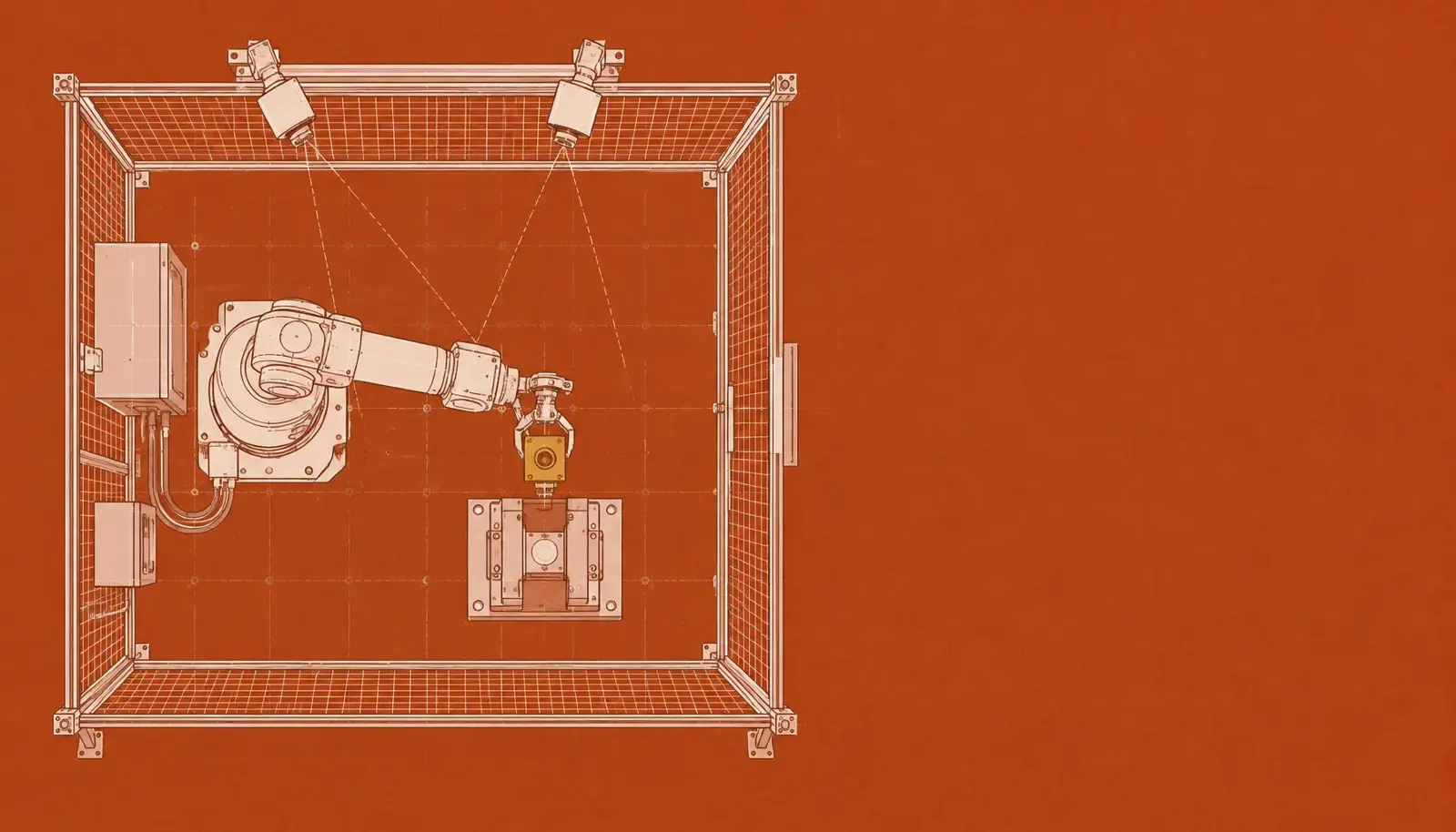
A visuotactile diffusion policy achieved an average success rate of 59.0% in simulated robotic assembly, compared with 42.7% for a visual-only baseline. The improvement is 16.3 percentage points across three independent training seeds in MuJoCo experiments, according to the paper. The results are presented in a paper by Kaihong Ouyang, Zihao Su, Chengxuan Zheng, Weiyi Lai and Dong Zhou.
Source arxiv.org
Combining visual and tactile histories
The paper focuses on long-horizon robotic assembly, which involves grasping, alignment and insertion. Its authors describe these stages as requiring perception and action as contact states change. Vision captures global object pose and scene context, while fingertip touch supplies local contact cues. The policy combines both types of observation to condition the generation of action sequences.
Specifically, its inputs are four-step histories from two camera views and two fingertip tactile images. A recurrent temporal representation integrates recent observations from the two modalities. The paper describes this temporal representation as part of the policy’s process for using the histories to generate an action sequence; it does not report a separate result for each camera or tactile input.
A tactile prediction objective used in training
The model also uses an auxiliary objective intended to encourage its temporal representation to capture how contact evolves under action. During training, the objective predicts fingertip-image changes two steps ahead, based on the temporal representation and demonstrated actions. This prediction is a training signal: the objective is used only during training and adds no inference-time computation, the paper says.
That distinction means the reported approach includes a future tactile-image prediction task while the model is being trained, but the paper does not describe that objective as an additional computation at inference. The abstract does not provide a separate performance figure for the auxiliary objective on its own, or a breakdown of how much of the overall result comes from that objective rather than from combining vision and touch.
Results in MuJoCo assembly experiments
The authors report an average success rate of 59.0% ± 2.6% for the full model and 42.7% ± 1.5% for the visual-only baseline. They give the difference as 16.3 percentage points. The results are averages across three independent training seeds. The abstract identifies the experiments as MuJoCo assembly experiments, so the headline figure refers to simulated assembly rather than a reported physical-robot trial.
“Across three independent training seeds in MuJoCo assembly experiments, the full model achieves an average success rate of $59.0\% \pm 2.6\%$, improving on the visual-only baseline ($42.7\% \pm 1.5\%$) by 16.3 percentage points.” — The authors write.
The abstract gives the success rates and the comparison with the visual-only baseline, but does not provide further experiment details such as the individual assembly tasks or a description of the baseline’s inputs. The reported figures therefore summarize the paper’s stated MuJoCo experiments; they do not establish a success rate for other tasks or settings.
The paper, titled “Visuo-tactile Diffusion Policy for Robotic Manipulation with Auxiliary Tactile Dynamics Prediction,” was submitted to arXiv on 2 November 2026. It was presented at ICCSSE 2026, according to the arXiv record.
Sources
- Original source · Preprint arXiv arXiv:2611.02677
Related stories
- Researchers Present LumiTac, a Six-Axis Sensor With a 12 mm-Diameter Sensing Head
- VICTR Preprint Reports 23.8% Success on Unseen Out-of-Domain Real-World Robot Tasks
- Hsu and Stone Introduce ELA Preprint for Learning Robot Policies from Video Demonstrations
- ExRL learns when to replan robot actions, researchers report
- UniLatent preprint tests robot-to-robot transfer in simulation and on arms