The Floor
W2A Cuts World-Action-Model Inference Latency About 21×
W2A transfers video-model representations into a robot action model during training, then removes the video model for deployment. The paper reports 55-millisecond action predictions and a 95.9% average success rate on LIBERO.
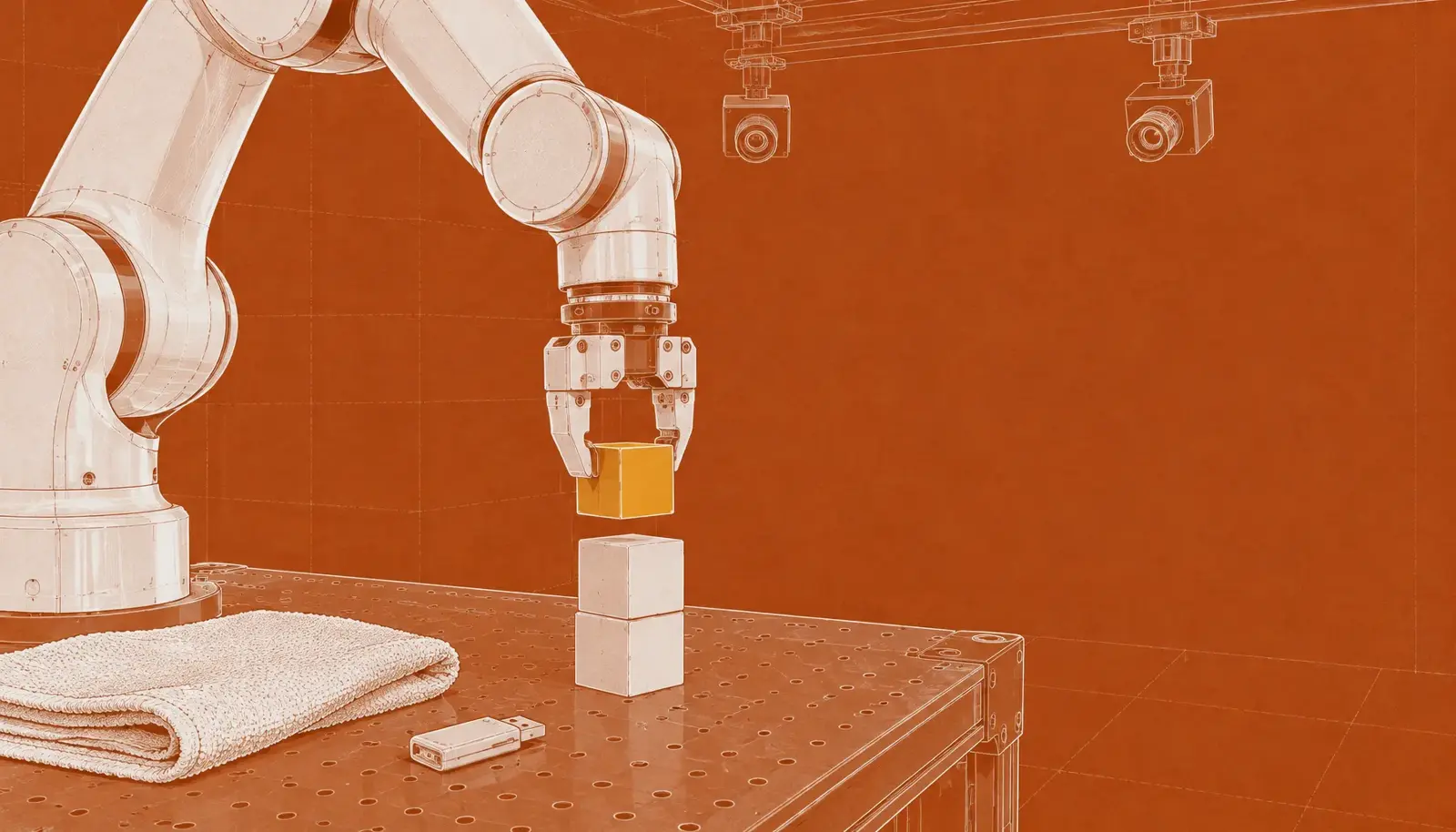
A robot-control model can retain information learned from video without running a video model during deployment, according to a paper submitted to arXiv on November 2, 2026. The authors’ W2A system reports about 21× faster inference than a representative world-action-model baseline, while achieving a 95.9% average success rate on the LIBERO manipulation benchmark.
“On LIBERO, W2A achieves a 95.9% average success rate.”
— Xiaopeng Zhang, Yongjin Mu, Yueyang Weng, Chengzhi Zhao and Yanjie Li, authors of the paper
W2A moves video priors into the action model
World action models use video models’ learned representations of how scenes change to help generate robot actions. But many such systems also imagine future states during inference, adding computation and latency. W2A is designed to transfer useful information from a video model during training, then remove that model from the deployed system.
The method has two training stages. First, the authors adapt a pretrained, language-conditioned video diffusion transformer to robotic video data and use principal component analysis to compress its latent representations. They then train an action diffusion transformer, using a Q-Former to extract action-model features and align them with the compressed video representations through a distillation loss.
At test time, W2A keeps only the action model. It predicts an action sequence from the current observation and task description, executes part of that sequence, and replans from updated observations. The paper also describes a warm-start method that reuses the unexecuted portion of a previous action sequence during replanning.
55 milliseconds per prediction on an A100
For its latency comparison, the paper uses a compute node with a single NVIDIA A100 40GB GPU. W2A takes 55 milliseconds per action prediction in that test; the authors report that the mimic-video baseline, which retains explicit future imagination, has about 21 times higher latency. With a lightweight text encoder, the paper reports deployment memory use of about 6 GB of GPU memory.
On LIBERO, W2A’s average success rate is 95.9%. The paper also evaluates the system on the CALVIN ABC-to-D benchmark and on a Franka Research 3 robot. For the real-robot evaluation, the researchers report success rates of 78.3% on pick-and-place, 65.0% on cube-stacking and 54.2% on long-horizon tasks.
Real-robot results come with a defined test scope
The real-world setup uses a front-view RealSense D435i camera and a wrist-view RealSense D405 camera. The authors collected 750 teleoperated demonstrations, with 50 demonstrations for each subtask, and tested each subtask with 30 consecutive rollouts. Three additional tasks—towel folding, table clearing and USB insertion—had reported W2A success rates of 76.7%, 63.3% and 50.0%, respectively.
The paper’s own limitations section identifies a trade-off in removing the video model: W2A gives up the video backbone’s additional capacity and explicit future-imagination ability. The authors say that design may limit performance under large distribution shifts, with unseen object dynamics, or on tasks requiring longer-horizon adaptation beyond the distilled priors. They also caution that compressing video latents into a fixed low-dimensional subspace may fail to preserve some task-relevant or higher-order information.
Sources
- Original source · Preprint arXiv arXiv:2611.02600
Related stories
- FRED Lifts Human-to-Robot Skill Transfer to 50%
- Study Traces LLM Robot Failure Gap to JSON Interface
- Robot memory model cuts planning latency in tests, researchers say
- VICTR Preprint Reports 23.8% Success on Unseen Out-of-Domain Real-World Robot Tasks
- NTT says physics-based model improved robot shelf-loading test