The Floor
WorldMirror Rebuilds Robot Demonstrations as Interactive Simulations
WorldMirror uses robot videos and recorded trajectories to build interactive digital twins for simulation. In tests on DROID demonstrations, the system replayed the recorded motions in Isaac Sim without retargeting, while its authors note that broader robot-policy and deployment tests remain future work.
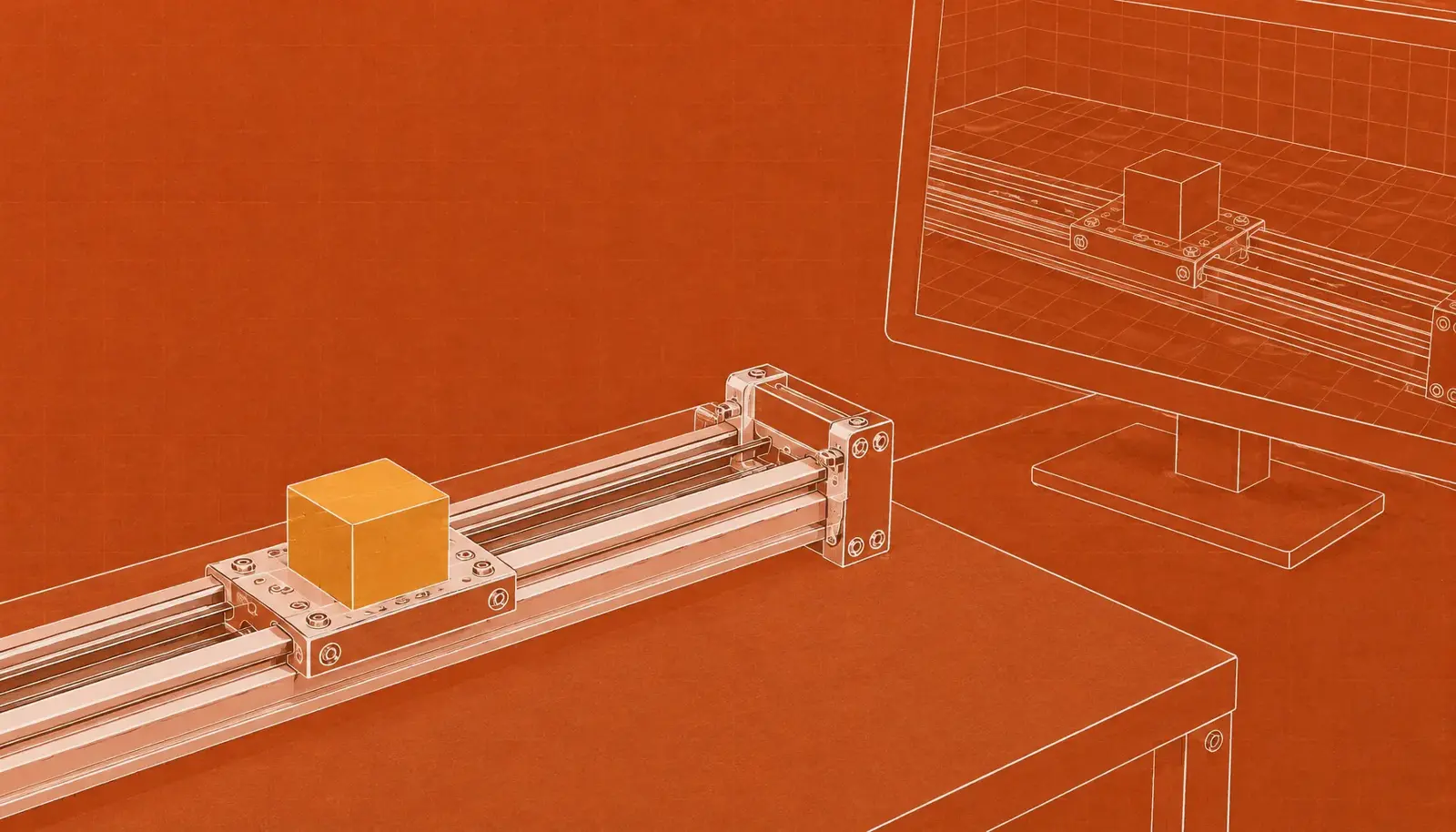
A new preprint submitted to arXiv on October 22 describes WorldMirror, a system that turns robot demonstrations into interactive simulation scenes while keeping the recorded robot motion intact. The method takes video together with the corresponding robot trajectory, then builds a digital twin designed for replay and physical interaction—not just a visual reconstruction.
That distinction matters because a scene can look convincing while placing an object, support surface or robot incorrectly enough to change what happens during contact. WorldMirror’s authors combine visual reconstruction with geometry, robot alignment and checks inside the simulation. They tested the framework on demonstrations from DROID, a dataset of real-world robot manipulation.
WorldMirror builds—and checks—an executable world
Rather than run a fixed sequence of reconstruction steps, WorldMirror maintains a structured record of the scene and uses a routing agent to choose what to construct or revisit. The system delegates work to four specialist agents for reconstruction, camera calibration, layout and trajectory replay. Candidate changes are checked before they become part of the shared world state; when a check fails, the system can revisit an earlier stage and rebuild dependent components.
The representation anchors the scene, objects and robot to a coordinate frame based on the calibrated camera. Static visual context and support geometry sit alongside editable objects with their own geometry and physical properties. The recorded robot trajectory can then run in the reconstructed scene without motion replanning or trajectory retargeting.
Replay results beat the paper’s comparison on motion error
In Isaac Sim, WorldMirror replayed the evaluated DROID trajectories with a reported displacement error of 1.79 centimeters, compared with 11.17 centimeters for GPT-6 Astra. Its final-position error was 5.83 centimeters, and its contact F1 score was 0.873. The paper reports a 100% replay success rate for WorldMirror on the evaluated demonstrations, against 40% for GPT-6 Astra.
Those figures describe replay in simulation, not a robot policy tested in the physical world. The authors also separate visual resemblance from spatial accuracy. On ten DROID scenes, WorldMirror recorded the best LPIPS and DISTS scores among the compared methods, two measures of perceptual image difference. But GPT-6 Astra scored better on object-mask overlap and position error; WorldMirror’s strongest result in the layout comparison was relative distance between objects.
Verification made the difference in a rail task
The paper’s ablation tests show why the authors emphasize feedback, rather than repeated reconstruction alone. On a rail-manipulation task, a one-pass system failed to move the object, and a fixed iterative method also failed. WorldMirror’s full refinement process diagnosed the problem and completed the interaction after four replay iterations.
Removing adaptive routing or feedback-driven refinement also caused failure in the component tests. Removing stateful memory, by contrast, left the reported task successful with only a small change in trajectory errors. The findings point to failure diagnosis and targeted revisions—not simply more passes—as the key pieces in this evaluation.
The preprint stops short of a policy-learning result
“Experiments on DROID demonstrate that WorldMirror can reconstruct visually faithful and geometrically consistent interactive worlds while preserving the physical validity of recorded robot trajectories,” the authors write in the abstract. Tianling Xu et al., “WorldMirror: Agentic Real-to-Sim Generation of Interactive Worlds from In-the-Wild Robot Demonstrations”
The authors describe the evaluation as limited to a small set of demonstrations. It does not establish that policies trained in the reconstructed worlds will perform well on real robots, nor does it test broader cross-task generalization. For now, the paper’s result is narrower: WorldMirror reconstructs selected demonstrations well enough to replay their recorded motions and interactions in simulation, with failure-aware refinement improving performance on the tested tasks.
Sources
- Original source · Preprint WorldMirror: Agentic Real-to-Sim Generation of Interactive Worlds from In-the-Wild Robot Demonstrations arXiv:2610.31834
Related stories
- Genie Sim Scores Correlate 96.7% With Real Robots, AgiBot Says
- HyperDrone Reports 20× Faster Quadrotor Simulation
- Hsu and Stone Introduce ELA Preprint for Learning Robot Policies from Video Demonstrations
- AgiBot’s Rollback Rewinds Robot Policies to Test Better Actions
- Ropedia’s DONIC Tracks Two Robot Hands With One Policy