The Floor
Alibaba’s RynnWorld-Latent Recasts Robot Actions as Shared Motion
Alibaba’s RynnWorld-Latent uses shared latent actions to train a video world model on human, robot and simulation footage. Its authors report gains in video prediction and robot-policy tests, while warning that generated footage does not prove physical correctness.
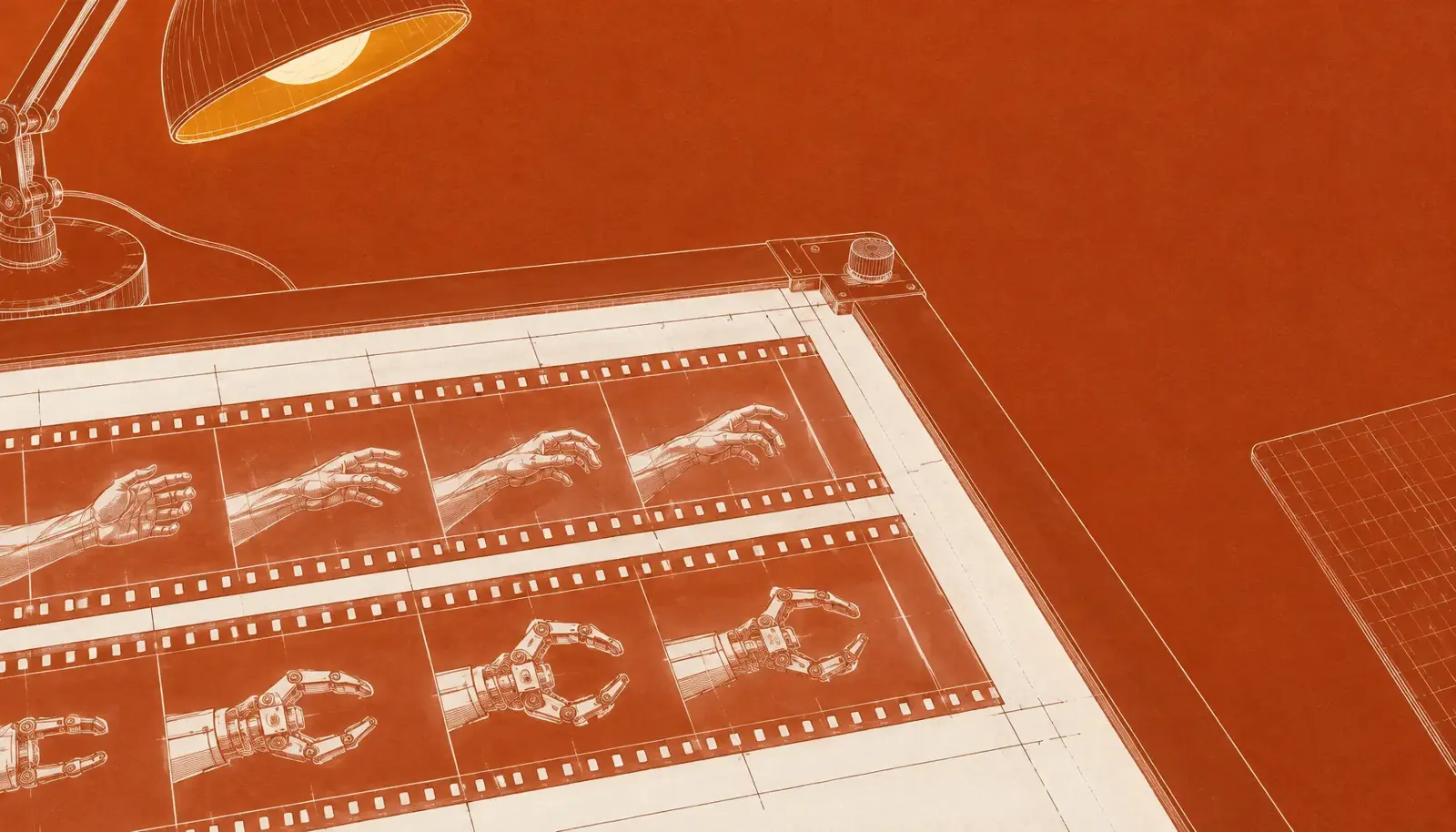
Robot commands do not travel neatly between machines: joint counts, coordinate systems and control modes vary, while human videos show interaction without robot-control labels. Alibaba’s DAMO Academy researchers propose a workaround in RynnWorld-Latent, a video world model that represents motion through shared latent actions rather than each robot’s native commands. The paper appeared on arXiv on October 27, 2026.
The approach aims to let human interaction footage, robot demonstrations and simulation rollouts contribute to one model, then adapt that model to a target robot. But the authors draw a line between plausible generated video and physically verified behavior: image-prediction scores and action-following examples do not establish that a simulated motion is causally or physically correct.
One motion code, many robot bodies
RynnWorld-Latent uses continuous latent actions extracted from visual transitions by RynnLAM, a separate model. Rather than encode a particular arm’s joint commands, those latents describe changes between observations. The world model takes an initial image and a sequence of latent actions, then predicts future video without a text prompt.
The researchers pretrained it on 23 datasets totaling about 553.5 million frames, or roughly 6,190 hours, spanning human videos, real-robot demonstrations and simulated robot data. The model builds on a pretrained video transformer, with action information supplied through global tokens and a frame-aligned pathway. That structure is intended to connect each action descriptor to the corresponding predicted frame.
“These results support universal latent actions as a scalable interface for learning controllable visual dynamics across heterogeneous embodiments.”
Haoyu Zhao et al., RynnWorld-Latent
Two routes to synthetic robot experience
The paper describes two ways to generate training data. In digital teleoperation, an operator’s control signals are mapped to a target robot’s commands, which condition generated video; the resulting observations and commands can form demonstrations without moving a physical robot.
For a second route, the system extracts latent actions from a source video, edits its first frame to depict a target robot or environment, then generates a new rollout using the original motion sequence. The generated observations are paired with robot commands produced through motion retargeting and inverse kinematics. Applying that process to EPIC-KITCHENS, EgoDex and Something-Something produced a filtered synthetic corpus of about 84.8 million frames, which the paper describes as roughly 800 hours of robot video-action data.
Reported gains, with narrow tests
On the DreamDojo EgoDex evaluation, the paper reports an LPIPS score of 0.19 for RynnWorld-Latent, compared with 0.21 for DreamDojo-14B; lower is better on that metric. The authors note that these baseline figures come from published literature, so the comparison measures complete systems and does not isolate the effect of the latent-action interface.
For real-robot policy learning, adding digital-teleoperation data raised the reported π₀.₅ success rate on Plate-Placement from 82.86% to 91.43%. On Steak-Serving, it rose from 40% to 54.29%. Each task result is based on 35 trials, and the paper says small differences should not be read as statistically significant. In simulation, synthetic mid-training moved π₀’s LIBERO-Plus score from 53.6% to 79.4%, while its LIBERO score increased from 94.4% to 96.1%.
Adaptation is still part of the method
The real-world tests use two different platforms: Marvin-WUJI, a stationary dual-arm system with dexterous hands, and Astribot-S1, a wheeled mobile robot with dual arms and parallel grippers. The model is post-trained for the target robot before those evaluations, so the results do not demonstrate zero-shot transfer to an unfamiliar machine.
The authors also caution that latent actions may capture camera motion or appearance alongside manipulation. In the synthesis pipeline, generated video and retargeted robot commands are produced through separate processes; filtering and timing alignment cannot guarantee that the two match physically. Those caveats matter because the model’s central promise is to create useful training experience from footage that never carried robot commands.
Code and weights have separate terms
Alibaba’s repository provides training and inference code, and points to model weights hosted separately on Hugging Face and ModelScope. The repository’s Apache 2.0 license covers its code, but the project states that model weights, pretrained bases and full training and evaluation corpora are separate resources subject to their own access terms. The release therefore offers an implementation path, but not a single license covering every component or dataset.
Sources
- Original source · Preprint RynnWorld-Latent: A Cross-Embodiment World Model Conditioned on Universal Latent Actions arXiv:2610.36791
Other pages read
- GitHub github.com