The Floor
Preprint reports lower continuum-robot tip error using known geometry
Researchers combined planar images, robot commands and a model of the surroundings to estimate a continuum robot’s state. In simulated and physical aortic-arch tests, the team reports lower tip-position error from a single view when the environment was included.
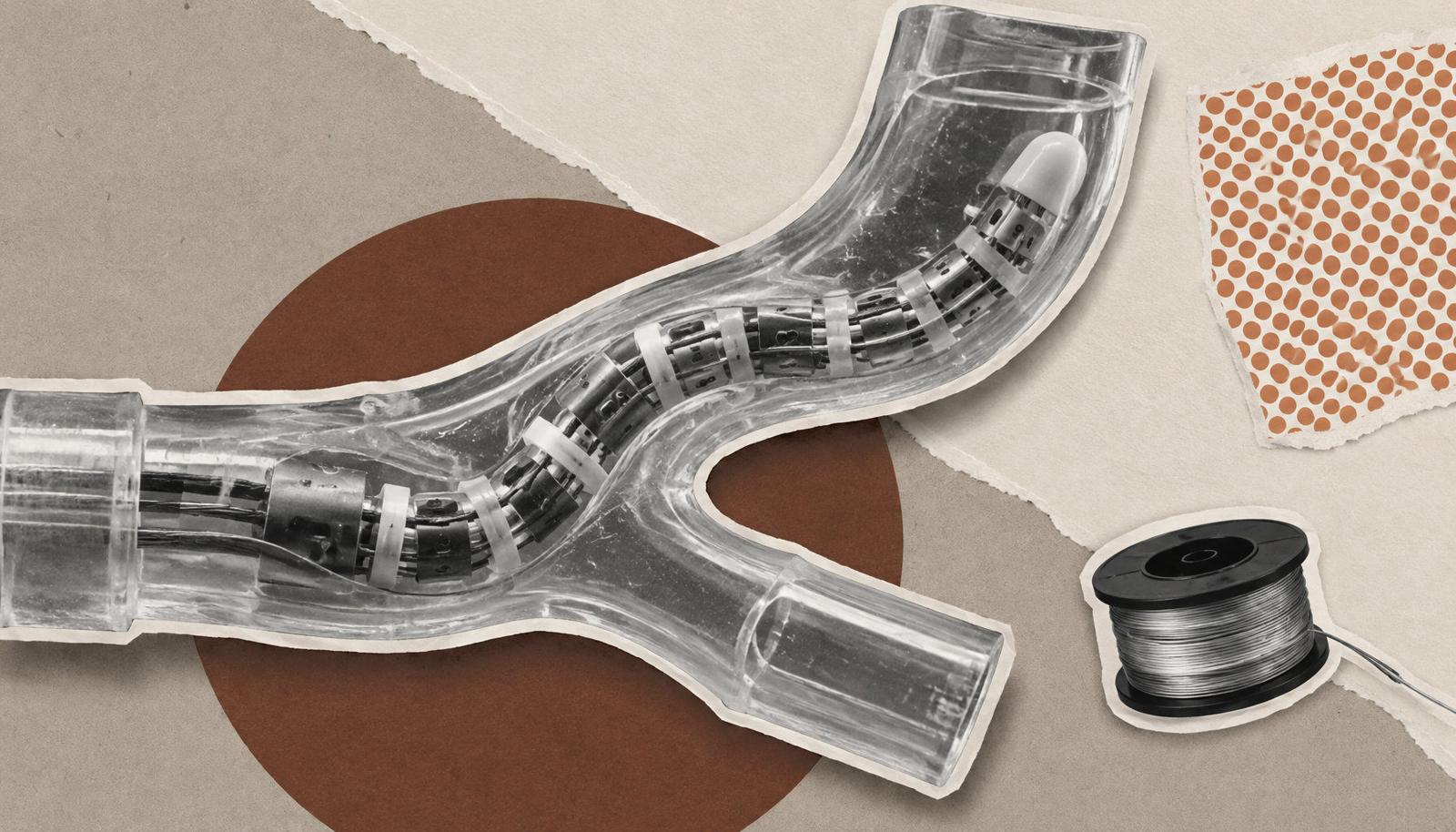
Researchers have used a model of a robot’s surroundings to improve estimates of its tip position from a single planar camera view, reporting lower errors in both a simulated aortic arch and a physical phantom. The work, described in a preprint submitted to arXiv on November 21, combines images of markers on a continuum robot with its commanded movements and a known representation of the environment.
Aedan Mangan and colleagues report that including the environment reduced tip-position error from 2.5% to 1.6% of robot length in the simulated arch, and from 20.0% to 11.3% in the hardware phantom. Those figures are mean root-mean-square errors for the single-view cases, compared with estimates made without the environment factor.
Estimating shape from images
Continuum robots bend along their length, and contact with surrounding structures can change their shape. The paper says a single planar image leaves the shape outside the image plane ambiguous, while a model based on commanded actuation alone can predict shape poorly under contact.
The proposed estimator combines images of markers fixed to the robot body with commanded tendon lengths and insertion. It also represents the known surroundings as a signed distance field, which supplies information about where the robot can fit.
The method estimates pose, strain and velocity continuously along the robot and over time, as well as the uncertainty of the estimate. Its camera can move between images, and the approach does not require sensors embedded in the robot, according to the authors.
Simulated and physical tests
In three simulated aortic-arch trials, an operator teleoperated the robot from the descending aorta into a target branch while watching the rendered scene. The researchers evaluated estimates using the frontal view alone or three views, both with and without the environment factor.
With all three views, mean tip error was 0.9% of robot length both with and without the environment factor. The paper says the estimate seldom reached the vessel wall with three views, leaving the environment factor little opportunity to act.
The hardware tests used a scanned aortic-arch phantom scaled to twice human size to match the tendon-driven robot. The physical robot had two segments, a length of 197.7 mm and four tendons per segment; an operator teleoperated it into the target branch in three trials.
A camera on a robot arm cycled through views and looked for colored markers. An electromagnetic sensor provided the camera pose and, for evaluation only, ground-truth measurements at the robot base, the end of its proximal segment and its tip.
With the environment factor and all three views, the mean tip error was 17.5 mm, or 8.9% of robot length, the team reports. Glare and limited phantom transparency hid some markers: an average of 3.3 of six were detected per hardware image, compared with 6.7 of seven in simulation.
Assumptions and next steps
The method assumes a static, rigid environment. The authors say that approximation does not suit surroundings that move or deform substantially.
Each trial was solved as a batch rather than described as a live control run. The researchers propose future work on moving and deforming environments and tests with a clinical C-arm and radiopaque markers on a clinical-scale continuum robot.
Sources
- Original source · Preprint Environment-Aware Probabilistic State Estimation of Continuum Robots from Planar Imaging arXiv:2611.28521
Related stories
- Preprint adds estimator uncertainty to robot safety reachability
- HumanoidPose preprint targets 3D robot pose from monocular video
- Preprint tests robot navigation with uncalibrated external cameras
- Continuum grasper combines traction and cutting in one endoscope channel
- BeyondEgo raises humanoid task success in simulation, preprint says