The Floor
CoTAMP plans cooperative quadruped motions in simulation
A KAIST research framework uses language models and code-based checks to plan tasks for pairs of simulated quadrupeds. The researchers report valid motion references in all 30 trials across three courses.
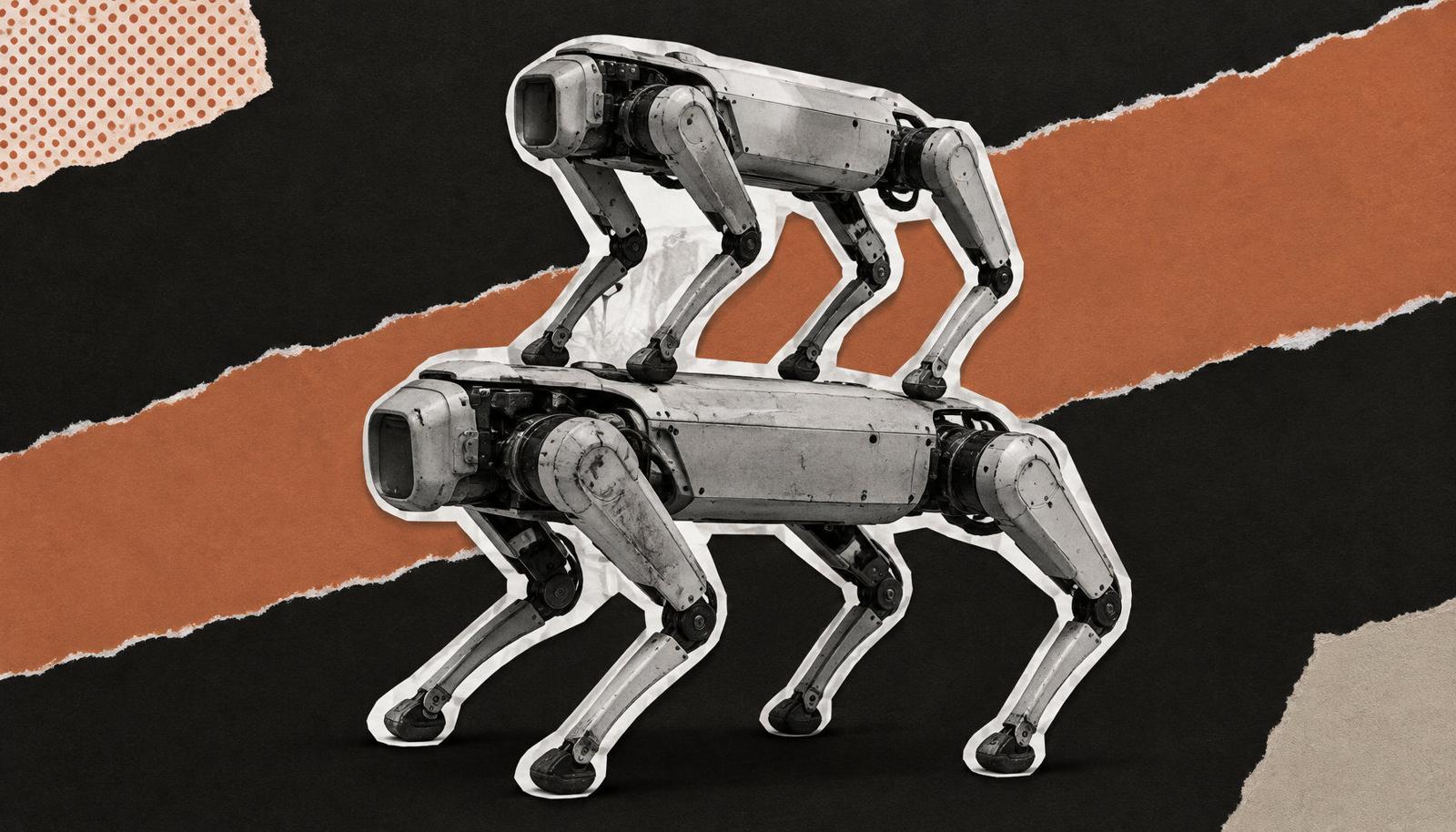
A planning framework produced valid motion references in all 30 trials across three simulated courses for pairs of quadruped robots, its researchers report in a new preprint. All of those references also converged in a subsequent trajectory-optimization step, according to the paper.
Source arxiv.org
Researchers Woojin Kim and Jemin Hwangbo of the Korea Advanced Institute of Science and Technology, or KAIST, call the framework CoTAMP. It combines large language models with code-based checks to plan cooperative tasks and generate the motions needed to carry them out.
Courses built around cooperation
The researchers tested the framework with two simulated RAIBO2 robot models on each course. In one, a robot climbed onto its partner's back to reach an upper platform; in another, a robot crossed a gap over its partner's back.
The third course involved pushing boxes to free a trapped robot and build a bridge. Each robot had its own goal region, and the task was complete when both stood in their respective regions.
Each course had 10 trials. Kinematic success meant that the combined reference passed validation and brought both robots to their goals; trajectory-optimization convergence meant that the subsequent optimization found a trajectory satisfying its constraints. The paper says convergence suggests that the reference is dynamically plausible.
From task plan to trajectory
CoTAMP first divides a task into steps and fixes the robots' poses at the boundaries between them. The planner can describe a step for one robot or a coupled step involving both, rather than selecting only from a predefined set of skills.
For motion generation, the language model produces a walking route for ordinary walking steps or keyframes for other motions. Code-based modules fill in motion between keyframes, check the resulting trajectories and send failures back for correction.
Validated steps are assembled on a shared timeline, with robots waiting when an ordering constraint or a coupled step requires it. A final optimization refines the combined reference while accounting for constraints including dynamics, contact forces, joint and torque limits, and collision avoidance.
Comparisons and limits
Generating a valid kinematic reference took 13.5–15.3 minutes per course on average, excluding trajectory optimization, the authors report. Their comparison with a minimal baseline used a single language-model call to write the full trajectory for both robots and the boxes.
On the course involving a climb onto a partner, that baseline produced six kinematically valid trajectories in 10 trials, none of which converged in trajectory optimization. On the gap-crossing course, it produced seven valid trajectories, of which two converged; those baseline figures were reported without the support-edge margin.
In a separate comparison using the same keyframes for six steps, kinematic synthesis passed validation in 30 of 60 cases without optimization and 60 of 60 with it. The authors say the improvement was concentrated in motions involving height changes and robot-to-robot contact.
The framework currently handles only two robots. The authors say its behavior on real hardware and in more diverse environments remains to be validated, and that the time needed to generate a reference limits its use for fast replanning.
Sources
- Original source · Preprint CoTAMP: Cooperative Task and Motion Planning for Quadruped Robots with Large Language Models arXiv:2611.33911