The Floor
COWBOY Grasps Objects Across 24 Unseen Real-World Scenes
Researchers at Carnegie Mellon University describe COWBOY, a robot-learning system tested across 24 real-world scenes. Its single vision policy coordinates a mobile base, arm, dexterous hand and camera to adapt its grasping approach to surrounding geometry.
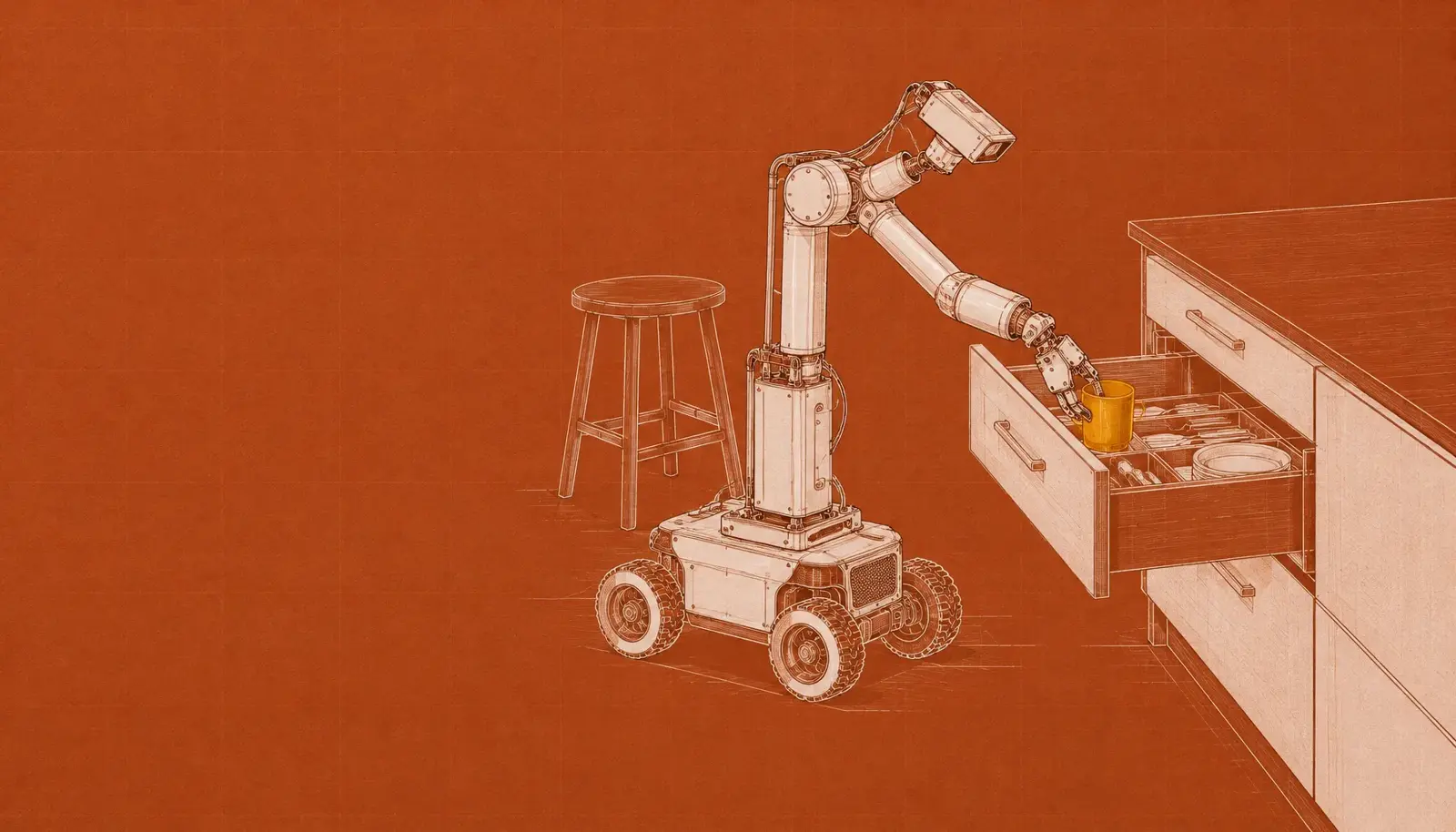
“The resulting policy exhibits contextual whole-body behavior, automatically adapting base placement, camera viewpoint, arm trajectory, and grasp strategy to observed scene and object geometry.”
Jiahui Yang et al., researchers at Carnegie Mellon University
Researchers at Carnegie Mellon University describe COWBOY in a paper submitted to arXiv on October 20, 2026. The system is designed to make a mobile manipulator change how it approaches and grasps an object as shelves, drawers, clutter and other obstacles reshape the available path. Its single vision policy coordinates the robot’s wheeled base, arm, dexterous hand and movable camera.
One policy coordinates a 32-degree-of-freedom robot
The researchers tested COWBOY on a platform built around a holonomic TidyBot++ base, a Franka arm, a 16-degree-of-freedom LEAP Hand and an actuated neck carrying a RealSense D435 depth camera. A Unitree L2 lidar supplies a wider view of the surrounding space. Together, the platform has 32 degrees of freedom, including the base, arm, hand and neck.
Rather than asking reinforcement learning to discover navigation and grasping together, COWBOY splits the work into reaching and object interaction. A vectorized whole-body controller moves the base and arm toward a target, steers the camera to keep it in view and avoids self-collisions and nearby geometry. Three local reinforcement-learning experts handle top-down, side and constrained side grasps; the same experts can be reused in many larger simulated scenes.
Training spans 8,192 simulated scenes
The team distilled those controller-and-expert combinations into a single policy using point-cloud observations from a depth camera and lidar. Training covered 8,192 full-scene environments and 250 objects in Isaac Gym, distributed across eight NVIDIA A6000 GPUs. The resulting policy outputs base velocities and joint-position targets for the arm, hand and camera neck.
In the real-world evaluation, the researchers tested 24 scenes that included shelves, boxes, chairs, refrigerators and drawers. They report a 91% average grasp-success rate. A successful trial required the robot to lift the object 10 centimeters without a collision; the objects included items excluded from the simulation training set.
Simulation results offer a separate measure of performance, not a substitute for the physical trials: on held-out simulated scenes, COWBOY’s student policy reached 92.4% success, compared with 95.6% for its teacher. An end-to-end reinforcement-learning baseline scored 0% in the same obstacle-filled simulation setting, but reached 96% when obstacles were removed. The contrast points to the difficulty of learning scene reasoning, collision avoidance and dexterous interaction together.
Target selection and grasp intent remain open
COWBOY adapts its approach to a target; it does not independently decide which object to pick. The real-world pipeline starts with an estimate of the target’s position, initialized using an object segmentation model such as SAM3. The policy updates that estimate during execution, but the experiment therefore does not establish open-ended object discovery.
The paper also identifies a limit in how the policy chooses grasps: scene and object geometry guide its grasp strategy, but the system lacks information about what the object will be used for afterward. A mug, for example, can admit several valid grasps with different consequences for later handling. The authors say functional grasping will require conditioning on information beyond the scene itself.
Sources
- Original source · Preprint COWBOY: A Scalable Sim-to-Real Framework for Learning Contextual Whole-Body Manipulation arXiv:2610.28948
Related stories
- Zero-HLM Simulation Training Beats Real Data in G1 Trials
- LEAP Hand State Policy Reaches 95.2% of Unseen Pose Goals
- HyperDrone Reports 20× Faster Quadrotor Simulation
- RGraph-Eval Scores Robot Videos on Objects, Actions and Motion
- Humanoid Controller Uses Its Torso to Reposition Objects in 45 of 50 Trials