The Floor
cuArms Uses GPU Search to Coordinate Multi-Arm Workcells
A paper describes cuArms, a GPU-accelerated planner that coordinates robot arms’ tasks, schedules and motions in shared workcells. Its reported tests include simulated welding and tabletop tasks, plus two real-robot electronics-assembly demonstrations.
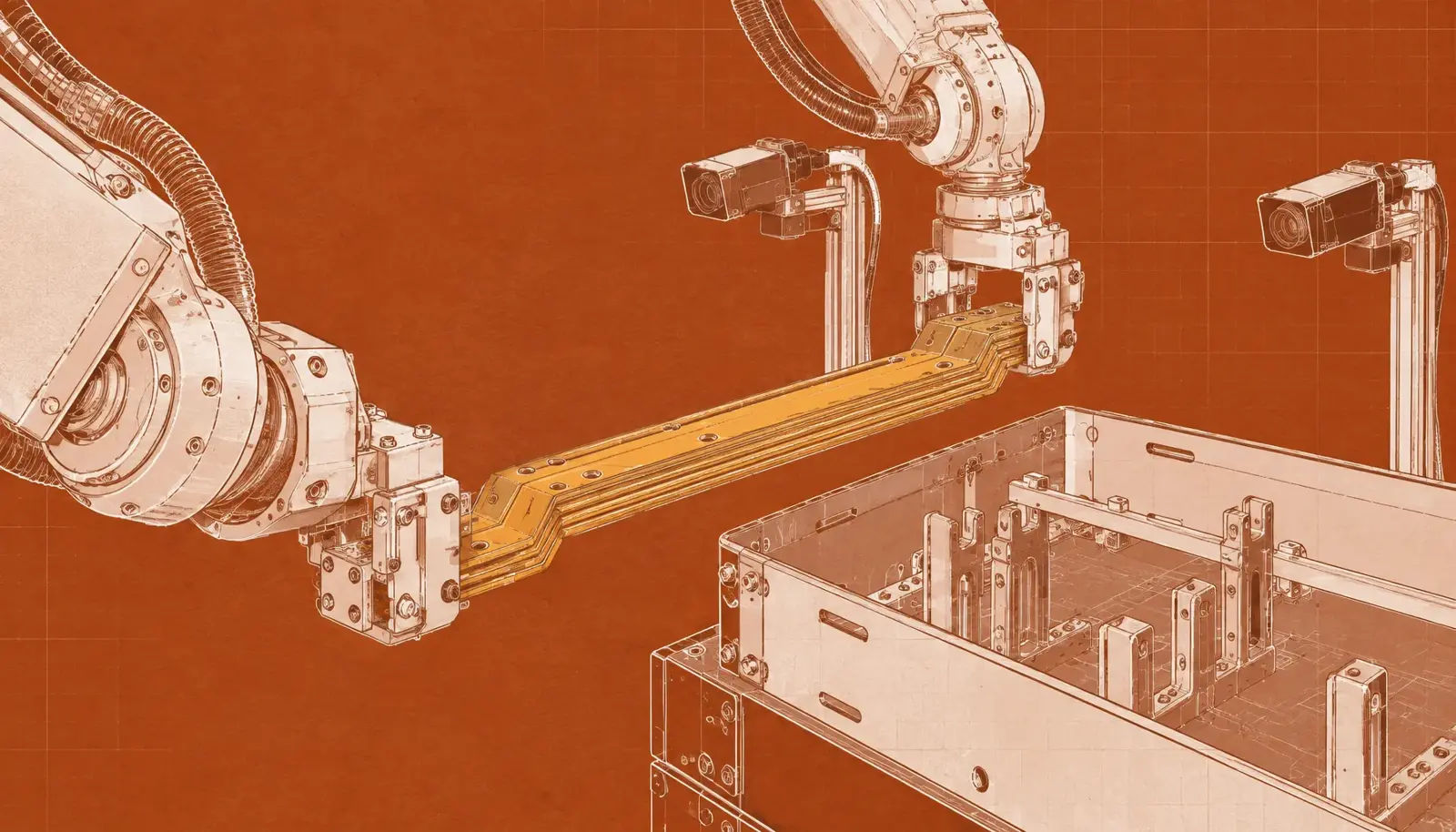
On October 26, researchers submitted a paper describing cuArms, a GPU-accelerated planner designed to coordinate multiple robot arms sharing a workcell. The system searches for collision-free motions while accounting for which arm handles each task, the order of actions and manipulation skills such as handovers or carrying an object together.
Source arxiv.org
The work targets a practical planning bottleneck: arms can block one another even when each has a valid path on its own. cuArms combines per-robot motion roadmaps with a conflict-driven search that evaluates candidate interactions in large GPU batches. The authors test it in simulated welding and tabletop tasks, then demonstrate coordinated planning for two electronics-assembly tasks using real robot arms.
GPU batches address the collision-checking bottleneck
Rather than repeatedly checking arm-to-arm collisions as the search unfolds, cuArms builds a table of potential conflicts among candidate actions. The GPU checks those candidates in batches; a search process then uses the results to choose compatible actions, resolve deadlocks and allow arms to wait or yield when needed. Reusable roadmaps store possible motions for each arm, while mode-specific checks account for objects being grasped, moved or placed.
A high-level scheduler supplies candidate task sequences, including assignments, ordering and sampled manipulation parameters. cuArms coordinates the lower-level motions and skills for each candidate. If a schedule cannot be completed, the system can try another; after finding a plan, it also searches for shorter paths and better schedules.
“Experimental results show that our method establishes a new state of the art, with real-time initial solutions and anytime improvements in both motion quality and scheduling, without days of domain-specific training required by learning approaches.”
Philip Huang et al., authors of “cuArms: GPU-Accelerated Conflict-Based Planning for Multi-Arm Manipulation”
Sub-second initial plans in simulated welding
In a simulated welding benchmark, four or eight arms must reach 10 or 40 targets in a shared, obstacle-filled space. The paper reports median times to an initial solution of 0.20 seconds for 10 targets and 0.41 seconds for 40 targets with four arms. With eight arms and 40 targets, cuArms found feasible plans within one second. The researchers ran the measurements on a workstation with an NVIDIA RTX Pro 6000 GPU.
Shortcutting and trying alternative schedules reduced the initial plan’s makespan—the time until the last arm finishes—by about 47% in the tested settings. In comparisons with a retrained reinforcement-learning system, cuArms completed a larger share of the benchmark episodes; among cases both methods solved, the paper reports lower median makespans for cuArms. The authors also identify roadmap construction as a remaining computational cost, especially where obstacles create narrow passages.
Tabletop results and a real-robot assembly test
For tabletop holding, stacking, packing and unpacking, cuArms coordinated two Panda arms and solved all evaluated instances in the paper’s comparison. Its initial solutions took 0.48 to 2.96 seconds, depending on the task. The authors report that shortcutting and testing alternative schedules cut median makespan by 42% to 57% across the four tasks; the tests also extended packing and unpacking to as many as eight objects.
The hardware evaluation used two Flexiv Rizon4 arms on electronics assembly. A GPU-accelerated sampler generated constrained poses for handover and bimanual carry, rather than relying on fixed handover poses or prewritten carry paths. The system planned collision-free approaches around camera mounts, and the paper includes successful real-robot executions.
Planning results are not factory throughput figures
The results establish planning performance on defined benchmarks and selected assembly demonstrations, not production-line throughput or reliability across a full factory shift. The paper’s welding comparison uses a particular task setup and retrained learning baseline; its electronics tests cover two tasks. Deployment would also depend on the quality of the task scheduler, object and robot models, and manipulation skills supplied to the planner.
For workcells where several arms must share tight space, cuArms offers a way to search task schedules and coordinated motions together instead of planning each arm independently and adjusting paths afterward. Its most concrete hardware result is a pair of Flexiv arms planning handover and carry motions around camera mounts—an example of the coordination problem the system is built to solve.
Sources
- Original source · Preprint arXiv arXiv:2610.36250
Related stories
- DIVAL reshapes motion fields to match a robot’s starting heading
- Preprint finds hand-written planners beat UniAD in some tests
- Preprint Sets Deadlines for Robots Awaiting Language-Model Plans
- Preprint reports faster planning with SI-MPPI in map simulations
- Robot memory model cuts planning latency in tests, researchers say