The Floor
CUE Turns Pool Shots Into Tests of Hidden Physics
CUE lets an agent probe a pool table and refine a simulator for physical properties that images alone cannot reveal. The paper reports a 72% reduction in held-out ball-position error in simulation and describes a separate deployment on a real table.
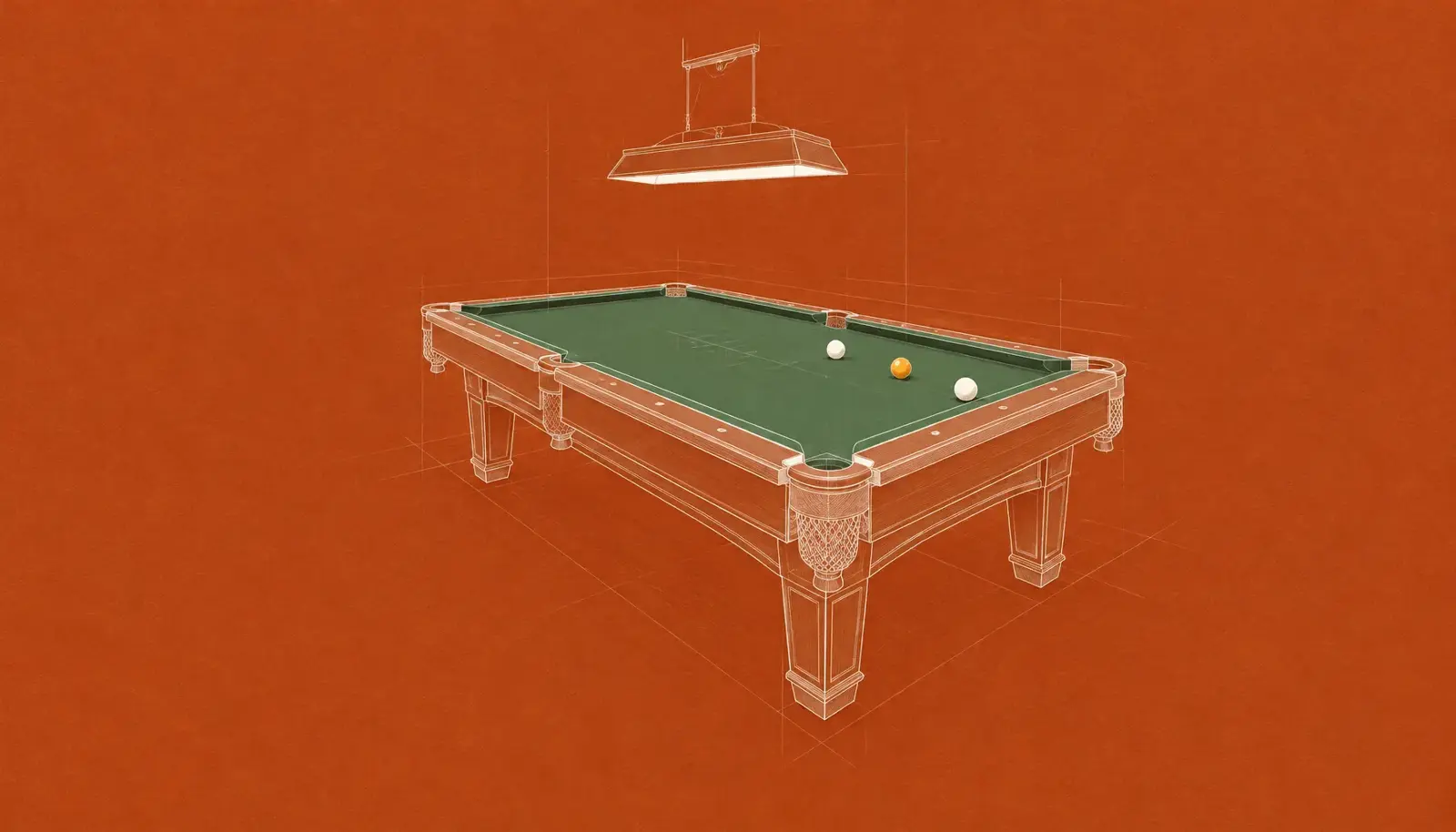
A pool-table model can look right and still predict the wrong shot. CUE, a system presented in a paper posted to arXiv on November 2, has an agent probe the table so it can learn physical properties such as friction and rebound that images do not reveal. The authors report a 72% reduction in held-out ball-position error in simulation; their real-table deployment demonstrates the approach, but the paper’s headline accuracy result comes from the simulated tests.
CUE chooses shots where its model fails
The researchers call the mismatch between a reconstructed scene and its contact-driven behavior the “dynamics gap.” CUE—short for Calibration Using Exploration—tries to close that gap by comparing real shots with simulated ones, then selecting new interactions to test where the model performs poorly.
The system begins with a high-level instruction and no human resets during exploration. From initial images, its agent builds a MuJoCo model of the table, cushions, pockets, cue and balls, then proposes initial probing shots. A camera-based tracker turns observed ball motion into trajectories; the system fits simulation parameters by minimizing the difference between real and simulated trajectories, using CMA-ES across parallel MuJoCo instances. It then shifts from generic shots to experiments aimed at the parts of the model that explain the observations worst.
“Given only a high-level instruction and no resets, the agent builds its own perception, identifies physical parameters, and targets interactions where its simulation is least accurate.”
Xilun Zhang, Liam Achenbach, Luis Pabon, Matthew Foutter and Marco Pavone, authors of the paper
The 72% result comes from 25 simulated conditions
For the quantitative benchmark, the team used a MuJoCo pool simulator as the hidden “real world.” The test covered 25 conditions—five table layouts paired with five physics settings—and gave each method at most 30 shots to build a model. After 30 shots, CUE paired with Opus 5.5 reached a mean held-out ball-position error of 0.91 centimeters; with Astra 6.1, the error was 1.32 centimeters.
The strongest baseline had 3.20 centimeters of error, a figure shared by cross-entropy method (CEM) and random search; an unfitted model reached 3.25 centimeters. Against the 3.20-centimeter baseline, the Opus 5.5 result is a 72% reduction, while Astra 6.1 reduces error by 59%. Those numbers describe the simulated benchmark, not an average measured on a physical pool table.
The real table exposes limits beyond parameter fitting
The authors also deployed CUE with Opus 5.5 on a small pool table with unknown physical parameters. They describe the real-world demonstration as learning the table’s dynamics without human involvement. In the paper, however, they do not give an aggregate real-table ball-position error comparable to the simulation benchmark, so the deployment supports a practical demonstration rather than the same quantified comparison.
The paper notes that small ball imperfections and local surface variations remain difficult to reconstruct from camera views. Parameter tuning cannot capture effects outside the model, and the authors suggest combining physics-based simulation with data-driven dynamics models as a future research direction.
Autonomy still depends on perception and judgment
CUE’s account of self-directed experimentation includes substantial engineering work by the agent: it built and revised its tracking pipeline, and the researchers say it needed prompting to reconsider parts of that process. During unsupervised exploration, the team says it intervened only when a potential safety hazard arose. The result is not a demonstration that a robot can infer every physical property from vision, but a test of how an agent can choose useful interactions, update a simulator, and identify where that simulator still falls short.
Sources
- Original source · Preprint arXiv arXiv:2611.02691
Related stories
- LEAP Hand State Policy Reaches 95.2% of Unseen Pose Goals
- Zero-HLM Simulation Training Beats Real Data in G1 Trials
- RoboColosseum Tests Robot Policies in 5,699 Comparisons at 124 Sites
- Georgia Tech Preprint Tests Seven Robot Policies on a New Generalization Benchmark; Best Averages 52%
- Metatron Turns Humanoid Skills Into Editable Code