The Floor
Researchers report trajectory-planning results for up to 1,024 agents
A preprint describes a decentralized method for optimizing the trajectories of interacting agents. In model-based tests, the researchers compared it with other optimization methods on tasks involving unicycles and drones.
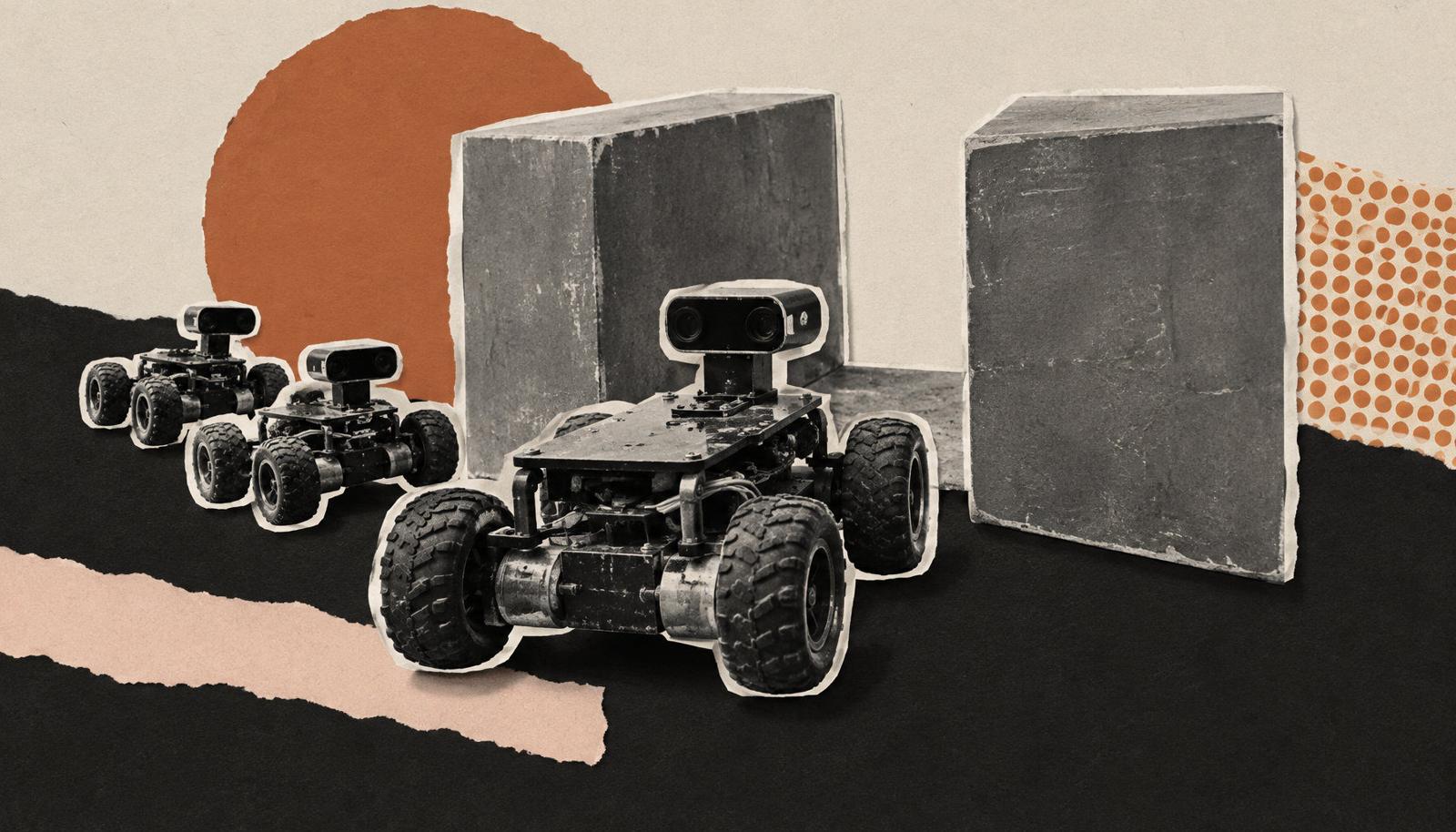
A decentralized trajectory-optimization method was tested on model-based tasks involving up to 1,024 interacting agents, including a three-dimensional drone scenario. Researchers from Georgia Tech and MIT describe the method and its results in a preprint submitted to arXiv on November 23.
The authors report better exploration and constraint satisfaction than a derivative-based distributed optimization baseline in their tests, as well as better scaling than an existing distributed sampling method. The experiments modeled agents as unicycles or drones rather than reporting tests on physical robot fleets.
Planning with local information
Called Distributed Sampling-based Trajectory Optimization, or DS-TO, the method lets each agent sample possible controls in its own control space while taking account of constraints and neighboring agents’ decisions. Its sampled control dimension does not grow with the number of neighbors, the paper says.
The method separates each agent’s dynamically feasible trajectory from local copies of trajectories that are subject to constraints. Consensus updates reconcile the trajectories and copies, while agents exchange information with their neighbors and perform local updates in parallel.
The authors used a sampling-based solver called model predictive path integral control for the trajectory updates. Soft penalties expose the sampler to constraint and neighboring-trajectory information, while a separate local-copy update enforces constraints.
Passages and obstacles
For the unicycle tasks, the researchers evaluated 20 environments and measured the fraction of episodes that met their definition of a clean result. That measure required every agent to finish within twice its radius of its goal, with obstacle and interagent violations below 0.05 meters.
In a gate task, two groups had to exchange positions through a narrow passage. For 32 agents in that task, the researchers report a clean rate of 0.68 for DS-TO, compared with 0.15 for the sequential quadratic programming baseline; the DistributedDDP baseline had no clean episodes at eight or more agents.
The researchers report computation times of 17.1 seconds for DS-TO, 38.0 seconds for DistributedDDP and 523.3 seconds for sequential quadratic programming at 32 agents in the gate task. A distributed sampling baseline exceeded available memory at that scale.
In a separate circle task, agents started around a circle and were assigned either opposite positions or randomly assigned goals among obstacles. At 24 agents, DS-TO had a clean rate of 0.85 in the opposite-goal setting, while both deterministic baselines had no clean episodes there, according to the paper.
Scaling the team
In the larger drone task, the authors evaluated three-dimensional formations across five environments. They report an agent-wise success rate of at least 0.997 across the tested scales, with maximum penetration no greater than 0.017.
At 1,024 modeled drones, DS-TO took 44.9 seconds compared with 188.3 seconds for DistributedDDP, the researchers report. The distributed sampling baseline was omitted from the drone experiment because of memory limitations and poor scaling with neighborhood size.
The timing figures for locally connected cases have an important qualification. Because of hardware limits, the researchers processed cases with at least 64 agents in batches of 32 and reported average per-batch runtime to represent parallel execution in a distributed deployment.
Sources
- Original source · Preprint Sampling at Scale: Distributed Multi-Agent Trajectory Optimization arXiv:2611.31561
Related stories
- Georgia Tech researchers test parallel solver for contact-rich planning
- Amazon researchers report faster planning for 1,125 robots
- DFLAT preprint reports faster planning on tractor-trailer benchmarks
- RoboTeam Tests AI Agents on Up to 16 Robot Arms
- Researchers report safe robot planning without retraining