The Floor
FORCA Gives Robot Coding Agents Force Feedback
University of Illinois researchers introduce FORCA, a coding agent that writes robot programs using camera images and wrist force measurements. In five real-robot tasks, the system improved grasp success and reduced contact loss against a vision-only version of the same agent.
“We present Forca, a coding agent that takes visual observations and wrist force/torque (F/T) measurements as input to write Python programs for contact probing and force-responsive motion.”
Xiao Tan, Yixuan Wang, Zhexi Wang and Wenzhen Yuan, authors of “FORCA: A Force-Aware Coding Agent for Contact-Rich Robot Manipulation”
In a paper submitted to arXiv on October 22, researchers at the University of Illinois Urbana-Champaign describe FORCA, a coding agent that gives a robot program access to wrist-force readings as well as camera input. The system writes Python code for a task, runs it on a real robot, then examines force records and visual results to revise its motion and contact-control logic.
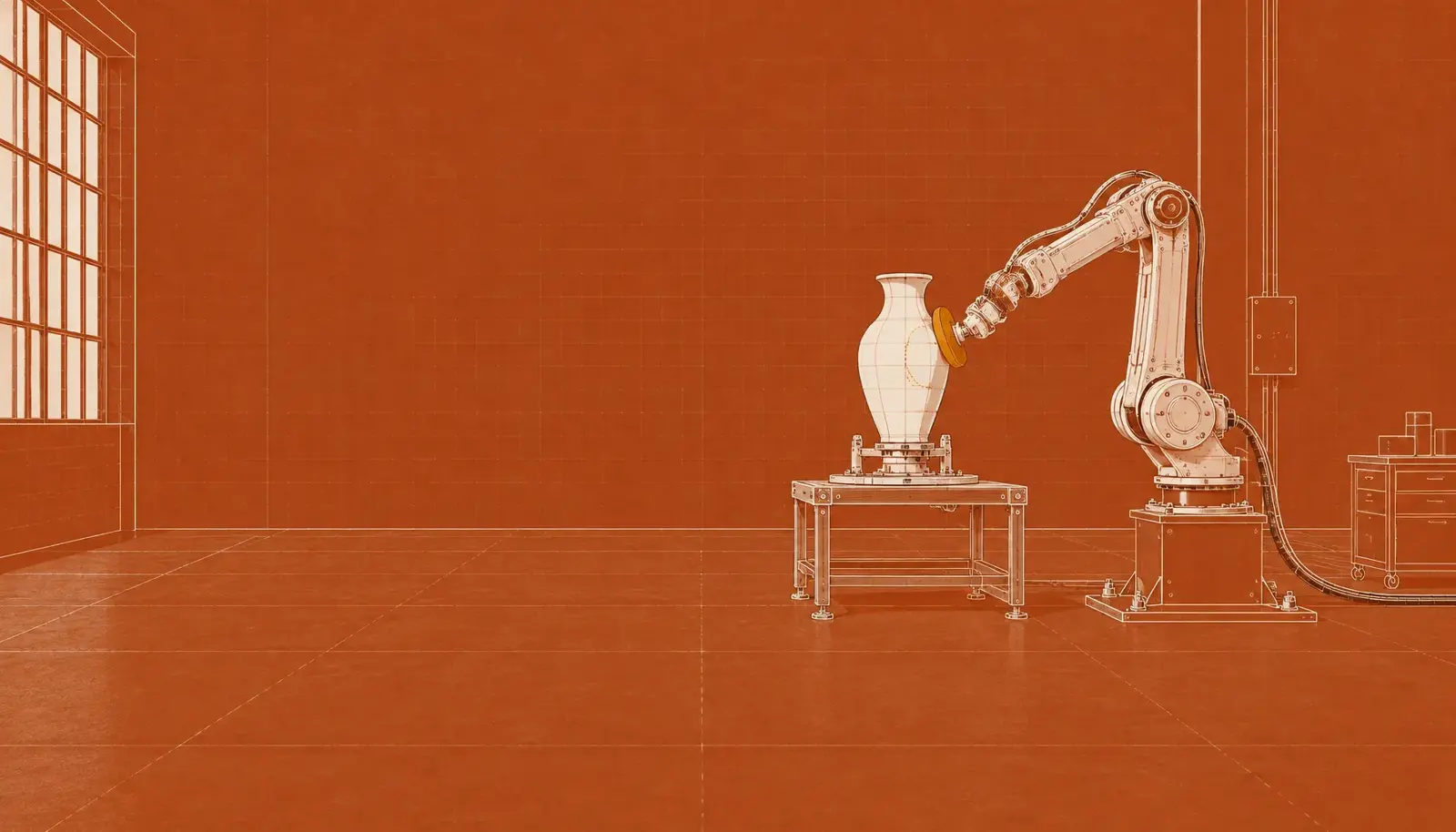
FORCA does not query its foundation model while the robot is executing a program. Instead, its generated code reads force measurements during movement, including through a 100-hertz control loop for tasks that require sustained contact. The authors tested the approach on five tasks with a UR5e arm: opening a drawer, operating a door handle, knocking an object toward a target, wiping a vase and peeling a cucumber.
Contact measurements change the grasp
For drawer opening and door-handle operation, the robot uses contact probes to refine grasp positions that vision alone estimates inaccurately. Across 10 trials per task, FORCA succeeded in all 10 drawer openings and all 10 door-handle operations. The vision-only version, which used the same foundation model, instructions and basic skills but received no force data, succeeded in four drawer trials and one door trial.
The probe readings help the robot update its estimate of where a handle or panel sits before it commits to a grasp. In the door task, force records also helped FORCA distinguish the handle’s latch release from the point where it reached its end stop. The authors’ account of the development process shows the agent revising both movement and the conditions that determine when the program should continue.
Force data helps the program adjust to change
The team also asked whether a program developed for one physical setup could adapt when the object or surface changed. In a cube-to-target task, FORCA first learned to knock a cube across a whiteboard, then reused and revised its program for different object-and-surface combinations. The paper reports that each new configuration reached the target region within a few additional revisions.
Wiping and peeling tested a different capability: maintaining contact as a surface moves or varies. After both agents refined their wiping programs on a stationary vase, the researchers deployed them without further revision while a person moved the vase by hand. Over 10 trials, FORCA removed 93% of the marker line with contact loss in 1.6% of task time; the vision-only system removed 21% and lost contact 55.9% of the time.
In cucumber peeling, FORCA achieved an 81.1% peeling ratio across 10 trials, compared with 37.4% for the vision-only program. Its contact-loss rate was 2.2%, against 40.6% for the comparison system. Those results show what the force input contributes in these tests, not a general guarantee that code written by an agent will handle contact safely.
Real-robot revision carries a time cost
FORCA relies on a wrist force/torque sensor and physical robot runs to develop and revise each program. The researchers capped each task run at 20 iterations and four hours; wiping and peeling used the full 20-iteration allowance. Agent reasoning took four to 10 minutes per iteration in the reported tasks, usually longer than the robot’s one to three minutes of movement.
The paper also notes limits in what a wrist sensor can reveal: it measures the combined effects of contact but does not show precisely where contact occurs or how force is distributed across gripper fingers. The authors say longer action sequences and tighter force constraints may also make failures harder for the agent to diagnose. In these experiments, FORCA’s gains came from pairing force readings with real execution records, while its program development still required repeated robot trials.
Sources
- Original source · Preprint FORCA: A Force-Aware Coding Agent for Contact-Rich Robot Manipulation arXiv:2610.31841
Related stories
- Hsu and Stone Introduce ELA Preprint for Learning Robot Policies from Video Demonstrations
- AstroBench Records 6 Captures in 400 Generalist-Policy Trials
- Researchers Demonstrate a Bistable Origami Robot for Multimodal Motion and Grasping in Nonuniform Magnetic Fields
- AgiBot’s Rollback Rewinds Robot Policies to Test Better Actions
- Ropedia’s DONIC Tracks Two Robot Hands With One Policy