The Floor
Authors propose ForPC, a force-aware whole-body control framework for humanoid cart pushing
A paper submitted to arXiv on 5 Nov 2026 proposes ForPC, a force-aware whole-body control framework for humanoid cart pushing. In simulation and after transfer to a physical Unitree G1, the policy regulates cart velocity without external force sensors or real-world training.
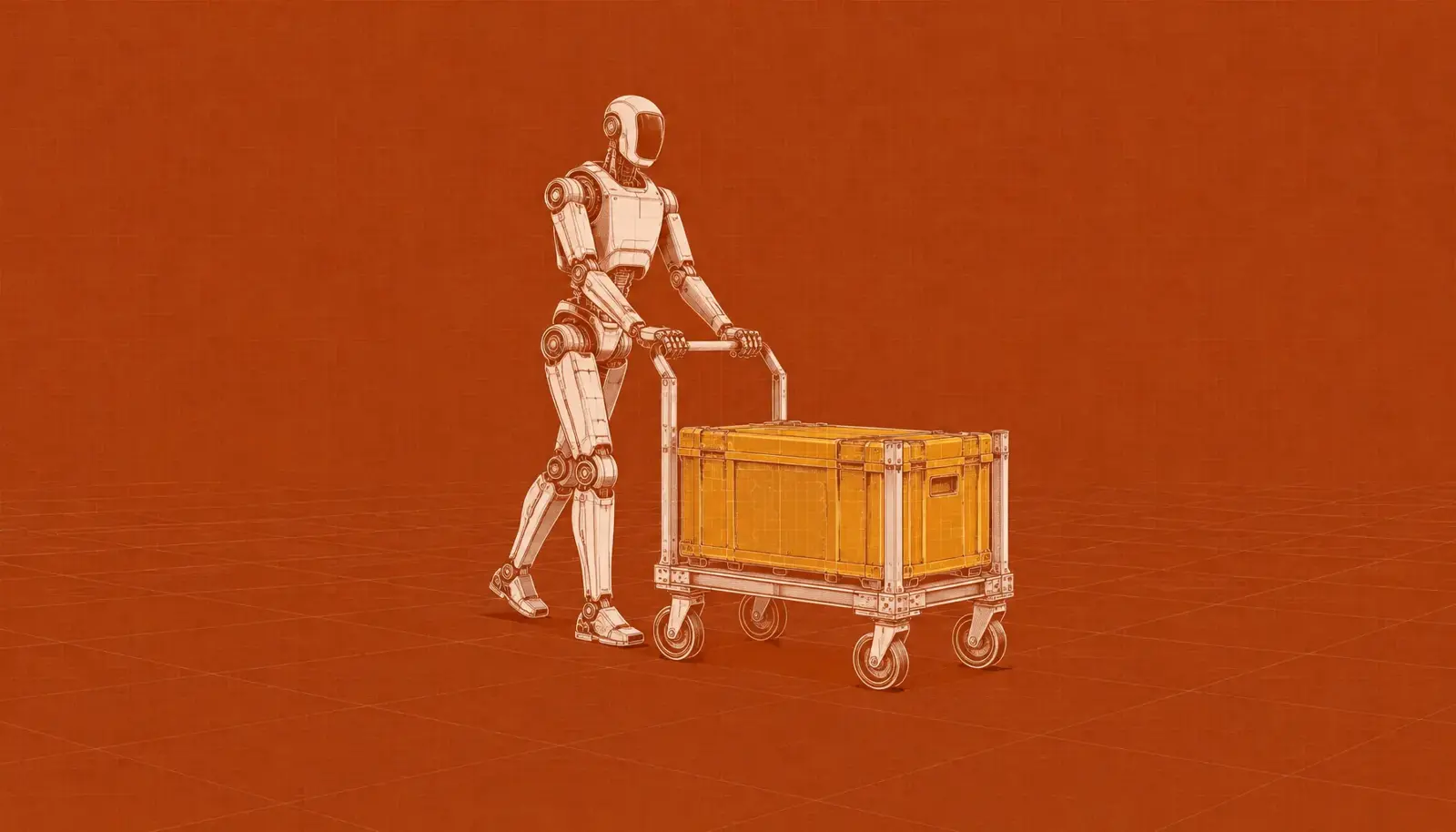
A paper submitted to arXiv on 5 Nov 2026 proposes ForPC, a force-aware whole-body control framework for humanoid cart pushing. The framework regulates cart velocity through two-stage reinforcement learning. The authors write that humanoid robots are expected to take over strenuous material handling in manufacturing, logistics and healthcare, where operating existing wheeled carts would let them move heavy loads without modifying the workplace.
Humanoid cart pushing remains challenging because its bimanual grasp closes a force-coupled loop
The authors describe the bimanual grasp as a force-coupled loop: contact wrenches drive the cart while also disturbing the robot’s balance. Changes in payload alter the coupled dynamics.
ForPC uses two-stage reinforcement learning
First, a locomotion prior is trained under varied hand loads and upper-body postures to support balance. A force latent and a state latent are then inferred from onboard observations, without external force sensors. A residual policy uses those latents to coordinate bounded arm, waist and leg adjustments with base-velocity commands.
Rewards target opposition, slip and saturation
ForPC’s multi-objective rewards penalize bimanual internal opposition and grasp slip. They also penalize actuator saturation. The rewards encourage the policy to apply contact force on demand without human demonstrations.
ForPC’s policy reduces cart-velocity RMSE by up to 68.2% in sim-to-sim experiments and transfers to a physical Unitree G1
In sim-to-sim experiments, ForPC reduces cart-velocity RMSE by up to 68.2% relative to a locomotion-only baseline. On a multi-bend route, it reduces cross-track RMSE by up to 74.2%. Trained solely in simulation, the policy also transfers to a physical Unitree G1 and pushes a cart carrying up to 30 kg at 0.5 m/s, without real-world training, fine-tuning or payload-specific adjustment.
Sources
- Original source · Preprint ForPC: Force-Aware Whole-Body Control for Precise Humanoid Cart Pushing arXiv:2611.08664