The Floor
GPT-6 Astra Posts 40% Zero-Shot Success on Robot Hardware
A study posted October 20 evaluates GPT-6 Astra as a direct robot controller across five benchmarks and a physical ROKAE Helios robot. Astra succeeds in 10 of 25 zero-shot hardware trials, while one demonstration raises its result to 20 of 25.
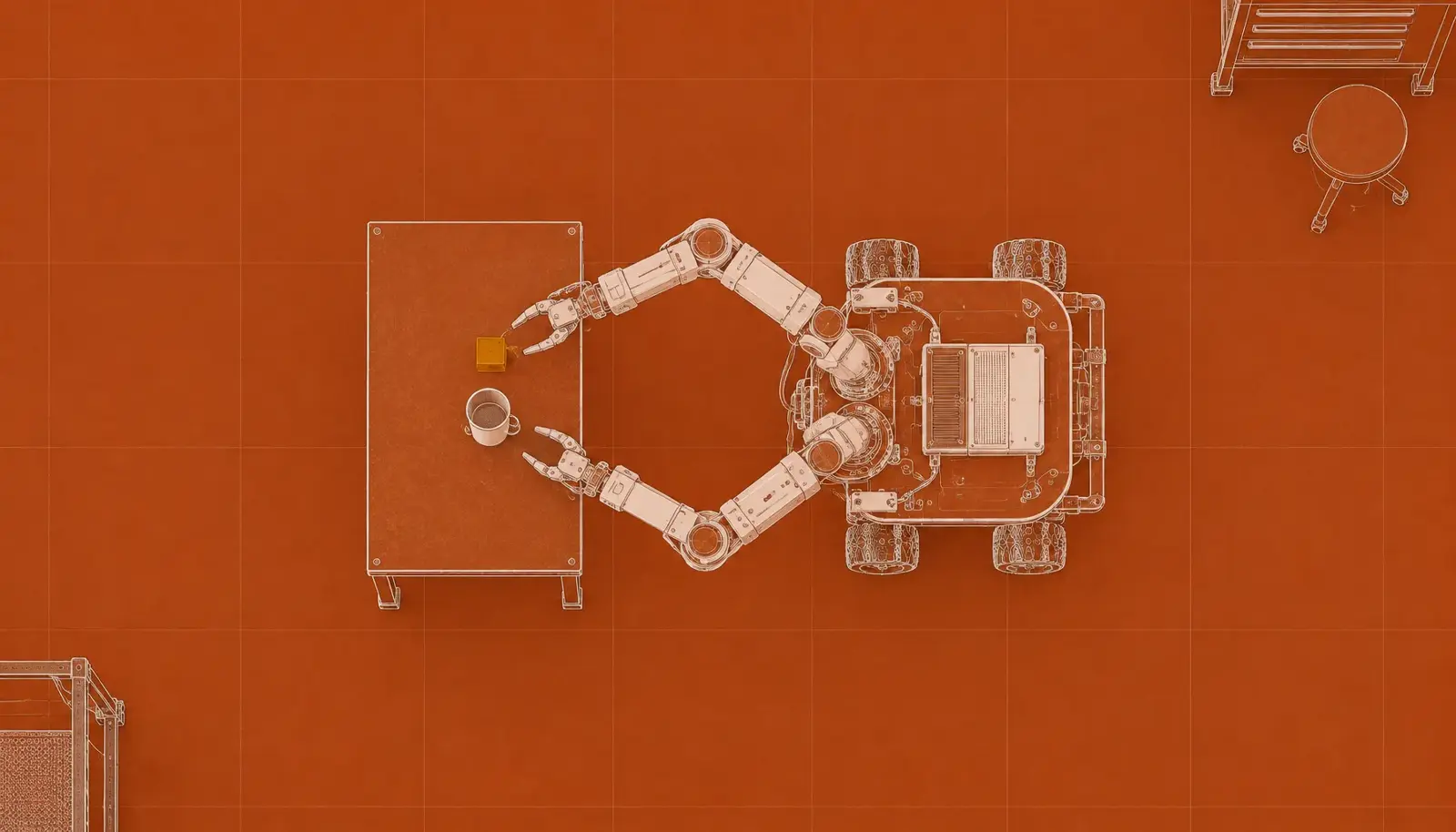
GPT-6 Astra scores competitively on several simulated manipulation benchmarks, but succeeds in just 10 of 25 real-robot trials when given no demonstration. A study posted October 20 by Youwei Zhou and co-authors reports that a single example of a similar task doubles the hardware success rate to 20 of 25, while leaving failures in grasping, alignment and coordinated movement.
Source arxiv.org
The findings put two capabilities in tension: Astra can interpret instructions and adapt to new scenes, yet often cannot turn that understanding into a physically workable sequence. The authors write, Despite competitive performance on several benchmarks—26.92% success on RoboDojo and 76.0% on RoboTwin 2.0—our analysis reveals a pronounced gap between semantic reasoning and physical execution, particularly in consequence-aware action planning, precision, and complex motion coordination. Youwei Zhou et al., “Large Multimodal Models for Direct Robot Control: GPT-6 as a Beginning”
Good benchmark scores, uneven physical control
The team tested Astra through GPT-GEAR, a tool-mediated framework for closed-loop robot control that does not use a separate, robot-trained action policy. The model receives camera images and robot-state information, proposes arm and gripper commands, then gets new observations and execution feedback before deciding what to do next. The controller checks proposed movements against kinematic and joint limits, but the paper cautions that those checks do not guarantee a collision-free path or a successful grasp.
Across five established benchmarks, Astra recorded success rates of 83.5% on LIBERO-Plus, 76% on RoboTwin 2.0 and 72.5% on UniVTAC. The paper evaluated 164 tasks, using 10 trials per task on three benchmarks and 20 per task on RoboCasa GR1 and UniVTAC; the researchers note that this was a reduced evaluation budget rather than each benchmark’s full official protocol. Results also varied sharply by task demands: across the study’s task groupings, success reached 73.45% for task understanding, compared with 33.03% for long-horizon execution and 36.19% for precision.
Demonstrations help, but do not settle the task
On a ROKAE Helios-series mobile robot with two seven-degree-of-freedom arms, the researchers tested pick-and-place, constrained mango grasping, block insertion into a close-fitting cup, pouring into a drawer and shelf rearrangement. Astra completed all five pick-and-place trials without a demonstration, but failed all five constrained mango-grasping trials. Its zero-shot success was two of five for both block insertion and pouring, and one of five for shelf rearrangement.
Giving the model one example of a similar task raised overall success from 40% to 80% across the five tasks. Pouring improved from two successful trials to five, while mango grasping rose from none to three. The sample remains small—five trials per task in each condition—and the demonstration did not eliminate errors on the harder tasks.
When a correct plan meets a physical limit
The failure traces show why benchmark averages can hide the difficulty of physical control. During a block-in-cup attempt, Astra first grasps the block appropriately, then turns its wrist inward until the arm reaches a joint limit and cannot place the block. In the mango task, the fruit is wider than the gripper opening, and a nearby peach restricts the approach; the model sometimes fails to choose the necessary sideways grasp.
A new test set, LIBERO-GeoMotion, isolates tasks that require orientation changes, tight geometric alignment and sequences of related movements. Astra succeeds in four of 36 variants without demonstrations, for an 11.1% success rate. In-context demonstrations lift that result to 50%, but package storage still fails in every tested variant, underscoring that a helpful example is not a substitute for reliably coordinating each movement.
Time and safety remain practical barriers
The paper also reports substantial delays from repeated model reasoning and action correction: average execution takes 7.82 minutes per LIBERO-Plus episode and 28.43 minutes per RoboDojo episode. On real hardware, some tasks take about 20 minutes. Such durations make the method difficult to use where fast response matters, even when a task can eventually be completed.
The study’s conclusion is narrower than a claim that a general-purpose model can already control robots reliably: Astra can perform basic manipulation and learn useful strategies from examples, but precise placement, safe contact and complex movement remain inconsistent. The authors identify the concrete gap in their hardware results: 10 successes in 25 attempts without a demonstration, and 20 in 25 with one.
Sources
- Original source · Preprint arXiv arXiv:2610.28259
Related stories
- Georgia Tech Study Finds No Best Humanoid Steering Strategy
- AstroBench Records 6 Captures in 400 Generalist-Policy Trials
- Hsu and Stone Introduce ELA Preprint for Learning Robot Policies from Video Demonstrations
- Researchers Demonstrate a Bistable Origami Robot for Multimodal Motion and Grasping in Nonuniform Magnetic Fields
- AgiBot Reports G2 Robot’s Store-Task Success Stabilized at 85.7%