The Floor
Hesai Launches Kosmo to Turn Real Spaces Into Robot Training Data
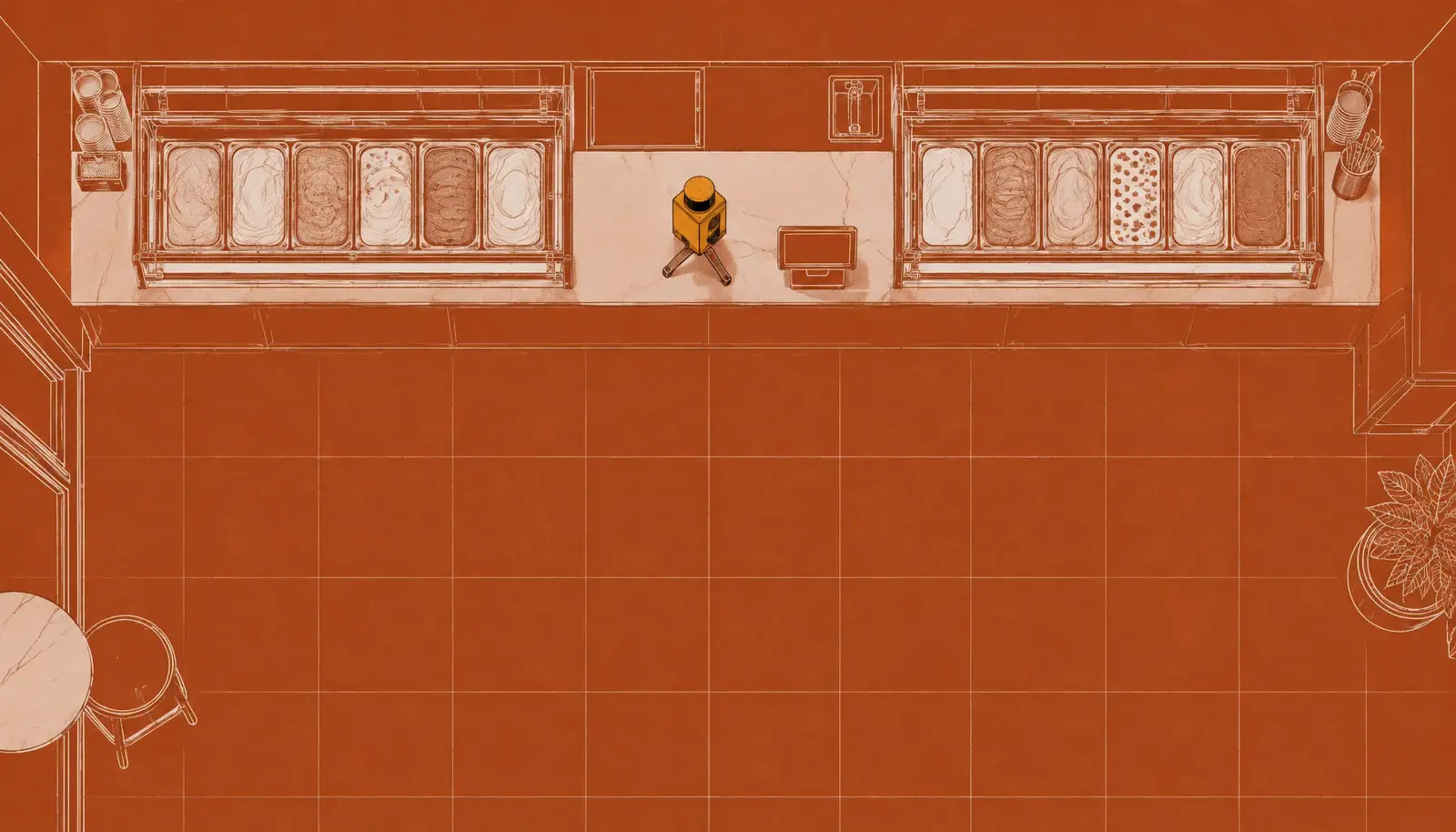
Hesai launched Kosmo, a lidar-and-camera system that converts scans of physical spaces into 3D environments for robot training and world-model development. The company says a Dairy Queen deployment cut scene preparation from about 300 hours of manual modeling to a 15-minute scan and reconstruction.
“Physical AI needs real-world data that is accurate, affordable and available at scale,”
Shaoqing Xiang, co-founder and CTO, Hesai
Hesai pairs a spatial camera with cloud reconstruction
Hesai launched Kosmo on October 14, combining its Kosmo One spatial camera with Kosmo World, a cloud platform for turning physical environments into 3D digital scenes. The company pitches the system as a way to supply reusable environments for robot training and world-model development, alongside applications in film, tourism and location services. Hesai also announced partnerships with embodied-AI companies Galbot and Dexmal.
Kosmo One combines lidar, a one-inch imaging sensor and an inertial measurement unit to capture a space’s geometry, color, texture and camera position. The sensors operate with microsecond-level synchronization and, Hesai says, its 3D Gaussian Splatting reconstruction produces millimeter-level geometric accuracy. The camera supports capture at up to 8K, while files exported by users top out at 6K.
One capture produces three kinds of scene data
Kosmo World uses Hesai’s Kosmo Spatial Core to produce 3D Gaussian Splatting, mesh and depth data in one reconstruction. The formats combine visual appearance with geometry and distance information, which can support different parts of a simulation scene. The platform also uses generative AI to fill unscanned areas and reconstruct textures, while semantic segmentation identifies individual objects.
The resulting views can be adapted to a robot’s camera characteristics, an attempt to make simulated observations more like what a robot would see during operation. From one captured space, the company says, Kosmo can generate more than 10,000 training trajectories. Its release claims more than 100 times the data-acquisition efficiency at the same cost as collecting a single high-quality real-world robot trajectory; it cautions that results vary with scene scale, trajectory volume and settings.
The Dairy Queen result comes with limited test detail
Hesai points to a Dairy Queen store deployment involving a Sharpa robot as an example of the workflow. The company says professional manual modeling previously took about 300 hours, while scanning and reconstruction with Kosmo took 15 minutes. It reports a 99% task success rate for the robot and says its failure rate fell to one-tenth of its previous level.
The announcement does not specify the number of trials, the tasks included in the success-rate calculation or how the prior failure rate was measured. The figures describe Hesai’s deployment, not a published independent evaluation. They offer a concrete example of the system’s intended use, but the release leaves those details open.
Hesai is selling tools and spatial-data services
Hesai has two business models: integrated hardware and software for customers, and services that produce real-world spatial data for Physical AI and world-model developers. Kosmo supports open access to raw capture data and 3D assets, with integrations for NVIDIA Isaac Sim, Isaac Lab, Unreal Engine, RenderMan and Houdini. The announcement does not give a price or a customer-access timetable.
Kosmo also targets media production and mapping. Hesai says a 10,000-square-meter European streetscape that would take about two months to build as a physical set can be scanned, reconstructed and edited in a week; it estimates potential savings of up to 80% compared with renting and building sets. For its Amap partnership, reconstructions of the Gravity Art Museum and PIFO Gallery are already available in the platform’s Flying Street View feature. In robotics, the most specific result in the launch release remains the Sharpa deployment: a reported 99% task success rate after a 15-minute scan and reconstruction.
Sources
- Original source Hesai hesaitech.com