The Floor
A Learned Lunar Swarm Cuts Its Simulated Nighttime Heat Budget
A reinforcement-learning policy taught a simulated swarm of 20 lunar robots to huddle and circulate through the 354-hour lunar night. The researchers report a survival threshold 37% below that of a motionless huddle, but the result has not been tested on hardware.
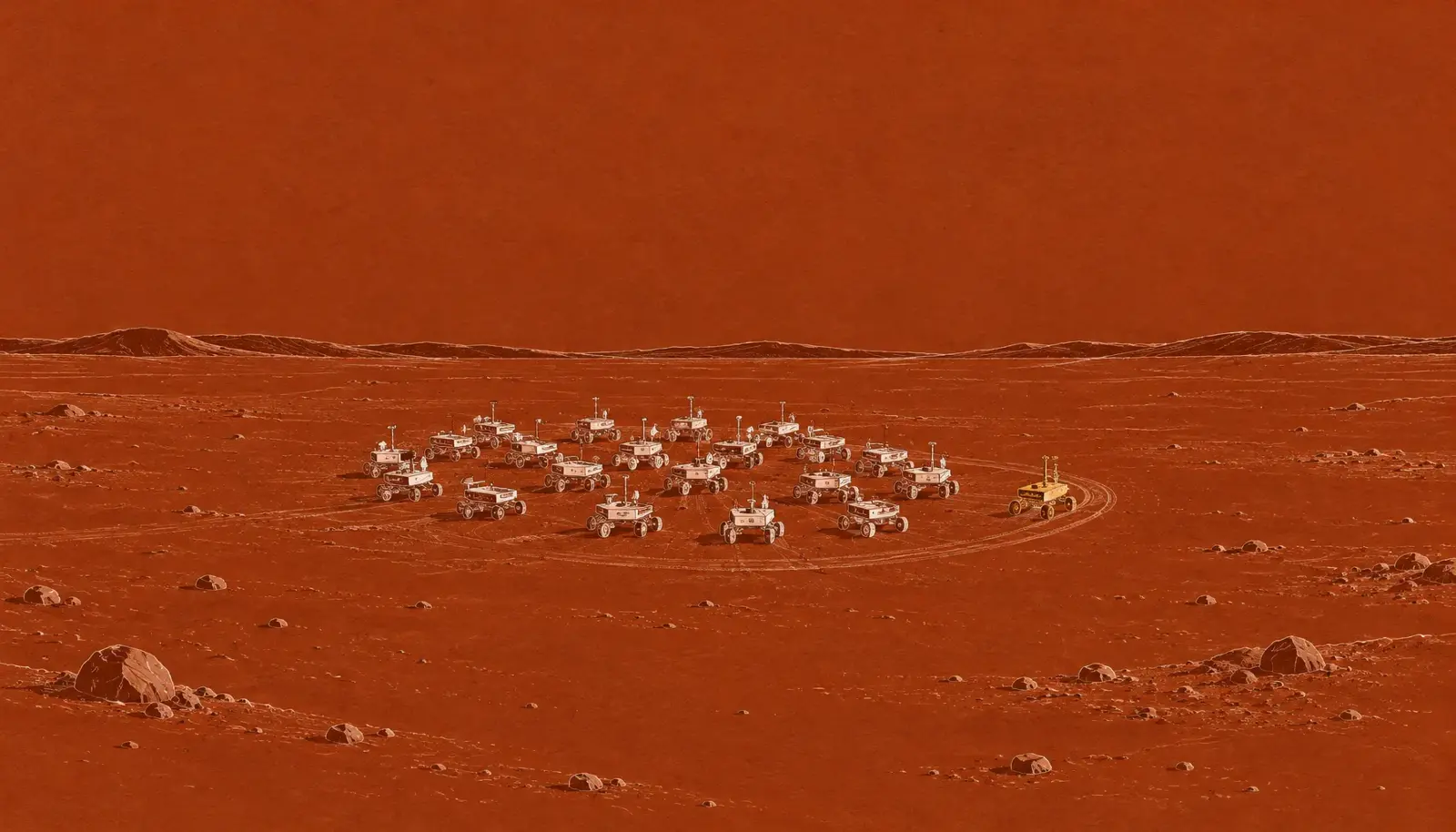
“The swarm aggregates, and robots circulate between the sheltered core and the exposed rim”
Anaïs Jeger et al., “Emergent Cooperative Thermoregulation in Lunar Swarm Robotics”
A shared reinforcement-learning policy taught a simulated group of 20 small robots to gather and rotate positions during the lunar night, using one another to block heat loss. The paper, submitted to arXiv on October 22, reports that the behavior lowers the stored-energy threshold for every robot to survive until sunrise by 37% compared with a stationary huddle. The authors have not tested the approach on physical robots.
The work addresses a specific obstacle for small lunar rovers: a lunar night lasts about 354 hours, while the surface can fall toward 95 kelvin. Radioisotope heaters have helped individual spacecraft survive such conditions, but the paper argues that supplying them across a swarm is difficult. Rather than rely on a shared shelter, the researchers model robots using their own bodies as thermal shields.
A sparse reward produces a moving huddle
The policy is shared across the swarm, but each robot acts from local observations. Its only reward arrives at the end of the simulated night and measures the mean temperature of the five coldest robots. The reward does not directly instruct the robots to gather, maintain spacing, move between positions or reduce exposure.
Even so, the learned behavior brings the robots together and circulates them between the group’s sheltered interior and exposed edge. That circulation matters: a hand-coded gather-only baseline forms a huddle but leaves the same robots at the exposed rim. In the paper’s simulation, the stationary huddle loses six of 20 robots at the energy budget used for training; the learned policy keeps all 20 alive.
155.6 pcm-h versus 246 for a static huddle
The researchers define the survival threshold as the smallest stored-energy budget per robot at which every robot remains alive at sunrise. Across 10 converged training runs, the learned policy reaches 155.6 ± 1.3 pcm-h. The paper defines one pcm-h as 7.2 kilojoules of stored heat, making the reported threshold roughly 1.12 megajoules per robot.
A motionless huddle needs 246 pcm-h to meet the same all-robots-survive test, while a dispersed swarm with no movement needs 328.5 pcm-h. The study also calculates a physics-based equalization bound of 138.1 pcm-h, the theoretical reference used for comparison in its model. The learned result sits 12.7% above that bound; it is a simulation result, not a measured lunar power requirement.
Gathering alone does not deliver the same savings. A gather-only controller needs 250.3 pcm-h to keep the full group alive, close to the static huddle’s 246 pcm-h. The comparison isolates the contribution of circulation: moving between the rim and interior helps distribute exposure across the group over the long night.
Transfer works in simulation, with costs
The researchers tested five learned policies with 20, 30 and 40 robots, without retraining. At 40 robots, the stored-energy requirement fell by an average of 8% relative to the 20-robot case, tracking about three-quarters of the improvement available in the paper’s equalization-bound calculation. The result suggests the controller can accommodate a larger simulated group, though it does not establish how it would perform with different robot designs or real lunar terrain.
Some of the headline behavior also depends on conditions that require careful qualification. The policies were initially trained with physical contact, then transferred in simulation to a 25-millimeter keep-out distance. Keeping that separation reduced shielding and raised the energy requirement by about 13%, the paper says. Avoiding contact could reduce abrasion, but the robots still travel an average of 4.3 meters per hour across the night in short bursts.
Wheel wear remains an unanswered test
The model does not account for wear or changes in friction and contact properties as wheels repeatedly interact with regolith. The authors identify long-duration mechanical durability as unvalidated and say the next step is to transfer the policies to hardware and test them under realistic regolith and contact conditions.
For now, the result is a learned coordination strategy evaluated in a thermal and motion simulation. Its reported energy savings depend on continued circulation, and that means the same wheel–regolith interaction that enables the behavior must last through a 354-hour night.
Sources
- Original source · Preprint Emergent Cooperative Thermoregulation in Lunar Swarm Robotics arXiv:2610.31868
Related stories
- Würzburg teams receive about €1.4 million for Mars swarm research
- Preprint proposes affine-field control for safer robot collectives
- Researchers report swarm learning transfers to hardware
- Georgia Tech Study Finds No Best Humanoid Steering Strategy
- Hong and Zhang Use Human Motion Data to Train Dexterous Robots