The Floor
MuJoCo 4.0.0 Targets Tunneling, Adds Plasticity
MuJoCo 4.0.0 adds speculative contacts to help prevent fast-moving convex geometries from tunneling through thin obstacles, and introduces stateful elasto-plasticity for springs and flexes. The release also changes tendon wrapping behavior, splits the Python distribution into three packages and updates several engine and deformable-model features.
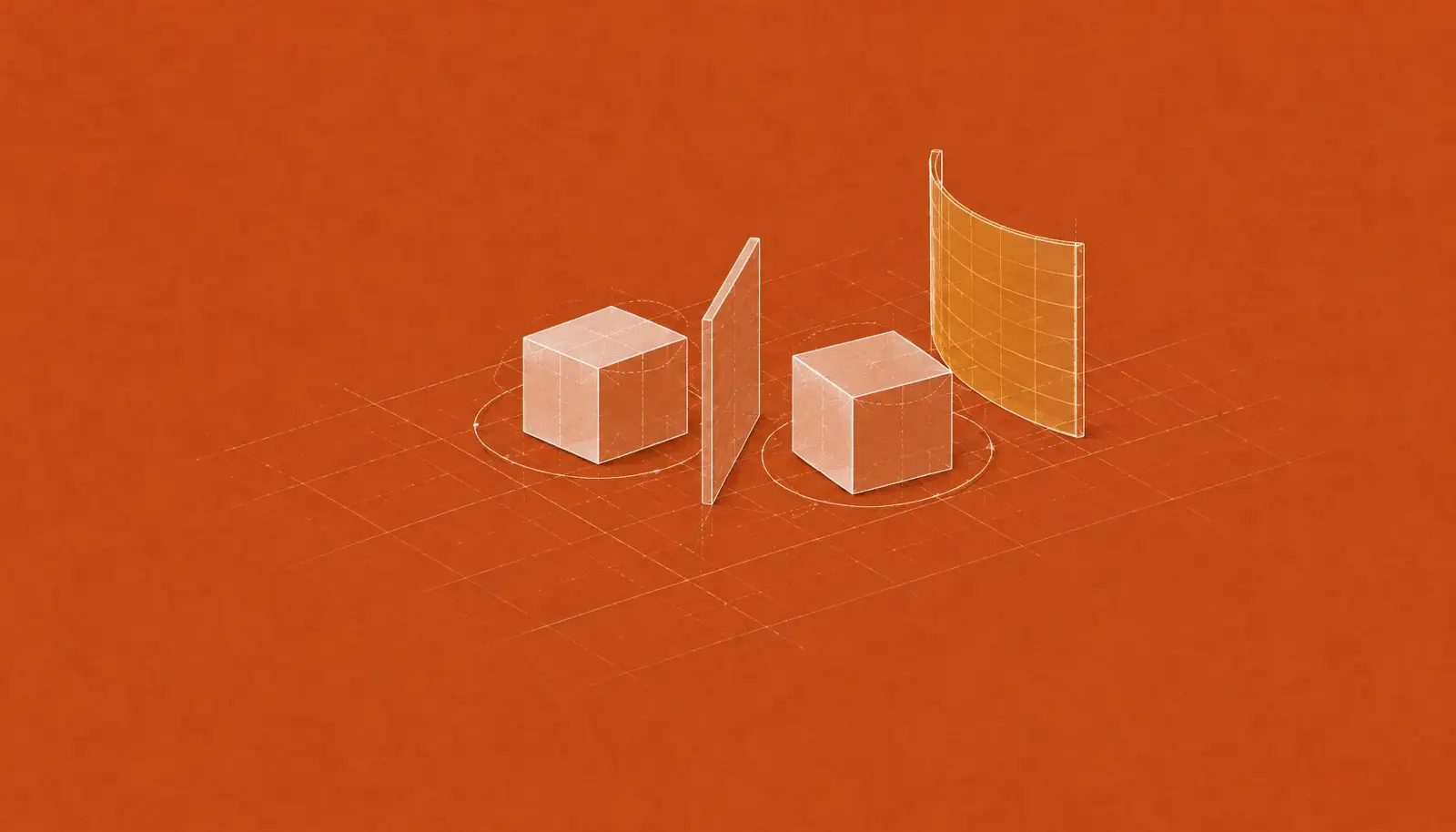
Speculative contacts target tunneling
MuJoCo 4.0.0 was released November 6, 2026, with a speculative-contact enable flag. The flag is intended to prevent fast-moving convex geoms from tunneling through thin obstacles within a single timestep. The release illustrates the feature with one step of conservative advancement between two rotating boxes.
Source github.com
Plastic deformation gains stored state
MuJoCo adds elasto-plasticity, with stateful plastic deformation stored in mjData.plastic under mjSTATE_PLASTIC. Ideal elasto-plasticity applies to joint springyield springs and spatial or fixed tendon springs. The release points to model/plastic/ for examples.
Flexes get separate yield strains
Continuum elasto-plasticity with yield applies to 2D and 3D flexes. For 2D shells, the release specifies separate stretching and bending yield strains. Its listed methods include volumetric-deviatoric (von Mises $J_2$) stretching and 2D shell bending return mapping.
Three Python packages replace one distribution
The distribution now separates into mujoco-core, with minimal bindings and a C library depending only on numpy; mujoco-studio, with Studio and Filament renderer bindings; and the default mujoco package, which installs both. For upgrades from a pre-split pip installation, the release directs users to uninstall and reinstall mujoco, or force-reinstall mujoco, mujoco-core and mujoco-studio.
The tendon side-site rule changes
A breaking change alters sidesite semantics: the tendon now follows the path from the first endpoint through the side site to the second endpoint around the geom. The previous half-plane test could make the tendon jump onto the geom, creating a discontinuity in tendon length, or select the wrong side for wraps longer than 180 degrees. The migration guidance is to place side sites so endpoints do not cross the ray opposite the side site, typically near the middle of the wrapped arc.
Engine updates affect simulation behavior
The RK4 integrator is now fourth-order accurate for orientations of ball and free joints. Previously, angular velocities from the Runge-Kutta stages were combined without the Runge-Kutta-Munthe-Kaas correction, leaving orientations to converge only at second order.
The release adds surfacevel to mjContact to store relative surface velocity in the contact frame. Collision detection populates the field from geom surface velocities when mjModel.flg_surfacevel is set; external contact generators can also write it directly. Contact-point visualization now draws one relative tangential-velocity arrow per active frictional contact.
New xiquat, geom_xquat and site_xquat fields in mjData store Cartesian quaternion orientations of body inertias, geoms and sites alongside the existing rotation-matrix fields. A new mjModel.tendon_type field, using values from the mjtTendon enum, distinguishes fixed and spatial tendons; previously, the type was implied by the first path element.
Cable plugin and composite element removed
The release removes the cable plugin in plugin/elasticity and the composite element, which are superseded by 1D flexcomp with elasticity. Its migration notes direct users to configure a one-dimensional grid or circle with flexcomp, or provide points with the direct type. They also describe replacements for cable radius, box geometry and plugin bend-and-twist settings using flexcomp and elasticity attributes.
Sources
- Original source · Release notes GitHub github.com
Related stories
- Google Shows Gemini 4 Argon Tackling Robot Tasks in MuJoCo
- Study finds MuJoCo soft-tissue models miss FEM hysteresis
- Researchers Demonstrate a Bistable Origami Robot for Multimodal Motion and Grasping in Nonuniform Magnetic Fields
- Hsu and Stone Introduce ELA Preprint for Learning Robot Policies from Video Demonstrations
- Hong and Zhang Use Human Motion Data to Train Dexterous Robots