The Floor
NVIDIA Shows AI Agents Building Omniverse Simulations
NVIDIA’s October 9 showcase details developers using frontier AI agents and Omniverse libraries to build and test simulation applications. Examples include a warehouse benchmark, robot cable routing and digital twins checked against recorded sensor data.
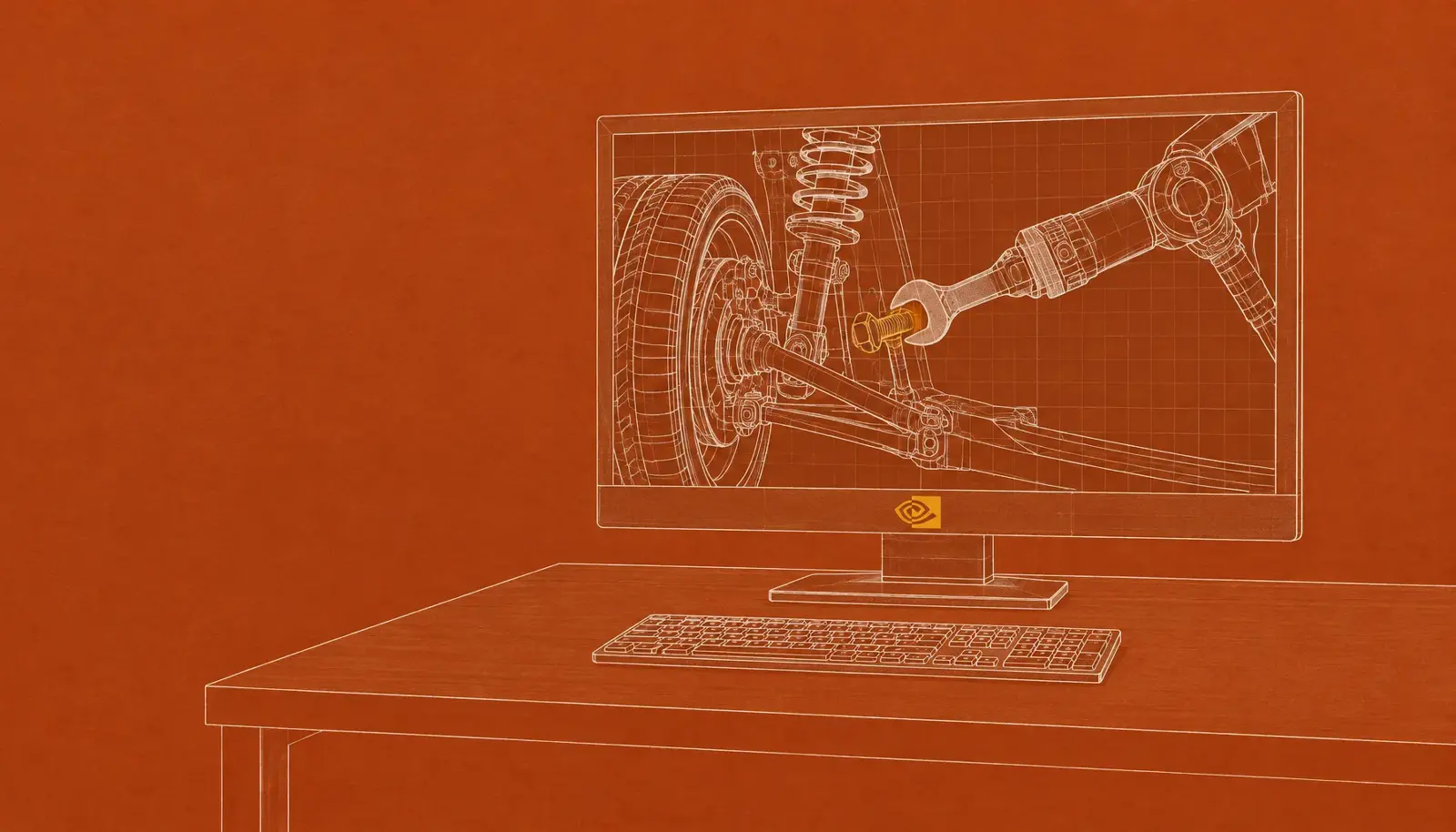
NVIDIA’s October 9 showcase puts frontier AI agents to work assembling simulation applications, testing robot behavior and refining digital twins through the company’s Omniverse libraries. The examples pair natural-language direction from developers with tools for physics, rendering, sensors and scene management. They are company demonstrations, not independent evaluations of agent performance or evidence that simulated results transfer directly to physical robots.
Warehouse tests expose a scaling limit
Bhavik Sanganee, a principal engineer at NVIDIA, used GPT-6 Astra to build a warehouse simulation and investigate performance as the scene grew. The test included robot arms, conveyors and boxes; when the scene doubled in size, performance fell below its target. Running physics calculations, image rendering and video preparation concurrently restored performance and let the simulation scale further.
At 80 conveyors, 40 arms and 800 boxes, the simulation sustained 30 frames per second at full HD resolution during a two-minute test. The robot arms completed 640 successful box placements. Doubling the scene again reduced performance, and the investigation traced the slowdown to the physics and robot-control pipeline. NVIDIA presents that result as a way to identify where an engineer should focus optimization, not as a general benchmark for other systems.
A simulated cable task keeps control in the loop
For a flexible-cable routing task, Oyindamola Omotuyi, a robotics technical marketing manager at NVIDIA, directed Astra to build a simulation using Isaac Lab, Newton physics and Omniverse rendering. A Robotiq gripper handled the cable. Astra also developed a reinforcement-learning system that combined learned routing movements with position-and-orientation feedback, then added corrective adjustments for USB-C insertion.
The simulation supplied the information used by the controller. NVIDIA identifies testing a friction-held grasp and using camera and sensor information available to a physical robot as next steps. That distinction matters: the demonstration shows a workflow for developing and testing control in simulation, while leaving those real-world checks for later.
Digital twins are checked against recorded sensors
Ashley Reid, who works on RTX sensor validation at NVIDIA, directed Astra and Claude Fable 5 agents to compare simulated camera and raw LiDAR outputs with recorded data. Over about three days, the agents created two digital twins from scratch and improved two existing ones. Their iterations addressed missing objects, geometry and materials, with acceptance guided by camera and LiDAR metrics.
The same emphasis on review appears in a project that converted an ABB Robotics YuMi CAD model into an OpenUSD asset for Isaac Sim. Developers configured joints and collision geometry, then tested both arms and grippers through four cube pick-and-place cycles using simulated contact and friction. NVIDIA says the estimated physical properties were not calibrated against the real robot, limiting what those trials establish about hardware behavior.
Simulation apps span robots, vehicles and space
Other examples extend the approach beyond manipulation. Frank DeLise, an Omniverse product manager at NVIDIA, used Astra to assemble an interactive warehouse simulator with first- and third-person views, connecting libraries for physics, scene updates, rendering and the user interface. Doyub Kim, a manager on NVIDIA’s simulation technology team, used Astra to build a reusable autonomous-driving test environment based on San Francisco’s Market Street and connect scene assets, traffic, sensor simulation and the Alpamayo driving model.
NVIDIA also describes an experimental Robo Olympics project in which simulated Unitree G1 humanoids attempted sports movements. Under developer direction, Astra built controllers that were refined through physics trials; in one experiment, a simulated robot cleared a single hurdle in 64 of 100 trials. The examples show agents helping construct workflows and examine outcomes inside simulation. They do not establish how reliably those agents can build comparable systems without developer guidance, or how well the resulting behaviors perform on physical machines.
Sources
- Original source · Blog post NVIDIA Blog blogs.nvidia.com
Related stories
- Oxford researchers report agent-designed soft robots in preprint
- Berkeley and NVIDIA pair robot coding agents with a new benchmark
- NVIDIA Opens Flora, a Three-Model Pipeline for Robot Video
- 12× Faster Robot-Planning Decoding With VFlash on Jetson Thor, NVIDIA Research Reports
- NVIDIA details SOMA tool for mapping human motion to humanoids