The Floor
12× Faster Robot-Planning Decoding With VFlash on Jetson Thor, NVIDIA Research Reports
NVIDIA Research’s VFlash framework drafts complete visual primitives in parallel for robot and driving inference, and the group reports a 5.1× robot model-pipeline speedup over autoregressive decoding in its Jetson Thor comparison.
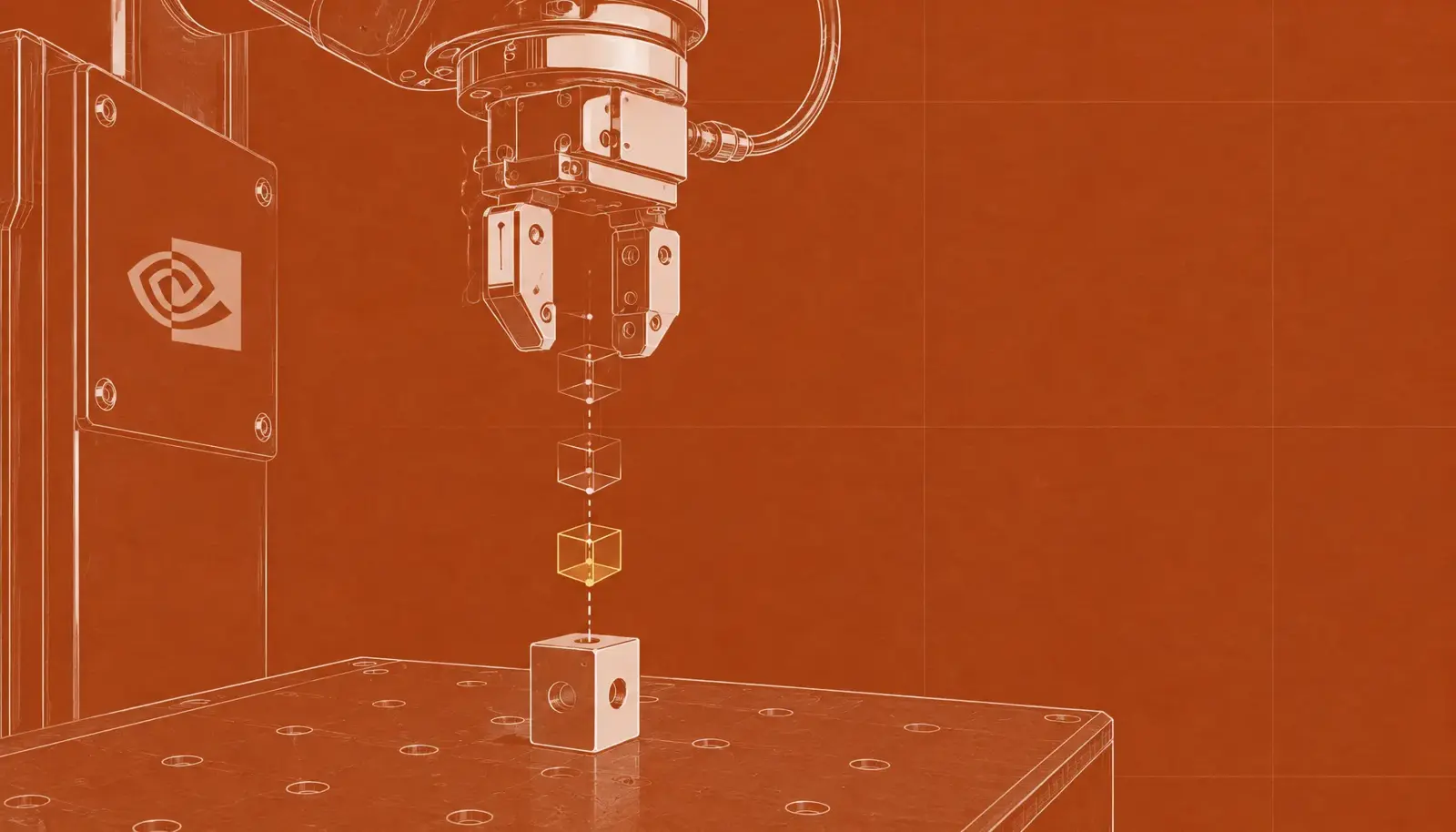
VFlash drafts complete visual primitives
Decoding for robot planning on Jetson Thor is 12× faster, NVIDIA Research reports. In a robot model-pipeline comparison, it reports a 5.1× speedup over autoregressive decoding.
VFlash is, NVIDIA Research says, a generalist decoding framework for Physical AI systems, including robots and autonomous vehicles. It uses a tool call to specify the requested output length, while the primitive type sets the coordinate layout. A lightweight drafter predicts the complete primitive in one parallel pass from frozen vision-language model features; the target model then processes the plan and extracts features for downstream action.
The method covers text and visual outputs such as points, bounding boxes, depth, and 2D or 3D trajectories. NAVSIM requires eight waypoints over four seconds, Waymo requires 20 over five seconds, and Alpamayo requires 64 over 6.4 seconds, NVIDIA says.
VFlash reduces trajectory errors relative to autoregressive decoding, NVIDIA Research reports
VFlash reduces all six trajectory-error metrics on ShareRobot-Bench and VABench-V compared with autoregressive decoding, NVIDIA Research reports. Across three robot datasets and three target variants, mean 3D displacement error decreases by 42.6% relative to the autoregressive target.
In MolmoSpaces, the VFlash system reaches a 70.2% average success rate across four suites, compared with 62.6% for the baseline and 61.0% for autoregressive plans, NVIDIA reports. The same world action model reaches 69.3% with VFlash’s 3D-only plans and 63.7% when image features replace trajectory features while retaining the generated sub-task. All variants use the same action-model architecture and training budget, NVIDIA says.
The downstream world action model receives visual-plan features through its existing cross-attention pathway and predicts 20-step action chunks, replanning every three chunks. On DAVIS, with frozen MolmoMotion-AR, VFlash reduces average displacement error by 27% and single-rollout generation is approximately 25× faster on an H100 at batch size one, according to NVIDIA.
VFlash supports boxes and sub-task text
On COCO and Dense200, VFlash delivers 2.6–2.8× more boxes per second, with mean F1 close to the autoregressive target, NVIDIA reports. Its drafter predicts all coordinates of one box in a single parallel draft, and subsequent blocks handle additional objects.
For sub-task text, VFlash uses verified 16-position blocks: one accepted anchor and 15 proposals. The target model verifies each block in one pass and retains the longest matching prefix plus its own next token. Both methods produce an identical sub-task description for the example, NVIDIA says.
Latency measurements include target-feature preparation
Robot-planning decoding is 12× faster on Jetson Thor and DGX Spark, and 11× faster on H100, NVIDIA reports. For driving, its reported speedups range from 19–42× on Thor, 22–49× on Spark, and 11–24× on H100 across NAVSIM and Waymo.
In the Jetson Thor MolmoSpaces comparison at batch size one, the robot model pipeline measures 3,552.7 milliseconds with autoregressive decoding, 1,828.4 milliseconds with DFlash, and 703.3 milliseconds with VFlash. The pipeline speedups are 5.1× against autoregressive decoding and 2.6× against DFlash, NVIDIA reports; decoding time is 3,107.6 milliseconds with autoregressive decoding and 258.2 milliseconds with VFlash.
NVIDIA’s measurements use customized TensorRT-Edge-LLM runtimes and TensorRT engines. CUDA events measure model stages, including target-feature preparation, while excluding model loading, engine building, warmup, file loading, CPU preprocessing outside the measured modules, and output detokenization. The totals are model-pipeline latency, not full sensor-to-actuator latency, NVIDIA reports.
Sources
- Original source NVIDIA Research research.nvidia.com
Related stories
- Berkeley and NVIDIA pair robot coding agents with a new benchmark
- Metatron Turns Humanoid Skills Into Editable Code
- Holoscan 5 ran a robot-arm loop at 400 Hz
- Rhoda AI Reports Higher Robot Benchmark Scores With Larger Video Models
- VICTR Preprint Reports 23.8% Success on Unseen Out-of-Domain Real-World Robot Tasks