The Floor
Holoscan 5 ran a robot-arm loop at 400 Hz
NVIDIA demonstrated a gravity-compensation loop for a Seeed Studio robot arm, with joint-state reads scheduled at 400 Hz. Published measurements from NVIDIA show lower p99.99 latency when the control partition was pinned and isolated, with results reported separately for C++ and Python.
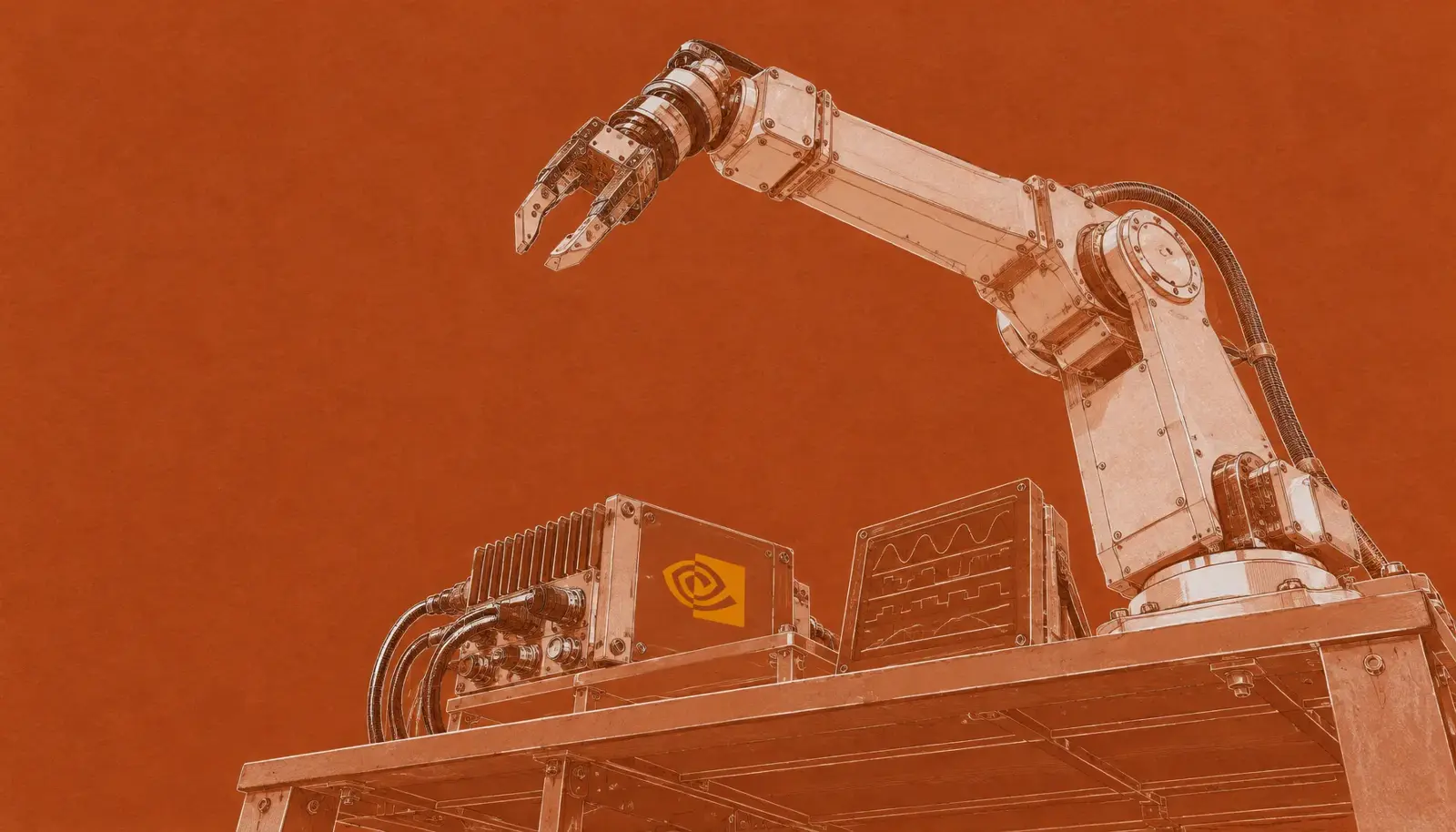
NVIDIA’s Holoscan 5 tutorial demonstrates a gravity-compensation loop for a robot arm, with joint-state reads scheduled at 400 Hz. The tutorial was published on Nov. 9 and describes a real-robot test built around the Seeed Studio reBot Arm B601-DM.
A three-part control loop
The example is intended, NVIDIA says, to let a person guide the arm by hand while its motors supply torque to support its weight. Holoscan 5 adds robotic control alongside sensor processing, using a programming model with CPU- and GPU-based execution paths.
The control graph has three operators: one reads joint state, one calculates gravity torque with Pinocchio, and one sends motor commands. The state-reading operator reads all seven motors, while Pinocchio uses the robot’s URDF model to calculate inverse dynamics. The walkthrough was tested on Jetson Orin Nano, Jetson Thor and x86 Ubuntu 24.04 systems, NVIDIA reports.
Keeping the path current
The three operators run in one partition on a single runtime-owned thread, avoiding thread handoffs between reading state, calculating torque and sending commands, according to NVIDIA. The example uses depth-one, drop-oldest queues so older samples do not accumulate. The graph is compiled and checked before the motors are enabled.
The motor-command helper rejects expired, out-of-order or out-of-range commands before sending them. A watchdog attempts to disable the motors and stop the graph if no command batch completes for 100 milliseconds; the operator’s shutdown callback also disables the motors.
Latency measurements
NVIDIA’s latency comparison retained more than one million cycles per run and measured the pipeline from its first operator to its last, excluding motor-command transmission. For the pinned C++ run, NVIDIA reports p99.99 latency of 17.2 microseconds, compared with 86.6 microseconds when unpinned. For Python, the corresponding p99.99 figures were 142.6 microseconds pinned and 1,373.5 microseconds unpinned.
Pinning plus isolation reduced observed p99.99 latency by roughly 5× for C++ and 9.6× for Python, NVIDIA says. The sequential, profiled runs excluded the first ten seconds and retained latency outliers. The measurements used a temporary Linux cgroup to reserve two physical cores, including their SMT siblings, from other applications; interrupts, timers and some kernel threads could still run on those cores, NVIDIA notes.
Beyond gravity compensation
NVIDIA attributes extra Python overhead to interpreter execution, object allocation and GIL coordination around Pinocchio and the Holoscan runtime. The tutorial repository also includes a Python example with kinematics and impedance control as reusable Holoscan operators. Gravity compensation is described by NVIDIA as a foundation for further work, including hand-guided teaching, teleoperation and manipulation, with NVIDIA saying perception can be added with Holoscan’s vision module and components from NVIDIA Isaac ROS.
Sources
- Original source · Blog post NVIDIA Technical Blog developer.nvidia.com
Related stories
- Berkeley and NVIDIA pair robot coding agents with a new benchmark
- 12× Faster Robot-Planning Decoding With VFlash on Jetson Thor, NVIDIA Research Reports
- NVIDIA Opens Flora, a Three-Model Pipeline for Robot Video
- NVIDIA details SOMA tool for mapping human motion to humanoids
- Metatron Turns Humanoid Skills Into Editable Code