The Floor
RageVLA preprint reports stronger LIBERO-PRO results with 0.21B parameters
A preprint reports that RageVLA scored 0.72 on LIBERO-PRO, compared with 0.53 for the best published VLA policy in its comparison. The system combines rearranged training demonstrations with explicit object-position inputs, and its reported evaluations were all in simulation.
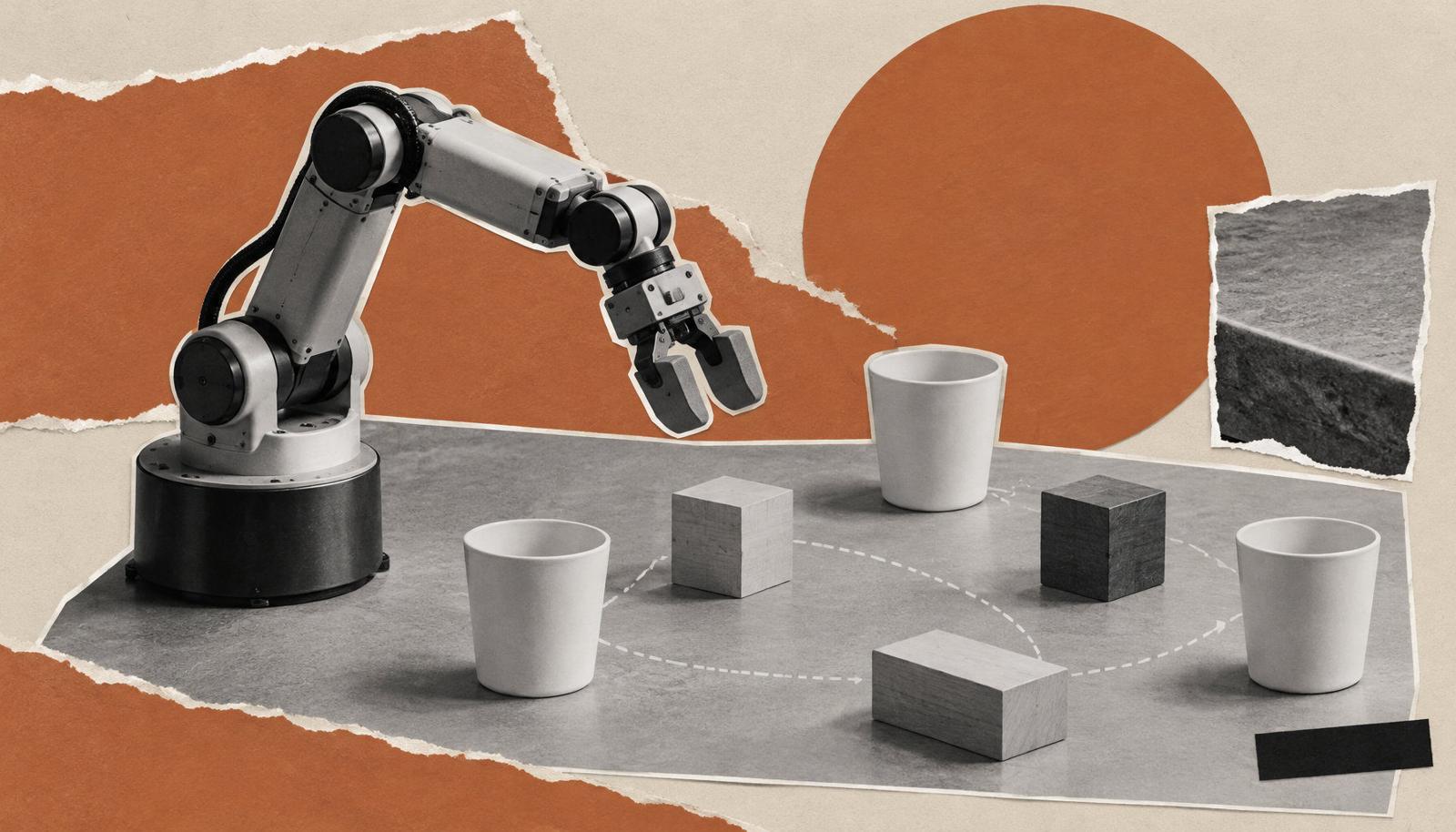
Results on a tougher benchmark
A 0.21-billion-parameter vision-language-action policy scored 0.72 on LIBERO-PRO, against 0.53 for the best published VLA policy in the comparison, according to a preprint introducing RageVLA. The paper, submitted to arXiv on November 17, reports that a larger version reached 0.73.
The results concern a benchmark designed to test changes to object positions, instructions and environments, among other factors. The authors report that RageVLA’s gains were concentrated in tests that moved objects or changed tasks; they say its results on object appearance and instruction wording were comparable to, but not better than, existing policies.
Varying the demonstrations
RageVLA’s training process rearranges objects and fixtures, moves tasks into other LIBERO environments and onto different surfaces, and paraphrases task instructions. The paper reports a training set of 132,610 generated trajectories, comprising 2.79 million samples. Those trajectories were generated from LIBERO’s human demonstrations, which the paper describes as 50 demonstrations for each of 130 tasks.
The policy also separates visual inputs instead of asking the action model to infer the entire scene from image tokens. Its perception system supplies object classes and positions, along with a compact representation of what is visible near the gripper; a separate image embedding and an instruction embedding provide additional inputs. A flow-matching diffusion transformer, trained from scratch, produces actions from those signals.
Position tests
The authors evaluated the systems across LIBERO-PRO’s four suites and report 12,000 episodes for the main protocol. They compared RageVLA with published leaderboard results, including the 3.3-billion-parameter pi0.5, which scored 0.53 overall. The paper reports that RageVLA’s smaller s1 version scored 0.94 in the position-perturbation column for LIBERO-Object, compared with 0.17 for pi0.5.
In a separate 200-episode LIBERO-Object test, the researchers shuffled the object positions given to RageVLA while leaving camera images unchanged. The authors report that its success rate fell from 0.965 to 0.215 in the original layouts. They also tested graded displacements of the target object: at 28 centimeters along the x axis, RageVLA s1 succeeded in 0.865 of episodes, while pi0.5 succeeded in 0.105 under the same evaluation harness.
Simulation scope
The authors say RageVLA was trained on 130 simulated tasks and that all reported results are in simulation. They note that the system does not handle goals outside its training distribution, its object detector is limited to LIBERO’s object and fixture classes, and the perception components rely on simulator labels and known camera calibration.
Sources
- Original source · Preprint RageVLA: Augmentation-Trained Perception and Action for State-of-the-Art Robustness on LIBERO arXiv:2611.23517
Related stories
- FoRe preprint reports gains in robot grasp recovery
- Preprint reports gains from training robot policies on action gaps
- CoRA-VTLA preprint adds tactile memory to robot manipulation
- LaST1.0 preprint reports stronger manipulation results in simulation and hardware tests
- GTI raises reported success in long-horizon robot tasks