The Floor
Rendezvous Robotics Raises $20M for Self-Assembling Spacecraft
Rendezvous Robotics raised $20 million to develop spacecraft tiles designed to assemble and reconfigure in orbit. Its planned 2028 flight demonstration will test seven independently deployed tiles after a separate 32-tile experiment aboard the International Space Station.
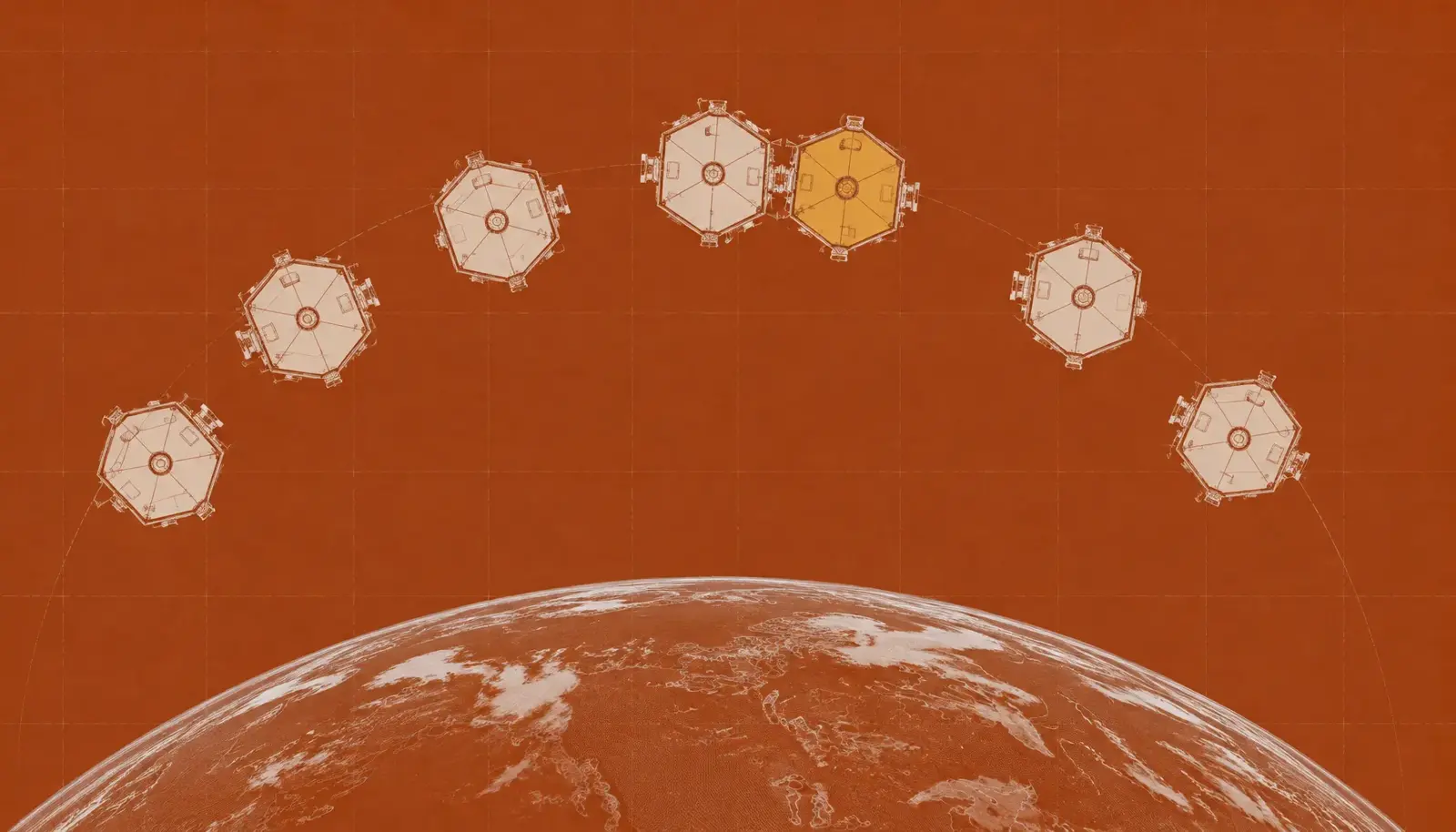
Rocket fairings set the dimensions of spacecraft built on Earth; Rendezvous Robotics wants to assemble larger structures after launch. The Golden, Colorado, company announced on October 28 that it raised $20 million in an oversubscribed seed round to develop modular spacecraft tiles that maneuver, align and connect in orbit. Its proposed free-flying demonstration is not scheduled before April 2028, leaving the company years of testing before it can show that the approach works beyond a controlled experiment.
Source prnewswire.com
Build for the fairing—or assemble beyond it
Conventional spacecraft must fit inside the rocket fairing that carries them to orbit. Rendezvous argues that constraint forces choices about power generation, computing capacity, antenna size and heat dissipation before a mission begins. Its alternative is to launch compact, independent tiles and join them in space, with the option to reconfigure the resulting structure after launch.
The company’s plan puts the burden on autonomous movement and connection: rather than deploy one large spacecraft, separate modules must find one another and assemble without external robotic assistance. Rendezvous says the system could let operators add capabilities or change a craft’s physical arrangement as mission needs shift. Those are proposed uses, not results the company says it has already demonstrated with its next-generation, free-flying spacecraft.
Seven tiles are planned for the 2028 test
The announced low-Earth-orbit mission will send seven independently deployed tiles to assemble into one spacecraft, separate, then join again in a different configuration. Rendezvous says it has reserved a rideshare for a launch no earlier than April 2028. Before that flight, a planned parabolic-flight campaign in November 2026 is intended to test electromagnetic actuation and mobility in microgravity.
A separate experiment is scheduled for December 2026 aboard the International Space Station. It will use 32 fifth-generation TESSERAE tiles to form a three-dimensional structure in a controlled microgravity environment. The company describes that experiment as the final ISS demonstration of the earlier TESSERAE research program; the later seven-tile mission is designed to test assembly in free space.
TESSERAE moves from research toward flight
Rendezvous traces its technology to TESSERAE, a modular self-assembly system invented by Ariel Ekblaw at MIT and later developed through the Aurelia Institute, which she founded. The company says earlier generations flew aboard Blue Origin’s New Shepard and on two International Space Station missions. The new funding will support development of larger, independently operating tiles, flight demonstrations and hiring.
“The vision behind TESSERAE was never simply to connect tiles in space. It was to rethink how we build beyond Earth,” said Dr. Ariel Ekblaw, co-founder and board chair of Rendezvous Robotics. Dr. Ariel Ekblaw, Co-Founder and Board Chair, Rendezvous Robotics
MaC and Toyota lead the $20 million round
MaC Venture Capital and Toyota Ventures led the oversubscribed seed financing. Other backers include the University of Michigan Endowment, Astera, Industrious Ventures and existing investors Aurelia Foundry, ATX Venture Partners and Mana Ventures. The company called the financing its first priced funding round but did not disclose a valuation in the announcement.
The next milestones are specific: a parabolic-flight campaign in November, the 32-tile ISS experiment scheduled for December, and the seven-tile free-flying demonstration no earlier than April 2028. The first two tests target components of the system in microgravity; the 2028 mission is intended to show the tiles assembling and changing configuration on their own in orbit.
Sources
- Original source · Press release PR Newswire prnewswire.com
Related stories
- NASA and Google Test a Deep-Space Medical-Support Robot
- AstroBench Records 6 Captures in 400 Generalist-Policy Trials
- Foundry Robotics Raises $100M for Its Emeryville Assembly Factory
- Bedrock Robotics Raises $600M to Expand Autonomous Excavators
- Wonik Robotics commits 100 billion won to Wanju production hub