The Floor
Researchers propose FloCOS for tighter vehicle occupancy forecasts
An arXiv preprint introduces FloCOS, a method for predicting surrounding vehicles’ future occupied areas as compact sets for use in motion planning. In tests reported by its authors, it reached 99.3% occupancy coverage at two seconds and an 85.6% interaction completion rate across 1,000 Waymo Open Motion Dataset scenarios.
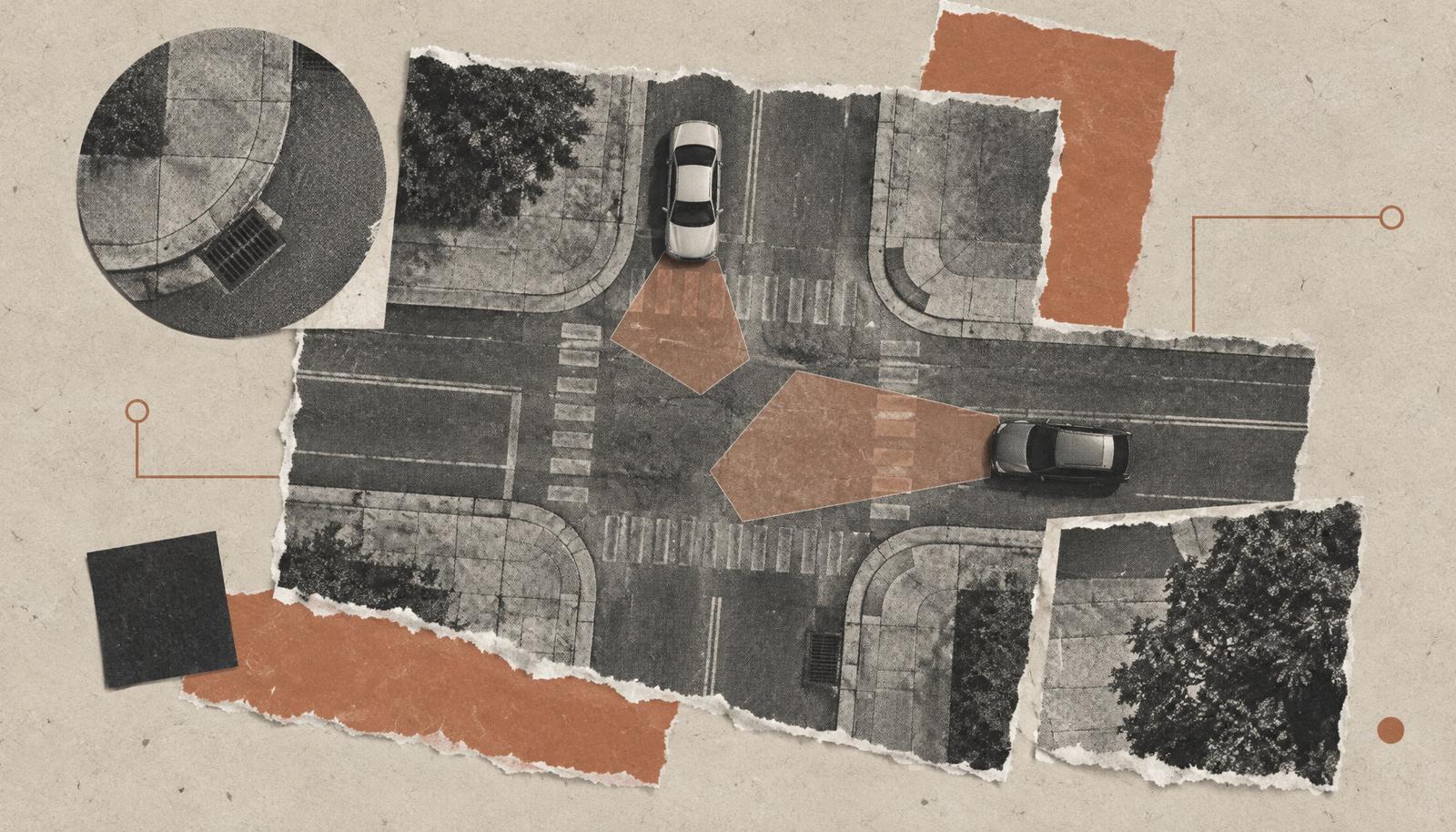
Forecasting occupied space
A new arXiv preprint proposes FloCOS, a method for forecasting the space surrounding other vehicles and passing those predictions into a motion planner. The six authors report that its predictions achieved high coverage while supporting a higher interaction completion rate than the evaluated baselines. The paper was posted on November 11, 2026.
The paper frames the task as balancing two errors: a forecast can miss space a vehicle later occupies, or cover so much space that a planner cannot find a route. FloCOS represents future occupancy as a changing union of half-space convex polygons, with their geometry described by temporal basis coefficients. Conditional flow matching models how those components evolve over time. Training combines that process with losses that penalize missed occupancy and excess area.
The approach is intended to keep distinct possible vehicle positions separate rather than enclosing them in one convex region. For planning, the predicted nonconvex union goes directly into hyperplane-based collision-avoidance constraints, according to the paper.
Dataset results
The authors trained and evaluated the predictor using the Waymo Open Motion Dataset, with 197,464 training windows, 13,984 development windows and 1,000 test scenarios. Each configuration predicts two seconds ahead in 0.1-second intervals, using one second of observed history. For planning tests, an ego vehicle was placed in each scenario while background vehicles replayed their recorded trajectories without reacting to it.
In the reported 1,000-scenario test, FloCOS recorded 99.7% occupancy coverage at one second and 99.3% at two seconds. Its mean area ratio was 1.70 at one second and 3.10 at two seconds; the ratio compares predicted area with ground-truth occupancy area. The interaction completion rate was 85.6%, with a reported 95% Wilson confidence interval of 83.3% to 87.6%.
The paper’s comparison with DOS-Ellipse found 98.8% coverage at two seconds, an area ratio of 3.98 and 59.1% completion for that baseline. MTR-GMM + FORCE-OPT recorded a higher completion rate than most baselines, at 85.2%, but its two-second coverage was 69.7%. The authors report that FloCOS had the highest completion rate among the evaluated methods, while noting that completion and occupancy coverage are separate measures.
Physical trials
The authors also tested FloCOS on two ROSMASTER mobile robots in a head-on encounter and a lateral cut-in scenario. The predictor ran onboard the ego robot in real time; the other robot followed a prescribed path and broadcast its ground-truth pose, allowing prediction and planning to be assessed independently of perception noise. The setup scaled positions, dimensions, map geometry and velocities before model inference, then scaled the predicted sets back to the physical workspace.
The paper reports that the planner completed both interactions: in the head-on case, the ego robot moved out of the conflict region, passed the other robot and returned toward its lane; in the cut-in, it yielded before continuing toward its goal. Matched simulations without FloCOS prediction sets, replaying the recorded paths, produced collisions in both scenarios, according to the authors. The paper lists extending the method to other traffic participants and conducting larger-scale real-world evaluation as future work.
Sources
- Original source · Preprint FloCOS: Predicting Compact Forward Occupancy Sets of Surrounding Vehicles via Conditional Flow Matching arXiv:2611.15488
Related stories
- Ego2Flow preprint ranks rule-based driving above learned policies
- Preprint finds hand-written planners beat UniAD in some tests
- Autoware 2.0 Adds AI Planning Alongside Rule-Based Driving
- RaMOD preprint reports moving-object detection from radar cubes
- Preprint refines driving policies with human takeover data