The Floor
SwapBot Raises Tofu-Task Success from 35% to 60%
SwapBot pairs interchangeable household tools with tactile sensors, helping a robot perform contact-rich tasks such as brushing, gripping and cutting. In a reported tofu-cooking task, the system achieved a 60% success rate, compared with 35% for an RGB-only policy.
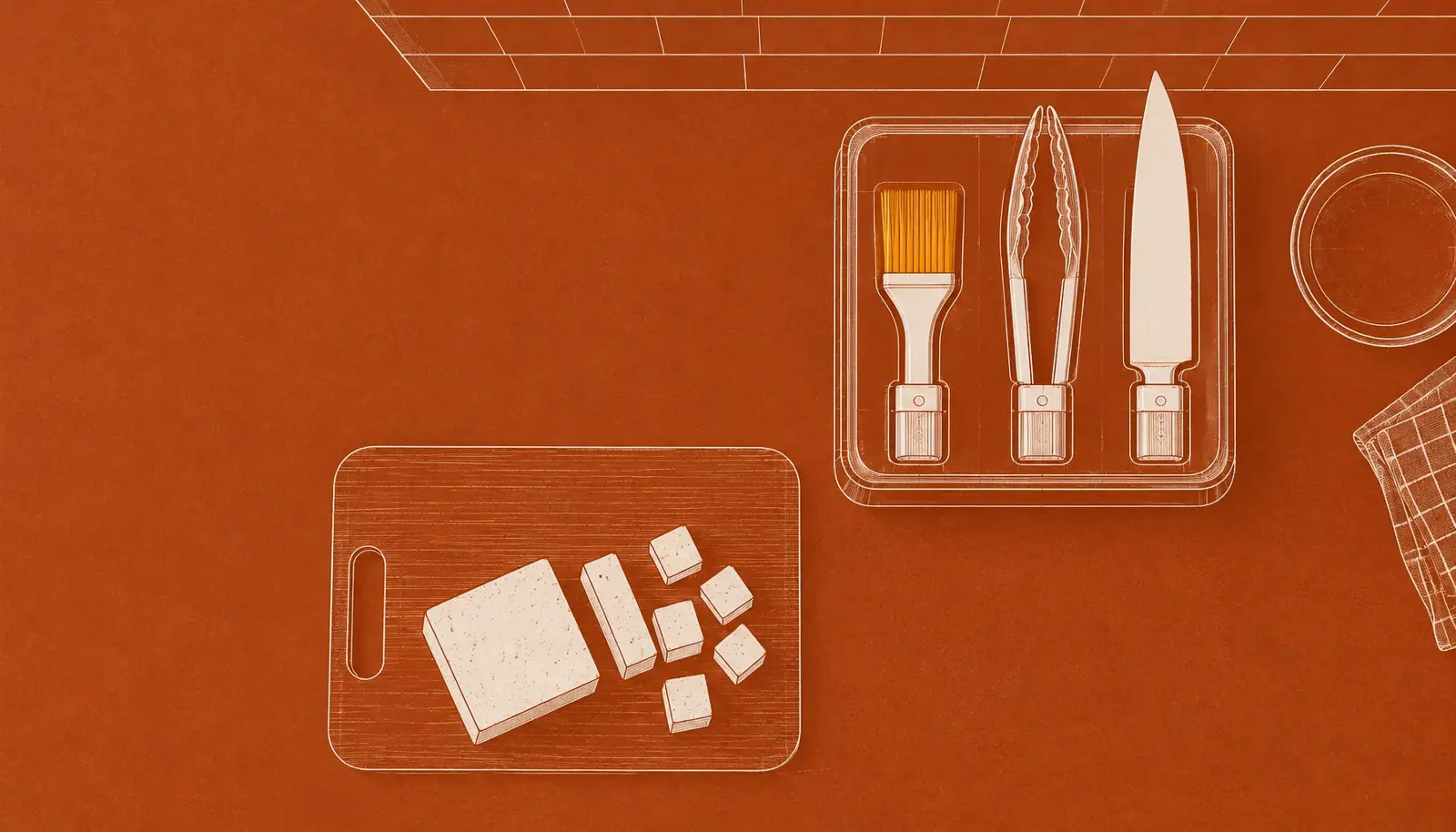
SwapBot completed a multi-stage tofu-cooking task in 60% of 20 trials, compared with 35% for a policy trained on RGB images alone, according to a University of Washington paper posted October 29. The system pairs interchangeable household tools with tactile sensors, giving a robot more information about contact while it brushes, grips and cuts. The result is a 25-percentage-point gain in the reported whole-task success rate—not a claim that the setup can cook reliably in an unstructured home kitchen.
Source arxiv.org
A tool dock instead of a universal hand
SwapBot takes a tool-first approach: rather than asking one complicated gripper to perform every motion, the system lets a robot exchange task-specific tools. A fixed robot-side hub mates with low-cost adapters fitted to items such as brushes, knives, forks, spoons, tongs and chopsticks. The researchers tested the setup with Franka, UR5 and Tycho robot platforms.
A self-aligning electromagnetic coupling and guided gear secure the attachment, including for articulated tools such as tongs. To change tools, the robot visits a docking station, releases the current attachment and picks up another; the paper reports a swap time of about 10 seconds. The authors put the 3D-printed interface at about $10 per tool, with a shared robot-side electromagnet system costing $20.
Each adapter carries custom piezoresistive sensors made with Velostat, a force-sensitive material, between conductive fabric electrodes. Depending on the tool, sensors sit on the handle and on a blade or tip; thin tools such as brushes and chopsticks are instrumented at the handle, so their contact with an object is measured indirectly. The sensors report normal pressure, while live visual overlays let a teleoperator see contact forces and changes in load.
Touch helps where the camera loses contact
The researchers collected demonstrations through a teleoperation interface that pairs familiar “leader” tools with their robot counterparts. For articulated tools, sensors track the operator’s hand movements to control opening and closing. The system synchronizes camera images, tactile readings, robot state and actions at 20 Hz for policy training.
In a study of 12 participants, the team compared a general VR-style controller with SwapBot, both with and without its visualized tactile feedback. Participants performed brushing and cutting tasks. The paper reports higher success rates, shorter completion times and lower subjective workload with SwapBot than with the general controller; its results are from this controlled study, not a test of household users in a kitchen.
The paper’s authors write:
“Our ablation study shows that using tactile-augmented demonstrations improves policy performance across contact-rich skills, increasing success rates by 15 to 25 percentage points over RGB-only policies.”
Yunchu Zhang et al., authors of “SwapBot: Tool-Centric Robot Manipulation via Interchangeable End-Effectors and Tactile Sensing.”
The full cooking sequence still fails four times in ten
For the autonomous task, SwapBot combines a high-level tool selector with separate learned controllers for each tool. The selector achieved 96.8% classification accuracy on its test set. The task sequence, however, depends on subgoal images specified by a person before the run; the system does not decide for itself how to break down a cooking task.
Across 20 whole-task rollouts, chaining the best-performing tool-specific policy checkpoints produced a 60% average success rate, against 35% for the RGB-only comparison. The authors attribute most failures to tofu slipping or to states absent from the demonstrations. They also describe a recovery behavior in which the robot re-approaches tofu after it is pushed away, but only within the situations covered by its training.
Those figures sit alongside stronger results on individual skills: the full RGB-and-tactile method reached up to 85% success in brushing, 70% in tong picking and 90% in knife cutting. The paper labels the table behind those skill comparisons as single-seed results; additional seeds and significance testing were reported for the RGB-only and full-method comparison. Whole-task performance is lower because the system must chain tool selection and multiple learned actions, any of which can fail.
Sensor wear and manual sequencing remain limits
The authors identify low sensor resolution, wear and human-chosen sensor placement as hardware limitations. The current policy pipeline also relies on manually defined task segmentation and subgoals. They say future work will examine more durable, higher-resolution sensors, data-driven placement and autonomous sequencing.
For now, SwapBot demonstrates a modest but tangible trade: inexpensive adapters and contact sensing help a robot manage tools that a simple gripper struggles to control, while the complete cooking sequence succeeds in three of every five trials. The remaining failures—and the need to specify the sequence in advance—mark the distance between a working lab demonstration and a robot that can take over an open-ended kitchen task.
Sources
- Original source · Preprint arXiv arXiv:2610.40646
Related stories
- Bimanual CTR Raises Worst-State Success from 56% to 76%
- Hsu and Stone Introduce ELA Preprint for Learning Robot Policies from Video Demonstrations
- UniLatent preprint tests robot-to-robot transfer in simulation and on arms
- HKUST’s EmArm Spreads Touch Sensing Across 71,000 mm² of Its Arm
- Preprint models how imitation policies discount noisy object readings