The Floor
Researchers propose vision method to estimate terrain before contact
A research team has proposed a method that combines images with past interactions to estimate terrain properties before contact. Tests included autonomous racing in simulation and predictions using recorded data from a real vehicle.
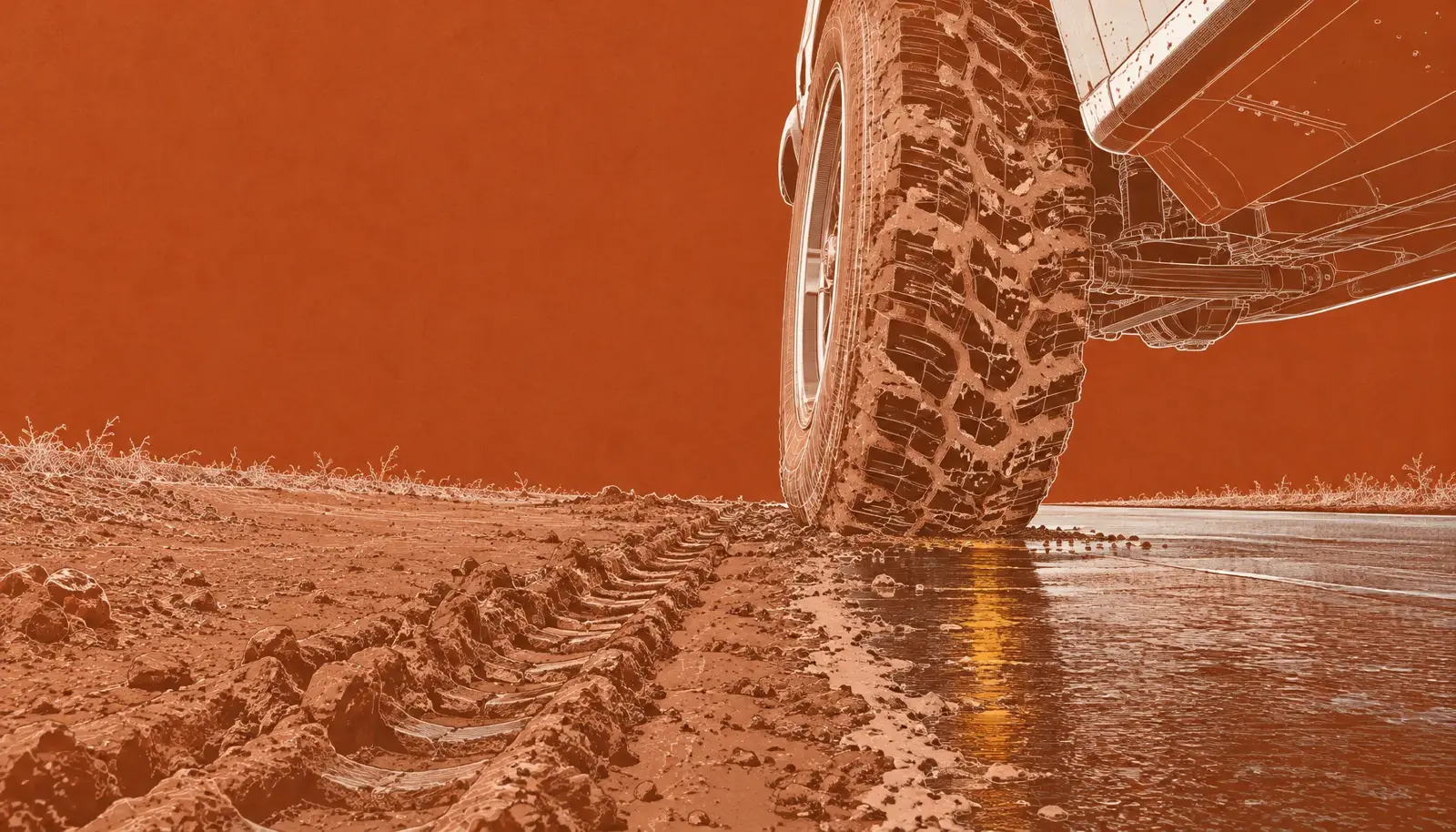
Researchers have proposed a vision-based method that uses evidence from past interactions to estimate terrain properties before a robot or vehicle makes contact. The November 6 preprint describes tests in which the method was used for autonomous racing in simulation and for predictions based on recorded data from a real vehicle.
Source arxiv.org
The authors are Alexander Borca-Tasciuc, Prayag Sharma and Franck Djeumou of Rensselaer Polytechnic Institute. The team tested the approach through simulation experiments and a real-vehicle parameter-prediction experiment.
Using experience to interpret a view
The authors say vision alone can leave physical properties ambiguous: surfaces that look similar may behave differently when touched. Their method combines a visual representation of a region ahead with estimates derived from previous interactions, rather than assigning the region to a fixed terrain class and giving it a single estimate.
Each past interaction is stored with an uncertain estimate of a physical parameter and a visual embedding of the region where it was observed. For a new region, the estimator retrieves and weights past estimates according to the similarity of their visual embeddings.
The authors say keeping the estimates as separate components allows the resulting distribution to represent more than one possible physical regime. When there is little relevant history, the method blends the retrieved information with a conditional prior model. The researchers also trained a refinement of the visual embeddings to improve retrieval of relevant interactions.
Tests on simulated surfaces
In one simulation experiment, a vehicle followed a fixed route across grass, dirt and concrete. The team compared its estimator with a semantic-property baseline, including a case in which concrete had both high-friction dry areas and low-friction areas covered by black ice.
The paper reports that the proposed estimator recovered both concrete friction regimes, while the baseline captured the high-friction mode but missed the low-friction one. The baseline received ground-truth region boundaries for the experiment; the proposed estimator retrieved individual interaction estimates from a visual query instead.
The team also tested control on a simulated oval track with high-friction asphalt and an unknown low-friction icy segment. The researchers report that across nine complete traversals of the same 200–300 meter low-friction segment, traversal time fell from 9.304 ± 0.316 seconds to 8.135 ± 0.007 seconds, a 12.6% reduction. The comparison was with a controller that used a generative prior without updating tire parameters from interaction.
In the racing setup, the controller used the mean of the estimated distribution at points ahead to parameterize its tire-force model. Newly traversed regions supplied interaction measurements for later planning.
Recorded vehicle data
The researchers also evaluated vehicle-motion prediction using recorded grass trajectories from an autonomous off-road vehicle. They added image and measurement pairs from a separate concrete run as distractors and compared simulated trajectories with the recorded path under recorded controls.
The paper reports that mean per-particle average displacement error over the prediction horizon fell from 0.737 to 0.628 meters as interaction evidence accumulated across 18 measurements. The authors note that closed-loop adaptation was evaluated in simulation, whereas the real-vehicle experiment assessed prediction under recorded controls. The work was supported by Toyota Research Institute.
Sources
- Original source · Preprint Beyond Semantic Classes: Online Physical Parameter Estimation via Embedding-Conditioned Gaussian Mixtures arXiv:2611.10107
Related stories
- Robot view-selection method improves coverage in helmet test, paper says
- Preprint tests robot navigation with uncalibrated external cameras
- BeyondEgo raises humanoid task success in simulation, preprint says
- RaMOD preprint reports moving-object detection from radar cubes
- Under evaluated conditions, a second viewpoint lowers mean per-joint position error from about 97 to 65 mm