The Floor
Robot view-selection method improves coverage in helmet test, paper says
A sensor-aware view-selection method reached 98.4% coverage of a reflective helmet in four captures, researchers report. The comparison method reached 97.5% after ten captures in the same experiment.
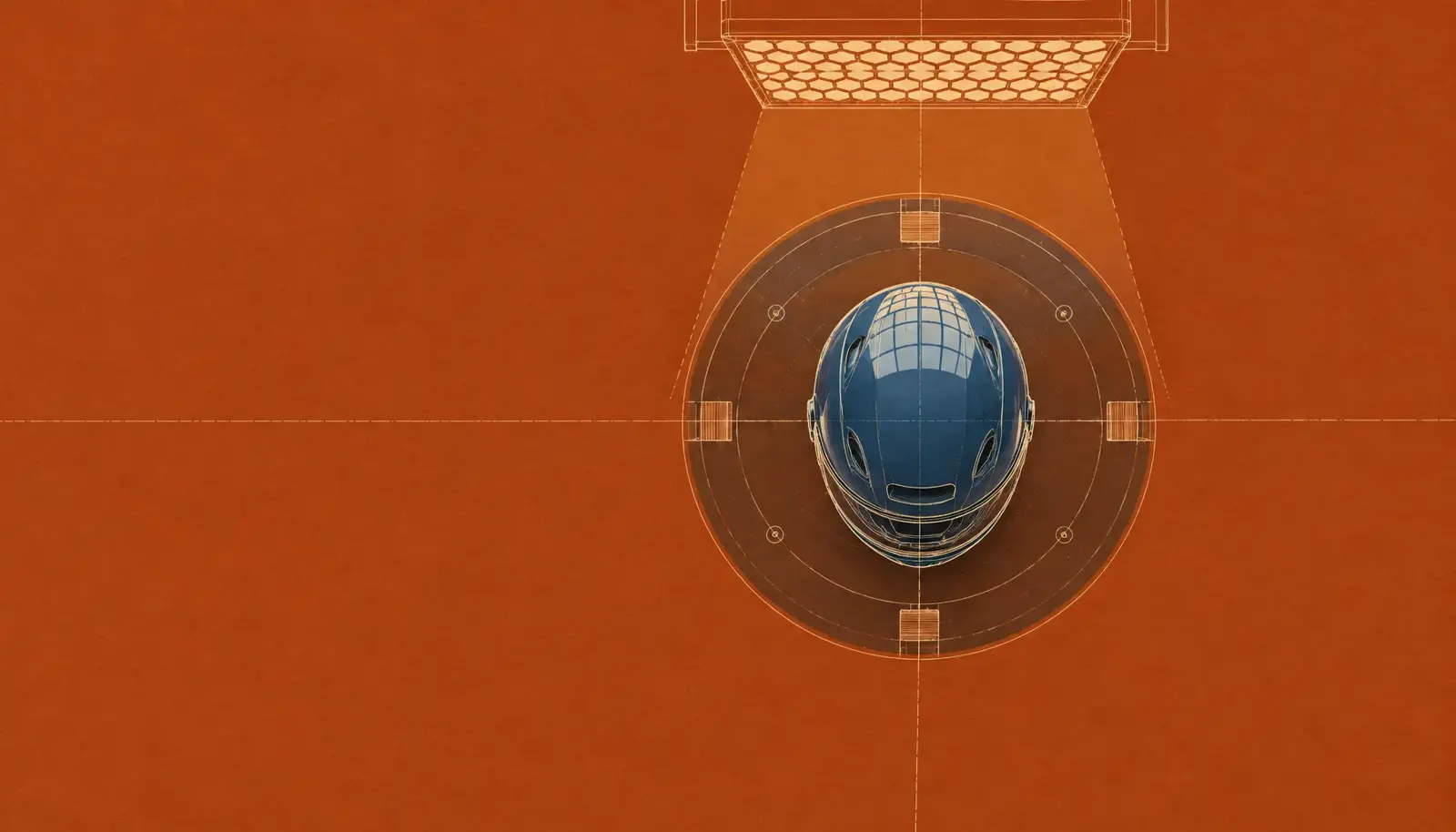
A robot using a sensor-aware view-selection method measured 98.4% of a reflective helmet’s surface in four captures, researchers report in a new preprint. Without the sensor-aware filter, the comparison method reached 97.5% after ten captures and missed the 98% target.
Source arxiv.org
The paper, by GrayMatter Robotics researchers Nikita Sarawgi, Omey M. Manyar and Satyandra K. Gupta, describes a way to adapt a pretrained predictive model to a particular sensor’s behavior. It was submitted on November 9 and accepted to the CoRL 2026 workshop “Do Robots Need World Models?”
Accounting for missed measurements
The work addresses next-best-view selection: choosing where a sensor should look next to add measurements to a three-dimensional reconstruction. A surface can be visible from a candidate position yet fail to produce valid depth data under the sensor’s operating conditions.
The proposed method keeps the pretrained predictor fixed and adds an adapter trained on local calibration data. The adapter estimates where measurements are likely to drop out, allowing the selection process to favor views expected to yield usable measurements of surfaces not yet captured.
Its estimates use viewing distance, incidence angle and normalized image intensity. Candidate views are scored by the amount of previously unmeasured surface expected to remain after points with a high predicted dropout probability are filtered out.
Helmet scan comparison
The experiment used a FANUC M-710iC robot and a Zivid 2+ LR110 structured-light sensor to scan reflective helmets. The team trained the adapter using 50 captures of four helmets, then tested it on a held-out blue helmet under fixed robot, lighting and sensor settings.
The adapted method rejected predicted points with a dropout probability above 20%; the nominal method scored predicted new coverage without that filtering. Both methods began with the same context images, candidate poses and acquisition rule, and used the same fixed predictive models.
The comparison ran each method once, stopping when it reached the coverage target or after ten captures. Coverage was calculated from measured points against a reference scan of the blue helmet; the capture counts excluded context acquisitions.
After four captures, the nominal method had reached 95.8% coverage, the researchers report. Its reconstruction retained a gap near the helmet’s lower edge after ten captures, while the adapted method recovered that region.
Limits of the test
The researchers used FrameCrafter to predict appearances at candidate views and Depth Anything 3 to infer geometry. Predicted points were used to score possible views; the reconstruction itself contained physical sensor measurements.
For this experiment, however, the team used depth projections from the reference scan because the predicted depth needed further alignment to prevent small geometric offsets from inflating voxel-based coverage gains. Calibration also depended on reference surfaces.
The evaluation covered an object from a class of geometrically similar parts under fixed sensing conditions. The authors say further work is needed to establish when changes in materials, sensors or lighting require updates to the adapter.
Sources
- Original source · Preprint Incorporating World Models in Decision Making for Next Best View Selection in Active Sensing arXiv:2611.13229
Related stories
- Researchers propose vision method to estimate terrain before contact
- RaMOD preprint reports moving-object detection from radar cubes
- Under evaluated conditions, a second viewpoint lowers mean per-joint position error from about 97 to 65 mm
- NTT says physics-based model improved robot shelf-loading test
- Paper reports 3.8 ms refinement for robot policies in simulation