The Floor
WPI Reports ActivePusher Matches Accuracy With 45% Less Data
WPI reported that ActivePusher matched a randomly trained neural-network baseline’s final prediction accuracy using 55 percent of the training data on average. The system combines a simplified physics model, learned corrections and uncertainty-guided choices for data collection and planning.
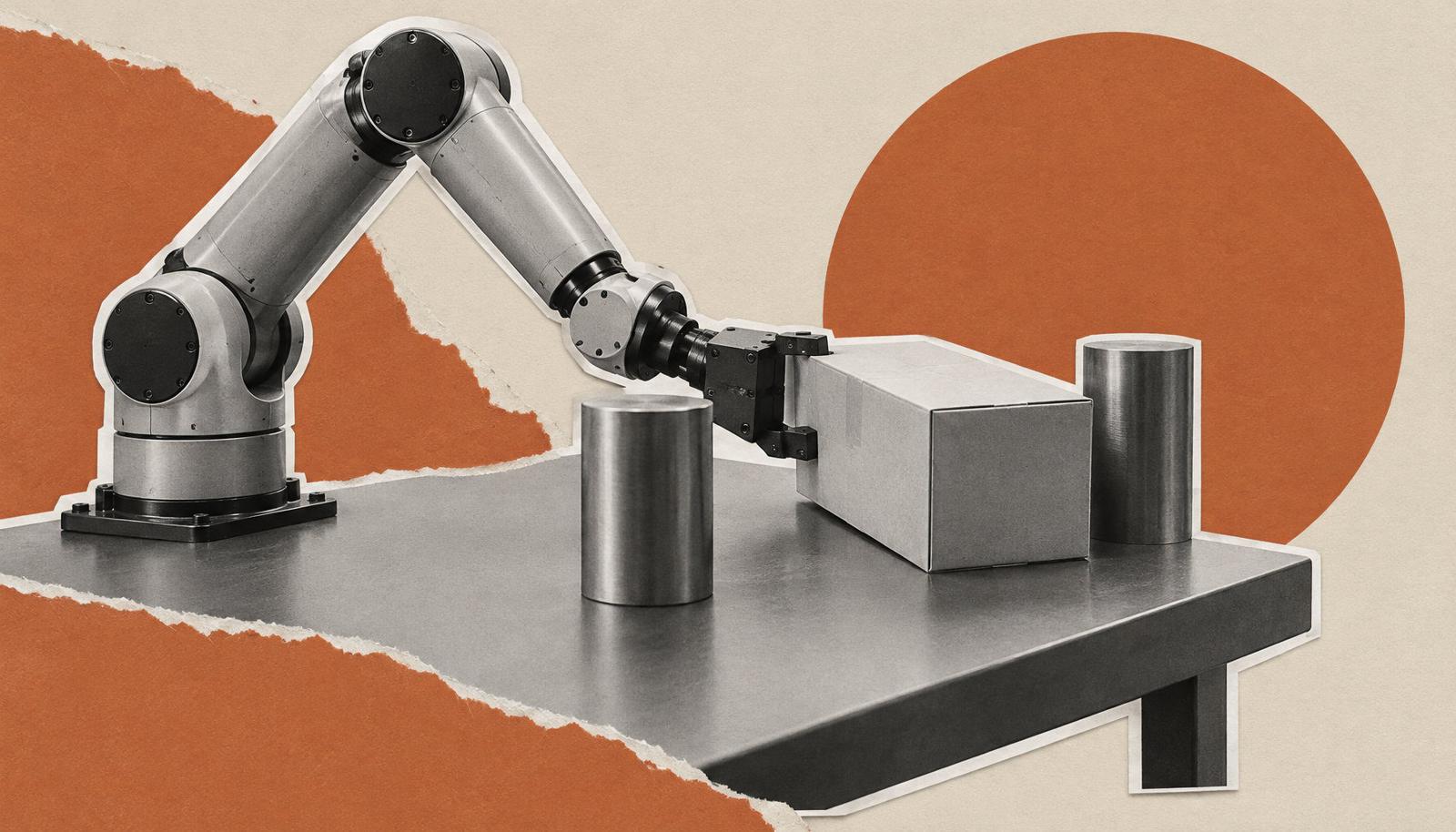
ActivePusher matched the final prediction accuracy of a randomly trained neural-network baseline while using 55 percent of its training data on average, a 45 percent reduction, according to the study. Worcester Polytechnic Institute said on November 20, 2026, that the work had received the Best Student Paper Award at ICRA 2026 and had also been a finalist for the conference’s Best Paper Award on Planning and Control.
Learning from selected pushes
Developed by robotics engineering PhD students Zhuoyun Zhong and Seyedali Golestaneh with assistant professor Constantinos Chamzas, the method addresses nonprehensile manipulation: moving an object by pushing it rather than holding it in a grasp. It begins with a simplified physics model of how an object will move, then uses a neural network to learn corrections from interaction examples.
ActivePusher also estimates uncertainty in its predictions. During learning, it selects pushing actions expected to add useful information to the model; when planning a task, it favors actions with more predictable outcomes. The approach is intended to use exploration differently at those stages: selecting informative actions to improve the model, then preferring better-understood actions in a plan.
Simulation and robot tests
The team assessed learning in MuJoCo simulation and with a six-degree-of-freedom UR10 robotic arm. The evaluation used banana, mug, cracker box and mustard bottle in simulation, and cracker box and mustard bottle in the real-world tests. For model tests, the researchers set up pools of 9,000 candidate pushes per simulated object and 1,000 per real-world object.
They added selected examples in batches of 10 across 10 acquisition stages, reaching 100 training examples, and evaluated predictions against separate test sets of 1,000 samples per object. Each model-training run was repeated five times. The comparison included a multilayer perceptron trained on randomly sampled pushes and models that combined the same type of network with physics-based predictions and active sample selection.
The planning tests covered two table-pushing tasks. In the “Push to Region” task, the robot had to move a mustard bottle into a 0.1-by-0.1-meter target area. In “Push to Edge,” it maneuvered a cracker box around two cylindrical obstacles toward the table edge, where the box could be picked up.
The simulated planning evaluation ran 100 randomly generated problems per task and repeated planning five times; the real-world planning test used 20 randomly generated problems once. The paper says plans in those tests were executed open loop, with task success and the difference between planned and observed object motion used for evaluation. The paper reports that active planning improved success and tracking accuracy, while the same experiments found average path lengths increased by approximately 9–13 percent.
Scope of the study
The current method is limited to planar pushing across a flat surface. The paper says its formulation approximates rigid objects as oriented bounding boxes and assumes sticking contact during a push; WPI identifies richer contact dynamics and three-dimensional manipulation as future research directions.
WPI said the research was supported in part by an Amazon WPI Robotics Engineering research award, a National Science Foundation CRII grant and WPI funds.
Sources
- Original source Worcester Polytechnic Institute wpi.edu
Other pages read
- arXiv arxiv.org
Related stories
- Preprint reports gains from training robot policies on action gaps
- LaST1.0 preprint reports stronger manipulation results in simulation and hardware tests
- TacPilot paper reports 56.4% fewer tactile regions encoded
- Preprint reports fewer simulated contacts using robot interrupts
- Mind2Act benchmark: strongest agent solves 12% of combined robot tasks