The Floor
ZAP Robot Policy Posts 96.7% Across 30 Real-World Trials
A robot policy trained only in simulation reached 96.7% success on real-world tasks, matching GPT-6 Astra in the researchers’ control setup. The paper also reports that ZAP completed tasks faster and at lower estimated cost than GPT-6 Astra.
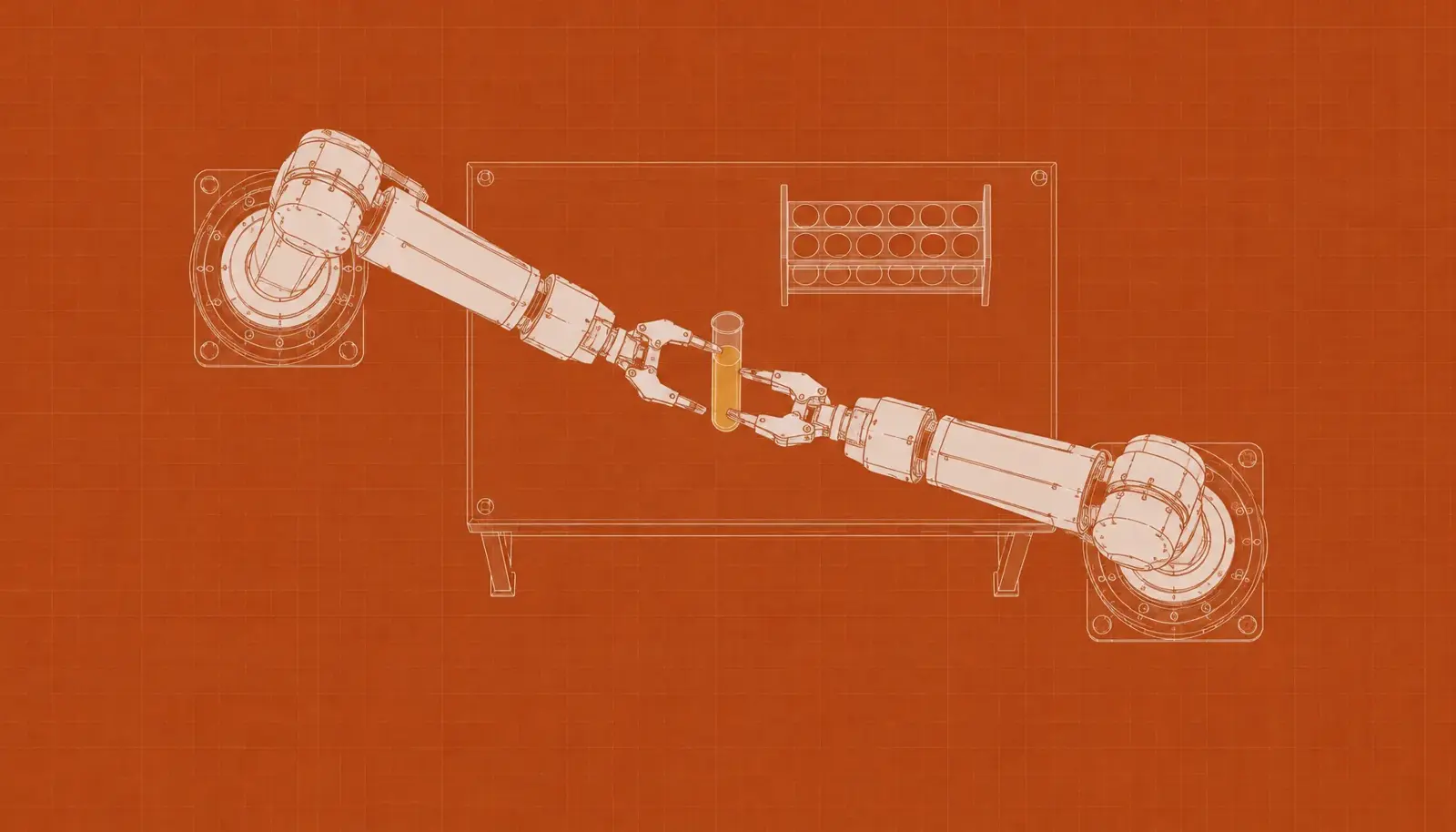
ZAP recorded 96.7% success on real-world robot tasks, matching GPT-6 Astra when both systems used the researchers’ control setup. The result puts an important condition alongside the headline number: the evaluation interface is part of the system being tested.
Source arxiv.org
The system, called Zero-real Agent Policy, or ZAP, was trained without real-robot data. Its authors combine a pretrained vision-language model’s scene and language understanding with motion skills learned through supervised fine-tuning and reinforcement learning in simulation.
Thirty trials across real-world tasks
The researchers recreated 10 tasks from the RoboLab-120 task list on a real bimanual rig with two YAM arms and three cameras. They ran three trials per task. ZAP and GPT-6 Astra each reached 96.7% success in the researchers’ control setup; MolmoAct2 reached 33.3%, while the untrained base Qwen model scored 16.7%.
The paper’s authors write:
A capable model is not enough on its own: what it observes and how it can act shape what it achieves.
The comparison concerns complete systems, including the model, perception and available controls, rather than model names alone.
Simulation taught motion, not the test tasks
ZAP starts from Qwen 3.6 27B, which supplies pretrained reasoning and visual understanding. The team teaches it to move through supervised fine-tuning on successful traces and reinforcement learning across 40 simulated pick-and-place, stacking and reorientation tasks. The paper says neither training stage uses real-world robot demonstrations.
At runtime, the model receives camera images and object measurements, then issues tool calls for perception queries, arm poses and gripper openings. It commands complete end-effector poses rather than selecting from a library of fixed grasp or movement macros. The authors’ claim is that learned motion skills can combine with existing semantic knowledge to handle tasks beyond the simulated training set.
Faster and cheaper in the reported evaluation
In the real-task evaluation, ZAP averaged 146 seconds per task, compared with 397 seconds for GPT-6 Astra in the same control setup. The reported average cost was $0.29 per task for ZAP and $4.87 for GPT-6 Astra. The authors served ZAP with vLLM on one B300 priced at $7.10 per hour, so the cost figures reflect the paper’s hardware and serving assumptions.
The study also reports transfer to a single-arm Franka robot: the same ZAP checkpoint scored 55.9% on RoboLab-120, against 51.0% for Lakeside and 42.9% for FLUX 3 Action. That is a separate benchmark result, not part of the real-world trials on the bimanual rig. The paper also describes demonstrations involving a test tube, a requested placement location, a mid-air handoff, drawing an X on a tic-tac-toe board and a chess move.
A result bounded by its test setup
The real-world evaluation uses three trials per task and reports results from a particular task selection, robot rig and control setup. ZAP’s 96.7% is a result within that test, not a general success rate across robot tasks or deployments.
The central experiment combines a 27-billion-parameter model, motion training on 40 simulated tasks and 30 real-world attempts across 10 tasks. In that evaluation, ZAP matched GPT-6 Astra using the same control setup and averaged 146 seconds per task.
Sources
- Original source · Preprint arXiv arXiv:2610.35817
Related stories
- VICTR Preprint Reports 23.8% Success on Unseen Out-of-Domain Real-World Robot Tasks
- AstroBench Records 6 Captures in 400 Generalist-Policy Trials
- Hsu and Stone Introduce ELA Preprint for Learning Robot Policies from Video Demonstrations
- Researchers Demonstrate a Bistable Origami Robot for Multimodal Motion and Grasping in Nonuniform Magnetic Fields
- COWBOY Grasps Objects Across 24 Unseen Real-World Scenes