The Floor
Renesas Launches 100V GaN Transistors for Robotics
Renesas launched four 100V enhancement-mode GaN transistor models for applications including humanoid robotics, factory automation and industrial motor drives. The devices can cut switching losses by up to 70% in some power-conversion designs, the company says, and are available with evaluation boards.
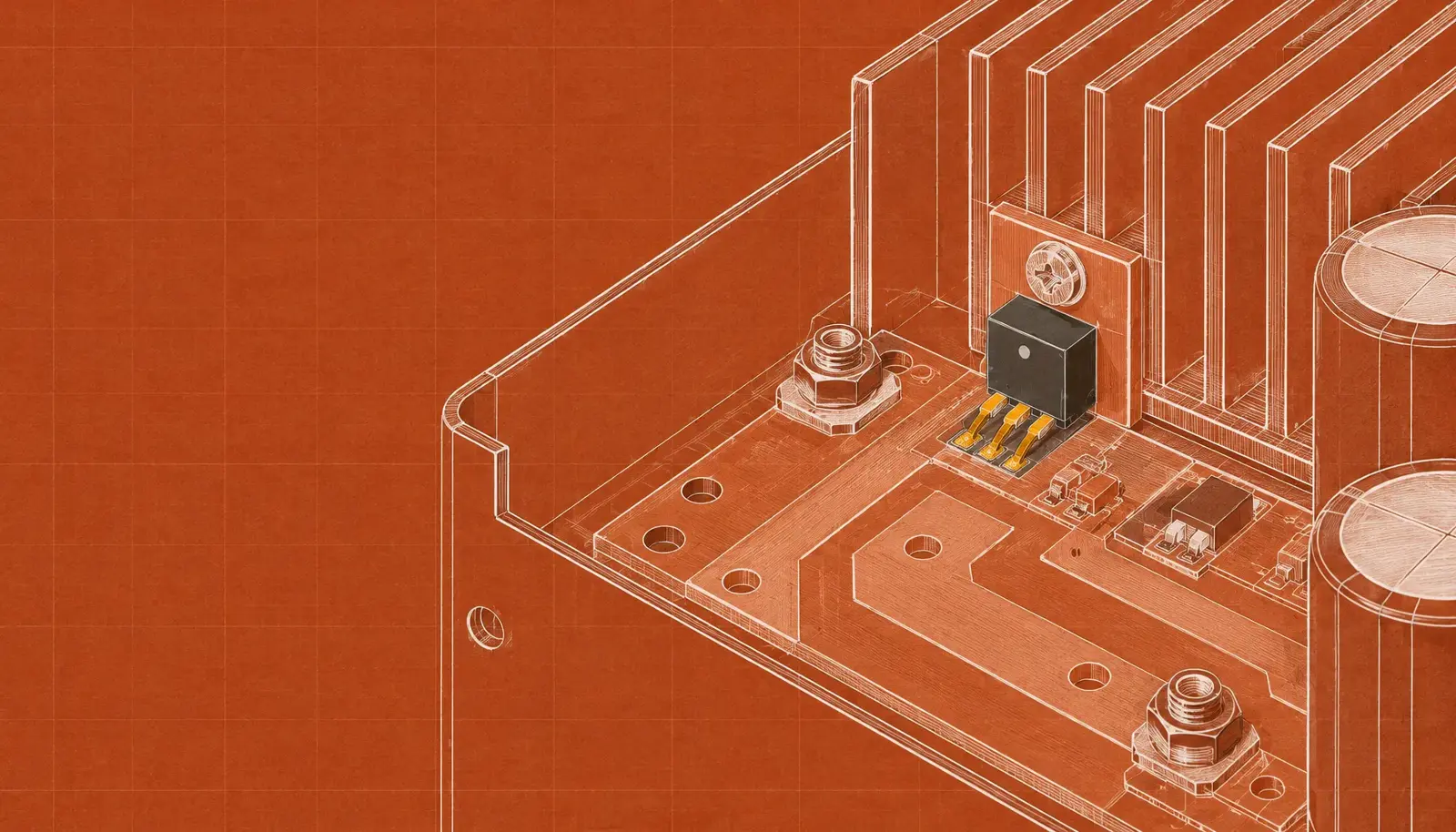
Four 100V devices target compact power stages
Renesas’ new low-voltage gallium nitride transistors can reduce switching losses by 40% to 70%, depending on the power-conversion design, according to the company. The company announced the family on October 6, describing its first 100V enhancement-mode GaN discrete power transistors as suitable for humanoid robotics, factory automation and industrial motor drives, as well as AI data centers, power tools and solar microinverters.
The four models are RTP100E005G1FL, RTP100E2P6G1FL, RTP100E1P8G1FL-DSC and RTP100E1P2G1FL-DSC. The devices combine fast switching with thermal options that include bottom-side and dual-side cooling. They use standard MOSFET-compatible packages, which the company says can help designers move from silicon layouts without significant printed-circuit-board rework.
The announcement concerns power components used inside equipment, not a new robot or robot-control system. In a robot, power transistors can serve conversion stages that supply motors and other electronics; Renesas identifies motor drives and DC-DC power stages among the intended uses.
Renesas separates device ratings from system claims
The devices have up to 35% lower hard-switching figure of merit and up to 63% lower soft-switching figure of merit compared with what it calls comparable GaN devices, Renesas reports. Those figures describe switching-performance metrics, not a direct percentage increase in robot efficiency. Separately, the company says its devices can deliver 40% to 70% lower switching losses and up to twice the power density at system level, depending on application requirements and power-conversion architecture.
The transistors have zero reverse-recovery charge, or Qrr = 0, according to Renesas. The company also points to low total gate charge and output charge, which reduce energy lost during each conversion cycle. Its stated on-resistance range is 1.2 to 5 milliohms across the family, with package and cooling choices intended to support different power levels and layouts.
“Significantly easier” migration from silicon
Renesas frames compatibility with existing silicon designs as a way to lower the effort involved in adopting GaN. “Our low-voltage GaN family delivers the efficiency, switching performance and power density designers expect from GaN while making it significantly easier to transition from existing silicon MOSFET designs,” said Akhil Nair, Senior Director, Low-Voltage GaN at Renesas.
For robotics developers, the practical payoff depends on the full drive design: the transistor is one part of a power stage, and the system-level gains Renesas cites vary with the conversion architecture. Higher switching frequency can allow smaller magnetic and passive components, while the available cooling packages give designers different ways to manage heat. The devices are available now, along with evaluation boards.
Evaluation boards are available now
The announcement also connects the low-voltage family to Renesas reference designs, including a 6 kW 800V-to-48V DCX LLC solution and an industrial DC Servo platform. Those examples point to uses beyond robot joints, including power conversion in data-center infrastructure and industrial equipment. The release does not specify pricing or name a robot maker that has adopted the new transistors.
Sources
- Original source · Press release Renesas renesas.com
Related stories
- Researchers Present LumiTac, a Six-Axis Sensor With a 12 mm-Diameter Sensing Head
- Sandia builds 2-by-6-inch crawler for Hanford waste pipes
- Multiply Labs Raises $75 Million for Drug-Manufacturing Robots
- Meta Builds Fourier Humanoid and Starts a Second Version
- Preprint adds data-aware state exploration to SkiNet-Sim