The Floor
AllenAI Introduces ToyBlocks for Controlled Robot-Learning Evaluation
ToyBlocks is a controlled simulated world from AllenAI for generating robot-training demonstrations and evaluating performance. The framework tests tasks from block flipping to multi-step spelling and provides measures beyond success rates.
Evidence on VLA generalization remains conflicting
The authors write that evidence on how well vision-language-action models generalize remains conflicting: some studies report brittleness to changes in object layouts and lighting, while others show that the models generalize well. AllenAI introduced ToyBlocks on November 6, 2026, as a controlled simulated world for studying robot learning and evaluation. Researchers can vary training data or model design, repeat tests and trace the cause of a robot’s failure.
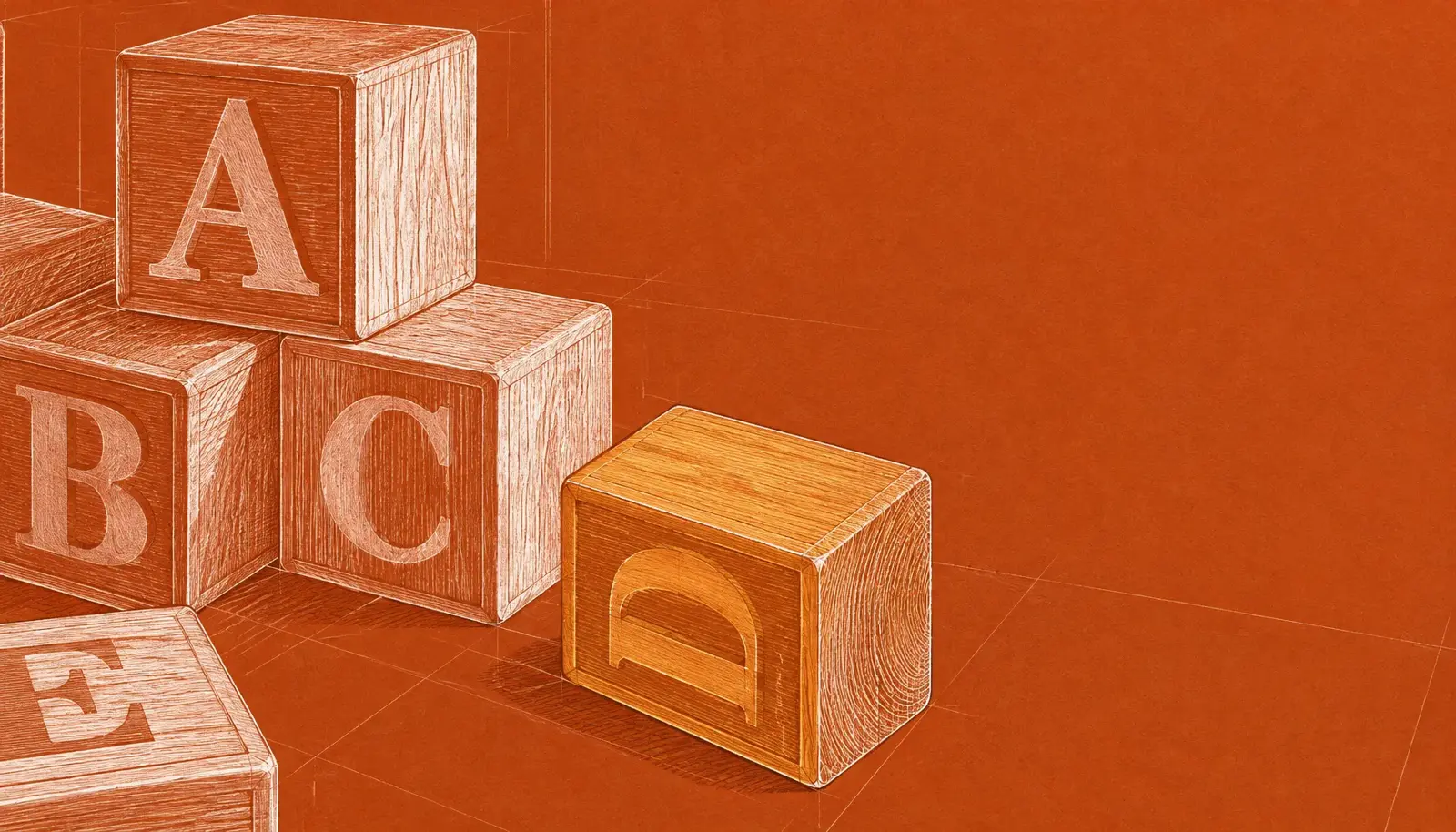
ToyBlocks is AllenAI’s first FoundationWorld, a framework pairing a controlled simulated world with tools to generate tasks and demonstrations and measure robot behavior over time. The tabletop setup centers on a robot arm and blocks, with tasks that require reasoning about how blocks interact while pushing, flipping and stacking them. The blocks’ faces carry letters and pictures, enabling search, sorting and arrangement tasks that may require a robot to turn a block to reveal a hidden face.
Blocks, skills and generated demonstrations
The project is designed around four requirements: realistic physics and appearance, automatic generation of tasks and demonstrations at scale, challenges combining reasoning with dexterity, and broad coverage of tasks within a domain. ToyBlocks also varies block size, table height and other physical properties from scene to scene to test how well models generalize as the geometry changes. ToyBlocks’ narrow scope makes it possible to study how a robot can learn to perform any reasonable task while being confident that the simulated arm and blocks behave very similarly to their physical counterparts, AllenAI says.
ToyBlocks uses reinforcement learning and motion planning to generate skills for short-horizon tasks, including pushing a block across a table or flipping it without picking it up. Skill training takes place in Isaac Lab, Nvidia's open-source framework for robot learning in simulation. The skill-generation process can use simulator information, such as a block’s exact position and orientation, that a physical robot cannot directly access.
A task-and-motion planner selects and sequences skills, then plans the robot’s movements between them; running those plans in simulation creates demonstrations labeled with the task or skill being performed. ToyBlocks can generate and execute hundreds of plans in parallel on a single graphics processing unit, reaching up to 24 times real-time performance. Users can build training mixtures that emphasize particular skills or fill gaps in existing datasets, then test models on tasks kept out of training.
Tests for spatial reasoning and planning
ToyBlocks tests Stack, Unstack, Flip and Rotate tasks, including interpolation within training ranges and extrapolation beyond them. The tests vary skill sequences, letters or colors on blocks, and the number of blocks in a scene. One setup trains models on stack heights of 2 and 5 blocks and tests them on heights of 3 and 4.
Popular action models ManiFlow, π0.5 and MolmoAct 2 generalize poorly in the initial results, despite large-scale pretraining, AllenAI reports. AllenAI says it improves generalization and analyzes the contribution of different techniques, and believes action-model generalization remains far from solved. ToyBlocks can also measure execution speeds, forces exerted on objects and task progress, in addition to success rates.
The framework enables high-level planning to be isolated from low-level execution with reference components that provide correct plans or actions. In one evaluation, Molmo 2 serves as the high-level planner and ManiFlow as the low-level policy for tasks that require stacking blocks to spell three-letter words. The scenarios increase in difficulty from characters upright and facing the camera to characters that are not visible at the start.
Claude agents search, test and spell
AllenAI tests agentic systems using Claude Opus 5.5. In a search-and-spell task, an agent uses camera images and calls skills such as pick, flip or rotate, selecting a block by pointing to a pixel. Scenes contain up to eight blocks, and 50% did not have blocks with all the letters needed for the target word; AllenAI required the agent to state that those tasks were infeasible.
The agent successfully solves or correctly declares infeasible 63% of the tasks. Errors were mostly caused by confusion between look-alike letters, at 13%, or incorrect letter orientation in a stack, at 15%, AllenAI reports. In a separate planning test, AllenAI’s system solves all 30 block-stacking tasks using text descriptions and also solves 30 out of 30 while observing camera images and choosing its next action in a closed loop.
In an experiment on agents learning how their skills behave, the agent forms a hypothesis, runs a test and revises its understanding. Skill descriptions written by the agent after its experiments raise success rates to 63%, compared with 24% for default descriptions and 36% for descriptions written by a human expert, AllenAI reports.
World models tested against simulator state
ToyBlocks provides the ground truth simulated scene state for testing action-conditioned world models that predict how scenes change in response to robot actions. AllenAI generated 900 trajectories for each of four skills: pick-and-place, flip, rotate and a mixed task. Half of the trajectories were successful demonstrations, while the other half were unsuccessful because of small changes to spatial configurations.
The comparison covered Wan 2.2, a video-prediction model with 5 billion parameters, Astra, an agentic model that created its own physics simulator, and LeWM, a latent world model. Wan 2.2 predicts block motion and task outcomes most accurately; Astra tracks the gripper but struggles with contact, while LeWM is faster and more accurate over short interaction segments but drifts over full trajectories, AllenAI reports. Adding 100 rollouts from the best video-generation model raises a policy’s success in an unseen region from 19% to 78%, AllenAI also reports.
Sources
- Original source · Blog post AllenAI huggingface.co
Related stories
- Library of Hands more than doubles simulated success, preprint reports
- Machenta Raises $40M to Teach Robots From One Demonstration
- OdorSpaces benchmarks visual-olfactory navigation in 3D indoor scenes
- Researchers derive force-closure test for cooperative pushing
- Oxford researchers report agent-designed soft robots in preprint