The Floor
CMU’s Wiggle-and-Go System Cuts Rope-Strike Error to 3.55 cm
Carnegie Mellon researchers’ Wiggle and Go system estimates rope dynamics from a brief robot-driven motion, then plans a goal-directed throw. In tests, it reduced average target-striking error to 3.55 cm, while the paper also reports limits in planning speed and performance on objects outside its training range.
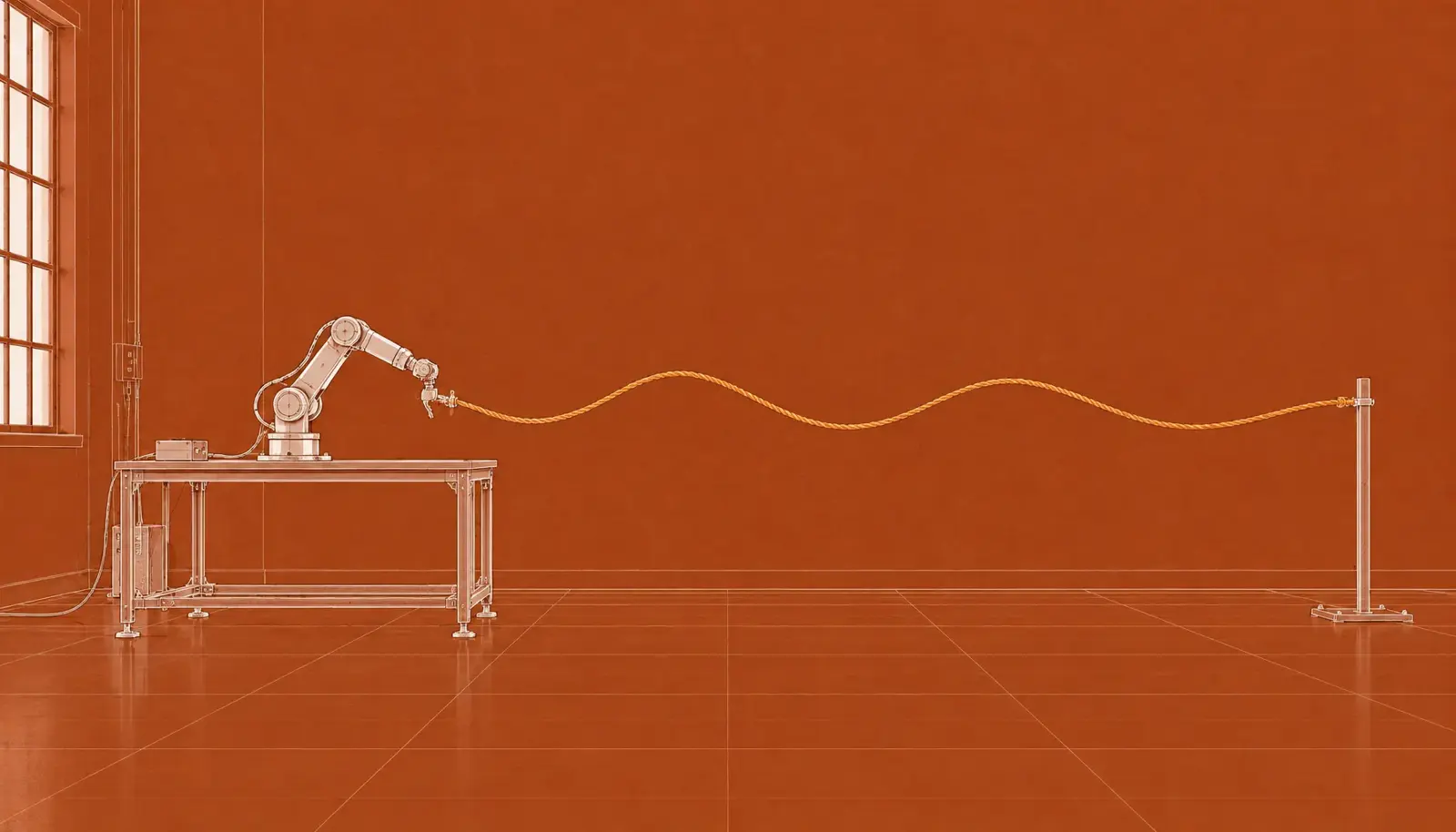
“On 3D pole-striking this yields roughly a four-fold improvement in real-world accuracy over non-system-identified baselines, and the same identification module extends without modification to lobbing and draping.”
Arthur Jakobsson et al., “Wiggle and Go!”
A probe before the throw
Carnegie Mellon University researchers’ Wiggle and Go system gives a robot a short, controlled motion to learn how an unfamiliar rope behaves before it tries to move the rope toward a target. The Robotics Institute described the work on October 29, 2026; the research paper was accepted to the 2026 Conference on Robot Learning, scheduled for November in Austin.
An overhead camera records the wave traveling along the rope during the wiggle. Computer-vision tracking turns that motion into observations for a model that estimates nine behavioral parameters, including properties related to stiffness, damping and mass distribution. The robot then uses those estimates in a simulator to optimize a trajectory for the requested task, before carrying it out on a physical robot.
The team trained the parameter-estimation model entirely in simulation. Its aim is to avoid repeated physical attempts: a robot can use one initial probe to inform different actions rather than throwing, measuring the miss and adjusting through trial and error. The paper describes the approach as “zero-shot” task execution after that identification step.
3.55 cm average error in target striking
In real-world 3D target-striking tests, the system averaged 3.55 centimeters from the target using its predicted rope parameters. The paper compares that result with 15.29 centimeters for an uninformed baseline, which plans without parameters identified for the rope. Its full-pipeline striking evaluation reports 600 task-policy rollouts across rope configurations and methods.
The team also tested lobbing and draping, two tasks with different goals from striking. Across four in-distribution ropes, the learned model hit the lobbing target in 54% of trials, but met the stricter combined condition—knocking down a domino and leaving the rope on the board—in 21%. It completed the draping task in 63% of trials, where success meant clearing a wall and hanging on the far side.
On an unseen trajectory, the predicted and observed rope motion reached a 0.95 Pearson correlation between their Fourier frequencies, a measure of how closely their motion patterns matched. The paper’s parameter analysis also attributes about 10 centimeters of the improvement over random parameter estimates to properties such as stiffness, damping and mass distribution, rather than just rope length and attached weight.
Planning time and unfamiliar objects remain hurdles
The short wiggle is only the first stage; planning can take far longer. The simulation-based trajectory optimizer is CPU-bound and takes between 25 and 120 minutes per task, depending on task and environment complexity, according to the paper. The authors identify faster optimization as a way to reduce that delay, but do not report millisecond planning in the current system.
Performance also weakens when the object falls outside the model’s training range. The researchers tested a metal chain as an out-of-distribution case and report that the learned model’s parameter estimates can saturate at the bounds of its training distribution. They also flag noisy visual tracking and limited simulation fidelity for rope behaviors such as kinking.
A rescue-rope example, not a field deployment
CMU points to rescue-rope throwing as a potential use: when a failed attempt could matter, predicting the rope’s motion before the throw may be preferable to learning through retries. That is an example of a possible application, not a rescue operation demonstrated by the study. The reported physical experiments instead evaluate target striking, lobbing and draping with a UFactory xArm 7.
Wiggle and Go’s central result is narrower and measurable: one brief motion helps the robot distinguish ropes whose dynamics are not apparent from appearance alone, and the resulting estimate improves target-striking accuracy in the tested setup. The paper’s reported average error is 3.55 centimeters.
Sources
- Original source Carnegie Mellon University Robotics Institute ri.cmu.edu
Other pages read
- arXiv arxiv.org