The Floor
DexArena Tests Long-Horizon Dexterity Across 10 Tasks
DexArena is a simulation benchmark with 10 multi-stage tasks and 30 stage-level tasks for evaluating dexterous robot manipulation. It includes teleoperated demonstrations and tests whether policies can combine individual skills into longer sequences.
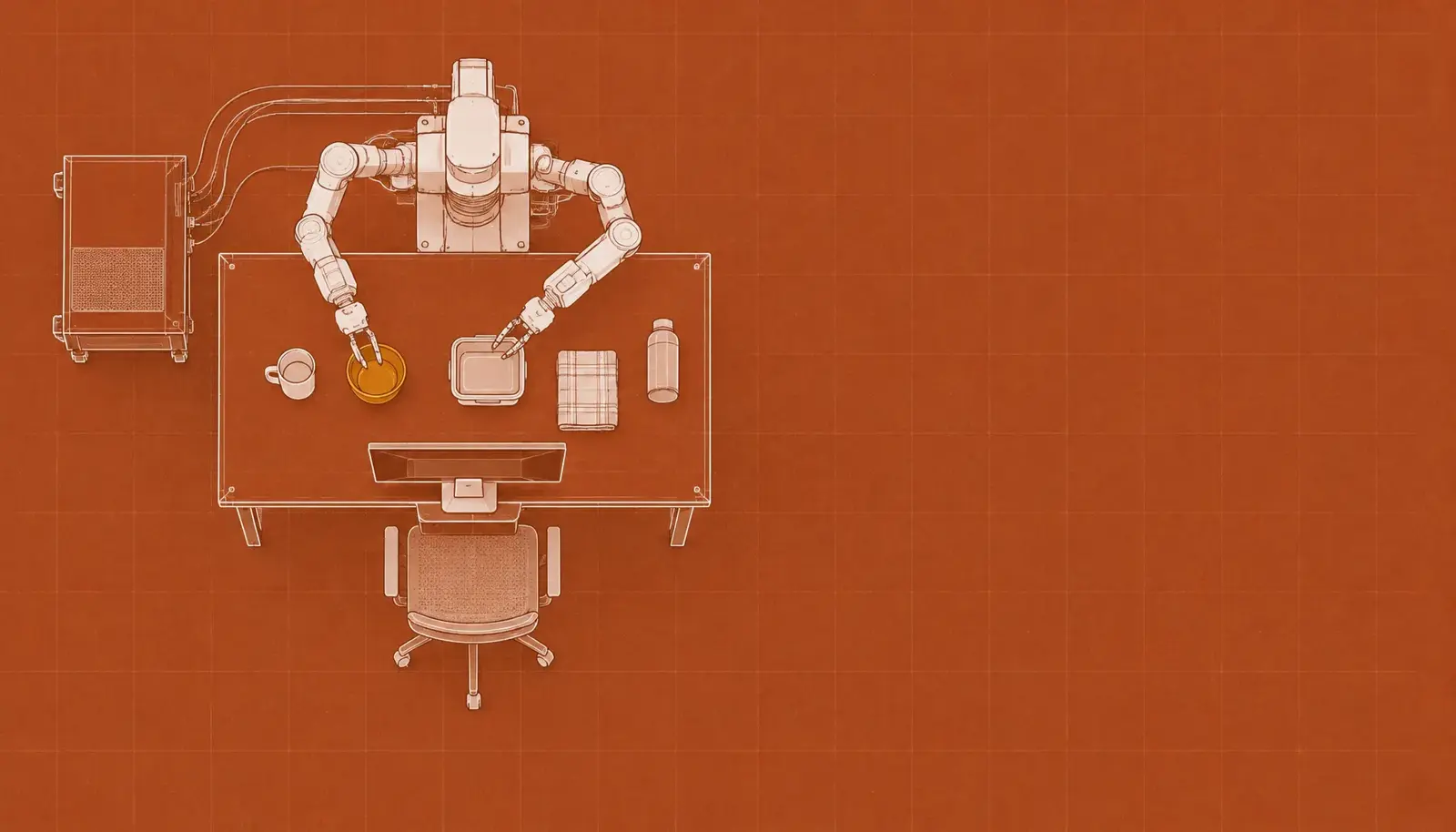
DexArena comprises 10 multi-stage manipulation tasks and 30 stage-level tasks. The authors designed it to test whether robot-learning policies can carry dexterous actions through multi-step tasks, rather than succeed only at isolated skills. The paper evaluates performance in simulation, using tasks drawn from household and industrial-style scenarios.
Source arxiv.org
Stages turn separate skills into full tasks
DexArena breaks each long-horizon task into two to five stages, with success defined by physical conditions such as object angles, relative poses and insertion depths. Most conditions must hold for 3 to 40 consecutive steps, depending on the stage, so unstable contact is not mistaken for completion. The same workstation, physics and randomization ranges apply across each long task and its component stages.
The benchmark covers opening and closing, grasping and placement, insertion and assembly, twisting and screwing, pressing, and scooping and pouring. It supports a parallel-jaw gripper and three dexterous hands: Sharpa Hand, Wuji Hand and XHand. Tasks include opening a lunch box, inserting a plug, fastening a screw and transferring liquid with a pipette.
Teleoperated demonstrations supply the baseline data
Researchers collected demonstrations through human teleoperation and released 100 replay-successful demonstrations for each stage-level task. The paper reports 3,000 released episodes, totaling 9.1 hours, selected from 4,112 accepted episodes. The recorded trajectories can be replayed from their starting states, and saved scene states allow researchers to render them with different cameras and backgrounds.
The experiments compare demonstration-guided reinforcement learning, imitation learning and vision-language-action models. For each long-horizon evaluation, the environment resets only at the start; success requires completing every stage in order within the task’s evaluation horizon. The paper specifies 50 evaluation episodes per task for completed stage-level and long-horizon measurements.
Isolated success rarely carries through the sequence
Stage-level results vary widely: some policies perform well on actions such as opening a laptop or drawer, while tasks including inserting a plug, typing keys and pipette transfer remain difficult. Scene-variation tests also produce changes in success rates across the evaluated policies. The authors’ central finding concerns the full sequence, where success remains low across most completed evaluations.
“Among completed evaluations, long-horizon success remains low across most tasks, indicating that individual-stage competence does not reliably translate into successful full-task execution.”
The authors write
The paper’s long-horizon table records nonzero imitation-learning results for furniture assembly and package opening, while most other listed results are zero. The authors add a qualification for the π0.5 model: four task results have independently verified zero success, but the remaining entries await independent final acceptance and are not measured policy-failure rates. They say those incomplete entries are excluded from comparative performance conclusions.
Simulation leaves a real-world gap
DexArena’s authors identify simulation fidelity as a limitation. They say contact among multiple fingers, objects and articulated components can be sensitive to small differences in geometry, friction and actuation, leaving a sim-to-real gap. The paper calls for further system identification and validation against physical-robot interactions.
Sources
- Original source · Preprint arXiv arXiv:2611.02629
Related stories
- Hong and Zhang Use Human Motion Data to Train Dexterous Robots
- LEAP Hand State Policy Reaches 95.2% of Unseen Pose Goals
- RoboColosseum Tests Robot Policies in 5,699 Comparisons at 124 Sites
- Georgia Tech Preprint Tests Seven Robot Policies on a New Generalization Benchmark; Best Averages 52%
- Google DeepMind introduces Gemini Robotics 2.5 for broader dexterity