The Floor
DiscoDemo Doubles Real-Robot Imitation Success to 78%
A study by researchers at KAIST and Holiday Robotics reports that policies trained on DiscoDemo-generated demonstrations succeeded in 78% of real-robot trials, compared with 39% for the strongest baseline. The method generates diverse simulated demonstrations from a small set of human examples, then uses them to train a visuomotor policy tested on four tabletop tasks.
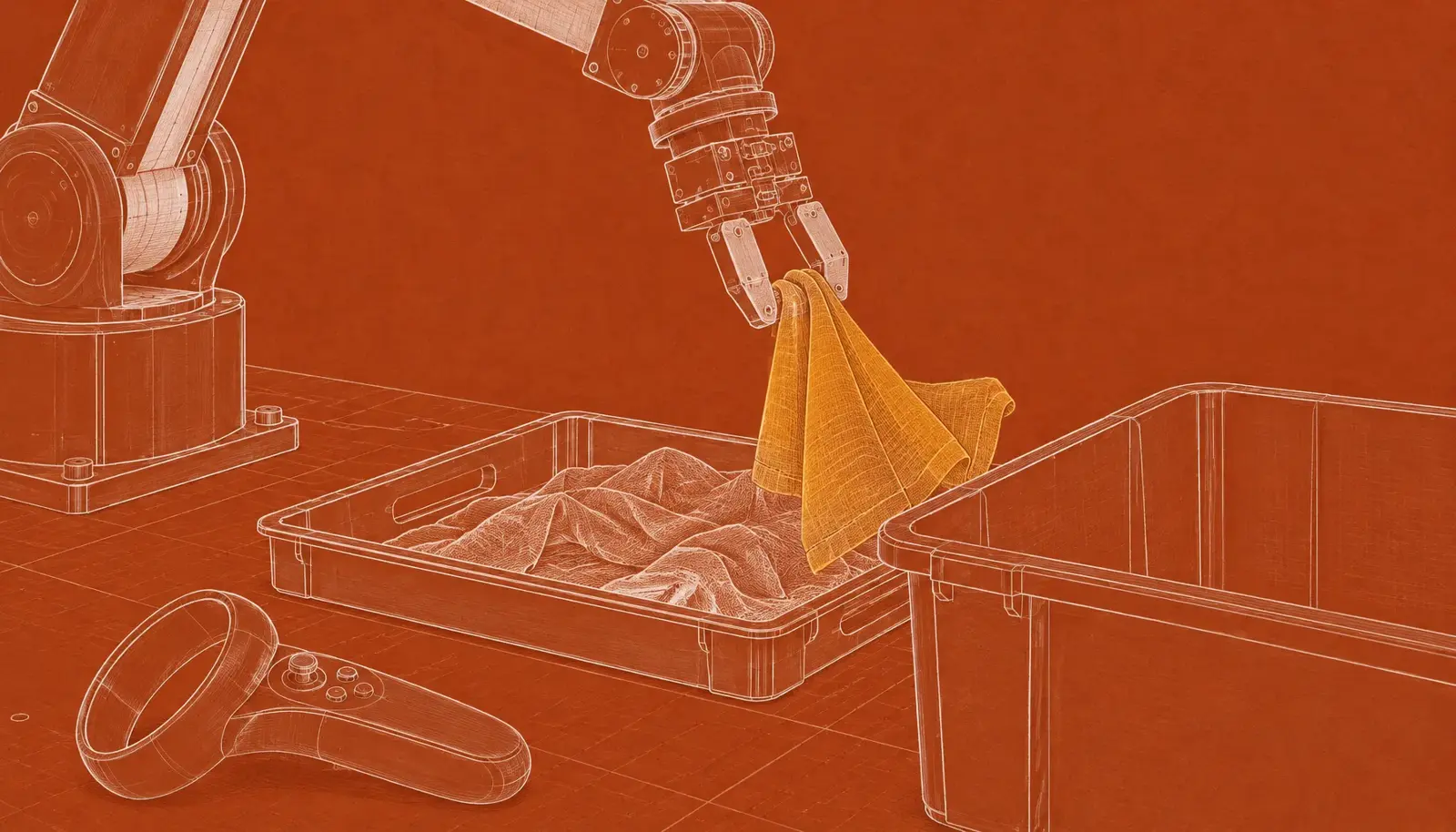
Real-robot success rose from 39% to 78%
Policies trained with DiscoDemo-generated data succeeded in 78% of real-robot trials, twice the 39% average for the strongest baseline across four tabletop tasks. In simulation, the same comparison was 62% to 40%. The figures measure the downstream imitation policies, not the reinforcement-learning generator itself. The researchers submitted their paper to arXiv on October 23, 2026.
“Across four manipulation tasks, DiscoDemo produces broader successful-state coverage and improves downstream visuomotor policies in both simulation and the real world,” write Minho Park, Kinam Kim, Donghu Kim, Byungkun Lee, Dongyoon Hwang, Yongjae Shin, Junha Hyung, Hojoon Lee and Jaegul Choo in the paper. The authors are affiliated with KAIST and Holiday Robotics. Their approach treats reinforcement learning as a way to create training data, rather than as the controller that will operate the deployed robot.
From 20 human demonstrations to 3,000 generated examples
The process starts with 20 teleoperated demonstrations for each task, recorded using a Meta Quest VR controller. The team recreates the tasks in Isaac Sim and trains a reinforcement-learning generator using privileged simulator state. A parallel reverse curriculum helps it learn task completion; a latent skill and a success-gated diversity objective encourage it to find distinct successful approaches rather than repeat one solution.
The generator’s rollouts pass task-specific safety checks before export. Each generated-data method supplies 3,000 successful demonstrations per task for training the same DROID-pretrained π0.5 visuomotor policy. Unlike the generator, that downstream policy uses camera images and robot state, not privileged simulator state. The project page estimates about 15 GPU-hours per task on average for generator training through rendering, while excluding human data collection, scene setup and downstream policy fine-tuning.
Four tasks, with zero-shot transfer to the robot
The tests cover placing a banana in a bowl, stacking two cubes, and inserting round and square pegs into a fixture board. The simulated tasks randomize object positions, and the two insertion tests use different peg geometries. In simulation, the researchers average three policy-training seeds with 50 evaluation episodes each. On the physical robot, they run 20 trials per task and method, deploying the first training seed without real-world fine-tuning.
DiscoDemo records higher success than the comparison methods on all four tasks, according to the paper. The comparison includes motion planning, human-demonstration augmentation and other reinforcement-learning data generators. One useful contrast is P-RFCL, the authors’ version of the generator without DiscoDemo’s diversity objective: its rollouts can be direct and quick, but the resulting policy has less support when its behavior strays from the narrow solution it learned.
Simulation fidelity sets the boundary
The gains do not establish that the method will transfer to complex workcells or tasks with hard-to-model contact. The authors limit their evaluation to four tabletop tasks with simple scenes and a modest simulation-to-reality gap. Their method also depends on accurate simulation, access to privileged state and resets, and a clearly defined success signal.
More diversity is not automatically better, either: the paper reports that excessive variation can reduce task competence, so its main comparison uses a moderate diversity weight. The authors also describe their safety criteria as task-specific. Whether DiscoDemo retains its advantage when simulation is less faithful and task success is harder to specify remains the central test beyond these four tabletop setups.
Sources
- Original source · Preprint DiscoDemo: Discovering Efficient and Diverse Robot Demonstrations for Imitation Learning arXiv:2610.32093
Other pages read
- DiscoDemo project page davian-robotics.github.io
Related stories
- Hsu and Stone Introduce ELA Preprint for Learning Robot Policies from Video Demonstrations
- Zero-HLM Simulation Training Beats Real Data in G1 Trials
- COWBOY Grasps Objects Across 24 Unseen Real-World Scenes
- LEAP Hand State Policy Reaches 95.2% of Unseen Pose Goals
- HyperDrone Reports 20× Faster Quadrotor Simulation