The Floor
Doosan Robotics Wins Two Korean Physical-AI R&D Projects
Doosan Robotics won selection for two South Korean government-backed R&D projects with a combined budget of about KRW 98.9 billion. The work pairs on-device AI chips for collaborative robots with an AI welding system aimed first at nuclear-power equipment.
Doosan Robotics is pursuing two different tests of Physical AI: getting collaborative robots to make decisions without a cloud connection, and teaching a welding system to reproduce skilled workers’ paths. The South Korean company announced on Oct. 6 that both proposals had been selected for government-backed research programmes. Together, the projects carry a research and development budget of about KRW 98.9 billion, including about KRW 68.1 billion in government funding.
Two projects, one on-device ambition
The projects sit under the K-On-Device AI Semiconductor Technology Development Program and the Robot Industry Technology Development Program, administered by South Korea’s Ministry of Trade, Industry and Energy and the Korea Planning & Evaluation Institute of Industrial Technology. Doosan Robotics describes the first as foundational work on robot perception, decision-making and control; the second applies those capabilities to complex manufacturing. The company plans to combine their results in a Physical AI platform for collaborative robots.
The on-device project would put a domestically developed AI system-on-chip inside the robots. The chip is designed to combine a neural processing unit for AI computing with real-time communication and control functions. Cameras, tactile sensors, force-and-torque sensors and voice inputs would feed locally processed decisions, without an external PC or cloud computing.
Four robot designs, with a 2031 target
Doosan plans three chip-equipped collaborative robot models with payload capacities of 5, 10 and 20 kilograms, plus an industrial humanoid with dual-arm manipulation and omnidirectional mobility. The company says the systems will undergo 72-hour continuous-operation demonstrations at two or more customer sites and pursue international safety certification. It targets commercialization as standard products from 2031.
The proposed local processing is aimed in part at settings where data security and communication latency can constrain cloud-based automation. Doosan names nuclear power, defense and biotechnology as potential sectors once the technology is commercialized. Those are prospective applications, not deployments announced alongside the project selection.
Welding targets put the claims to a measurable test
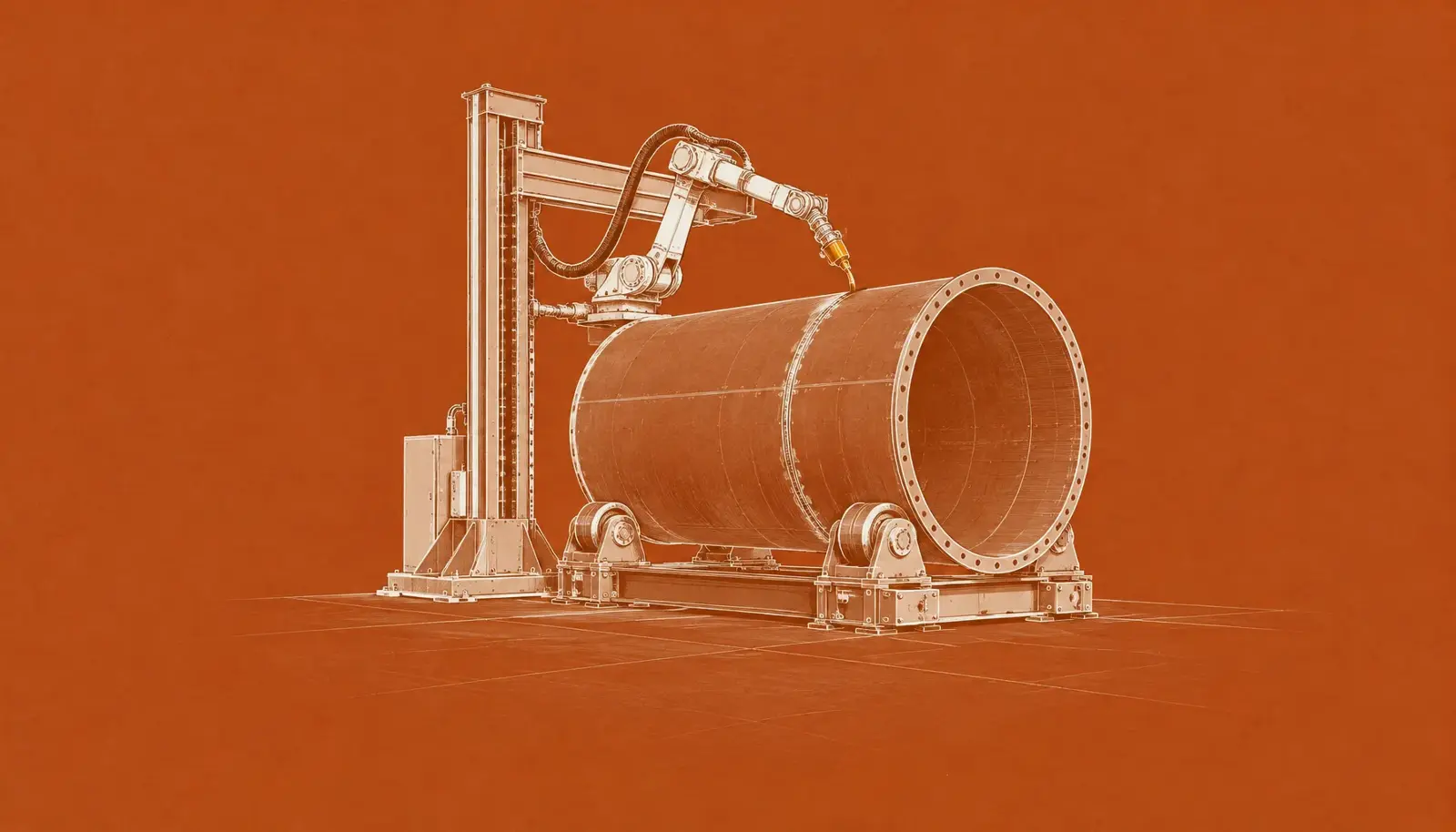
The second project combines collaborative robots with AI and digital-twin technology for high-complexity welding, including nuclear-power equipment. The system is intended to use vision to locate a weld and adjust its position, then learn from skilled welders’ movements to generate welding paths and weaving motions. Doosan’s stated target is for robot-generated paths to achieve more than 95% similarity to skilled welders’ paths, with error within ±3 millimeters under evaluation by a nationally accredited testing institution.
The company also aims to automate multi-pass welding of five or more layers and cut processing time by more than 50%. Demonstration testing is planned at the Doosan Enerbility Nuclear Power Center, initially covering tack welding, preheating and welding in nuclear equipment manufacturing. Expansion into shipbuilding, plant engineering and defense is conditional on obtaining relevant nuclear quality certification.
Park frames the work around skills automation misses
Doosan Robotics will lead both projects. Aidin Robotics, Mobilint, the Korea Electronics Technology Institute, the Korea Institute of Industrial Technology, SAIGE and university-industry cooperation foundations at Korea University, Dongguk University, Sejong University and Yonsei University are listed for the 54-month on-device project. The 45-month welding project includes DeepX, SAIGE and the Industry-Academic Cooperation Foundation of Changwon National University, with Doosan Enerbility as the end-user company.
Inwon Park, President of Doosan Robotics, said: “Labor shortages and the aging of skilled workers in manufacturing are structural challenges that cannot be addressed simply by expanding conventional automation.” He said the company aims to combine on-device chips with its collaborative robot platform so robots can learn and reproduce skilled workers’ tacit knowledge. The announced checkpoints are concrete: customer-site endurance demonstrations and safety certification for the chip-based robots, and welding-path accuracy, time reduction and nuclear quality certification for the welding system.
Sources
- Original source · Press release Doosan Corporation doosan.com
Related stories
- HD Hyundai Robotics Shows a 7-Kilogram-Per-Arm Physical AI Robot
- JAKA Debuts Kargo50 and a 50 kg Zu50 Cobot
- A3 Reports Q3 Robot Orders in North America Up 24.8% to 10,989 Units Worth $723.5M
- CoreWeave Packages Robotics Simulation for One-Command Runs
- Schaeffler Builds a Global Physical AI Platform on Wandelbots NOVA