The Floor
DRIP Adds Collision-Risk Distributions to LiDAR Crowd Navigation
Researchers introduce DRIP, a LiDAR-only planner that estimates the distribution of a robot’s closest clearance for each candidate route through a crowd. In tests reported in a paper submitted to arXiv on October 29, 2026, the system outperformed several baselines in crowded simulations and completed 17 of 20 real-world trials.
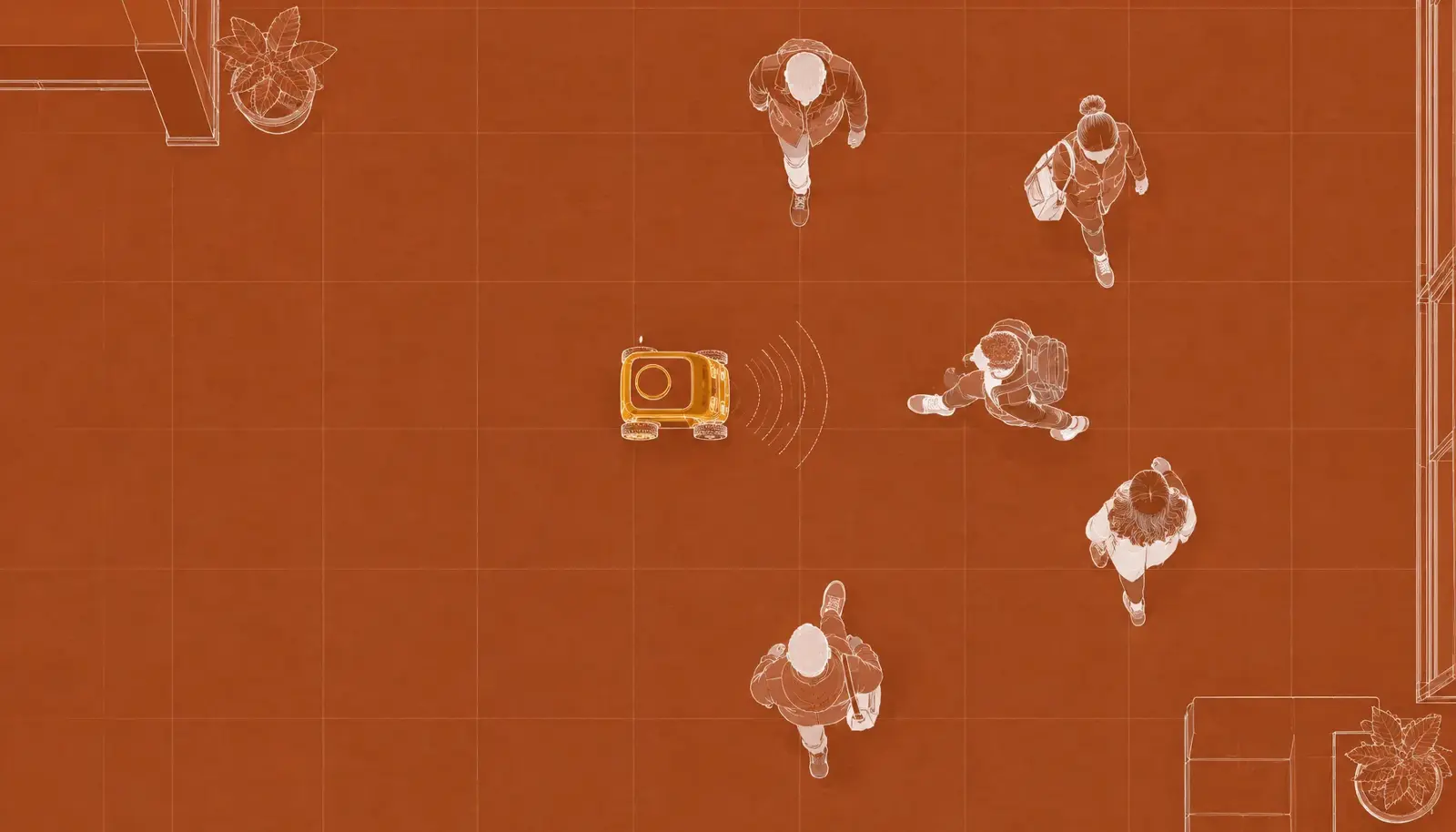
DRIP targets the trade-off between collisions and freezing
In a crowded hallway, a navigation planner can fail in opposite ways: it can misjudge a moving person’s path, or slow so much that it stops making progress. Researchers behind DRIP—the Don’t Risk It Planner—aim to address both problems by scoring the likely clearance of each candidate route, rather than relying only on a predicted map of where obstacles may be.
Source arxiv.org
The paper, submitted to arXiv on October 29, 2026, describes an end-to-end planner that uses LiDAR-derived occupancy-grid histories without explicitly detecting and tracking pedestrians. The authors write, In closed-loop experiments with up to 45 pedestrians, DRIP achieves higher success rates with fewer collisions and reduced freezing behavior compared to state-of-the-art baselines. Mathai Mathew Pulicken et al., “Don’t Risk It!: Trajectory-Conditioned Distributional Risk for LiDAR-Only Crowd Navigation”
Each route gets its own clearance estimate
DRIP forecasts how occupied space may change, then evaluates candidate control sequences against those forecasts. For each candidate, its model predicts a distribution over the robot’s minimum clearance from obstacles during the planning horizon. The planner turns that distribution into a risk score that reflects both the likelihood and severity of breaching a chosen safety buffer.
That route-specific estimate matters because an error in a forecast far from the robot’s path may have little effect, while uncertainty near a close encounter can change which route is safest. DRIP’s training objective ties uncertainty estimates to observed outcomes for safe and unsafe trajectories, instead of relying on geometric prediction error alone. A sampling-based local planner uses the risk score alongside goal progress, smoothness and an immediate occupancy check.
Simulation results favor DRIP, with comparisons to note
The researchers tested a simulated TurtleBot2 with a 270-degree, forward-facing 2D LiDAR in PEDSIM’s Lobby environment, with 35 or 45 active pedestrians. At 45 pedestrians, DRIP completed 85% of 100 nominal runs, compared with 78% for SCOPE, another LiDAR-based predictive planner; DRIP’s reported average completion time was 13.0 seconds, against SCOPE’s 15.2 seconds. The study defines a successful run as reaching the goal without collision or timing out within 90 seconds.
Under simulated LiDAR range noise with a standard deviation of 0.05 meters, DRIP completed 86% of 50 runs at the 45-person density, compared with 64% for SCOPE. These are simulation benchmarks, not a claim that the planner guarantees collision avoidance in every setting. The comparison also includes DRL-VO, which receives privileged pedestrian tracking and velocity information and therefore does not use the same input conditions as DRIP, DWA and TEB.
Hardware trials add evidence—and leave a limitation
The paper also reports tests on a Pioneer 3-DX mobile robot with a 2D RPLIDAR A3 and on a custom autonomous wheelchair with a Livox Mid-360 3D LiDAR. The complete perception and planning pipeline ran onboard a mobile workstation equipped with an NVIDIA GeForce RTX 3060 Laptop GPU. Across 20 trials in a cluttered laboratory and an academic corridor, with people acting as unscripted moving obstacles, DRIP succeeded in 17 without human intervention.
The authors report a decision loop of about 70 milliseconds against a 100-millisecond target for a 10 Hz control cycle. They also identify a constraint: the planner selects from a discrete set of trajectory primitives, which can limit its choices in tightly confined spaces. The paper proposes exploring continuous trajectory generation as future work; the reported results establish a testable approach, not a safety certification.
Sources
- Original source · Preprint Don't Risk It!: Trajectory-Conditioned Distributional Risk for LiDAR-Only Crowd Navigation arXiv:2610.40050