The Floor
EmbodiedLab Gives Robot Agents 30 Experiments to Run
EmbodiedLab tests whether robot agents can conduct simulated science experiments, gather measurements and report results without being given a procedure. In the researchers’ T0 evaluation, the top agent succeeded on 43.3% of experiments, while adding perception and motion planning raised that score to 53.3%.
Claude Opus 5.5 completed 43.3% of EmbodiedLab’s experiments with basic robot controls, the highest rate among six tested AI agents. HexaFuture’s benchmark asks agents not just to move objects into a specified arrangement, but to investigate an unfamiliar setup, take measurements and report what they learn. The researchers submitted their paper on October 26, 2026; the benchmark and evaluation code are available through the EmbodiedLab repository.
Source arxiv.org
Thirty experiments, with no prescribed method
The suite covers mechanics, electricity, optics, thermal physics and chemistry across 14 apparatus platforms. Tasks include finding an unknown resistance, measuring a lens’s focal length and determining the concentration of a dye mixture. Agents receive an objective and an apparatus, but not a procedure. The system’s physical parameters are resampled for each instance, so agents cannot know the answer in advance.
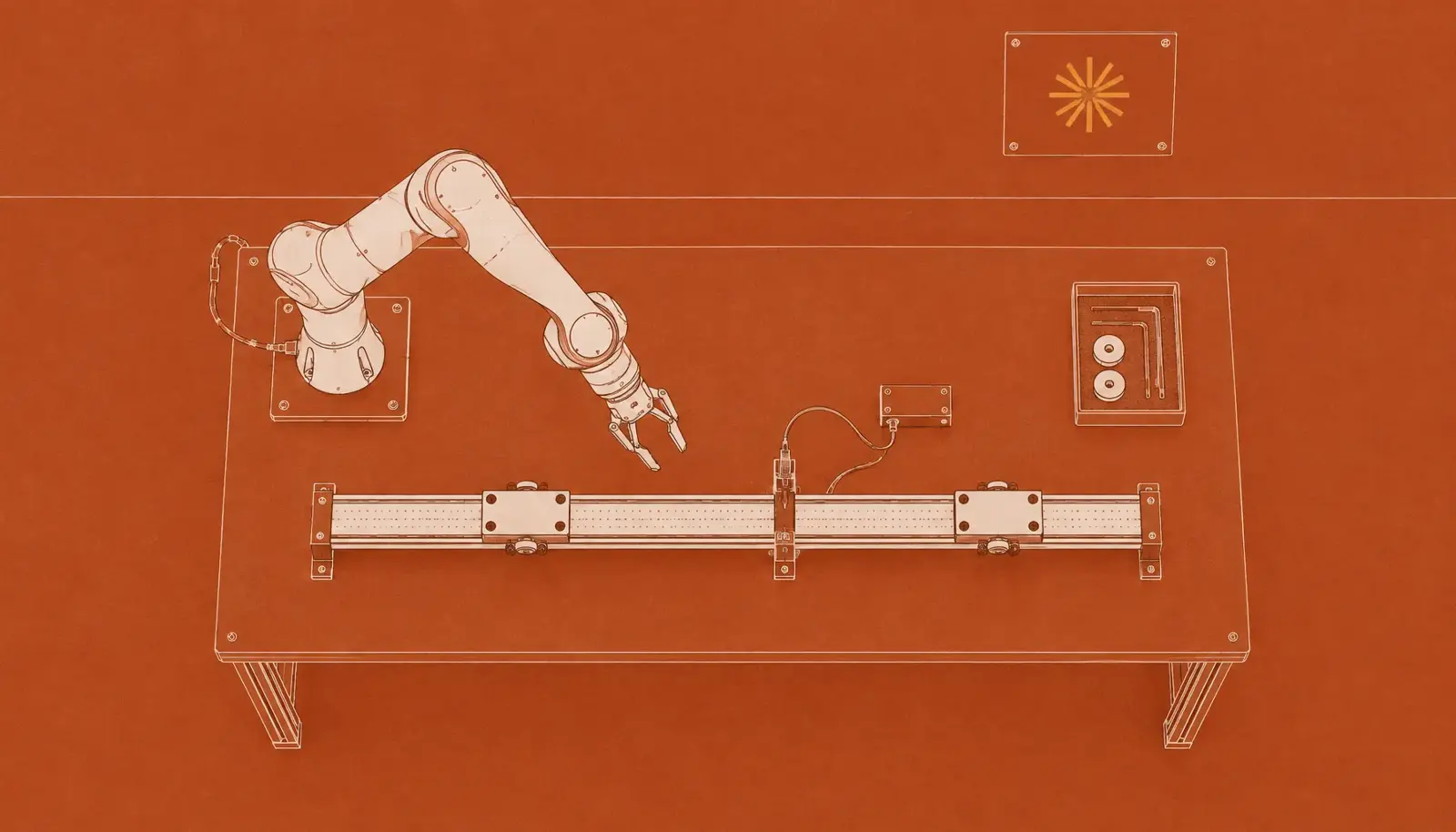
EmbodiedLab runs in NVIDIA Isaac Sim, with a Franka Panda arm, a two-finger gripper and three cameras. Agents operate the simulated apparatus through code and use camera views to read instruments and guide their actions. A run succeeds only if the reported result falls within the instrument’s tolerance, is grounded in readings collected during the run, and leaves the bench in the required state. The authors say they verified each experiment could be solved through the public interface.
“With native control, even the strongest agent succeeds less than half the time; for every agent, most failures arise in interacting with the apparatus, and manipulation skills help weaker agents more than perception and planning.”
The authors write in the paper’s abstract
More perception did not fix the hardest failures
At the basic T0 level, GPT-6 Astra scored 40.0%, while GPT-6.1 Sol reached 28.3%. DeepSeek-V4.1-Flash-1017 and Kimi K3 each scored 10.0%; GLM-5.3-Flash did not complete an experiment successfully. The scores average results across the 30 experiments, with each experiment weighted equally.
The T1 setup adds segmentation, depth information and collision-free motion planning. Claude Opus 5.5 rose to 53.3% and GPT-6 Astra to 46.7%; across the agents, T1 improved success by 1.7 to 10 percentage points. A separate T2 test gave three weaker agents manipulation skills distilled from successful GPT and Claude runs. DeepSeek rose to 40.0%, Kimi to 33.3% and GLM to 13.3%.
Failure often came before the answer
The researchers tracked six stages, from acting on the apparatus and collecting readings through calculating an answer and restoring the bench. The three strongest agents rarely stopped before gathering enough readings. Their lowest stage pass rates came when they had to determine the result within tolerance and return the apparatus to its required state. The other three agents more often stopped while changing the apparatus or observing it.
The paper attributes 75% to 100% of failed runs to acting on or observing the apparatus, or restoring the bench; reasoning from readings accounted for at most 25%. For the weaker agents, physical interactions such as slipping grasps, tipped parts and missed keys were common causes. Among the strongest agents, failures were more spread across later stages: the authors report that an untidy bench after an accurate result accounted for 25% to 33% of their failed runs. A misread instrument digit could also decide whether a run succeeded.
A simulated lab, not a physical one
EmbodiedLab’s robot and apparatus operate in simulation. The authors describe the benchmark as a controlled setting where hidden parameters can be varied and results scored against evidence gathered during each run. That makes the benchmark a test of end-to-end experimental work in the simulated lab, but its scores do not establish how the agents would perform at a physical laboratory bench.
With native controls, Claude Opus 5.5’s success rate was 43.3% across the 30 experiments. Adding perception and motion planning raised it to 53.3%; the larger T2 gains reported for weaker agents came from adding manipulation skills. The benchmark and evaluation code are available in the project repository.
Sources
- Original source · Preprint arXiv arXiv:2610.35385
Other pages read
- GitHub github.com