The Floor
ETH Zurich Co-Designs Living Muscles for Jumping Robots
ETH Zurich researchers co-designed lab-grown muscle tissue and hydrogel scaffolds to power small robots that jump, swim, walk and grip. The actuators increased their range of motion by up to eleven times, but still depend on nutrient solution to keep the tissue alive.
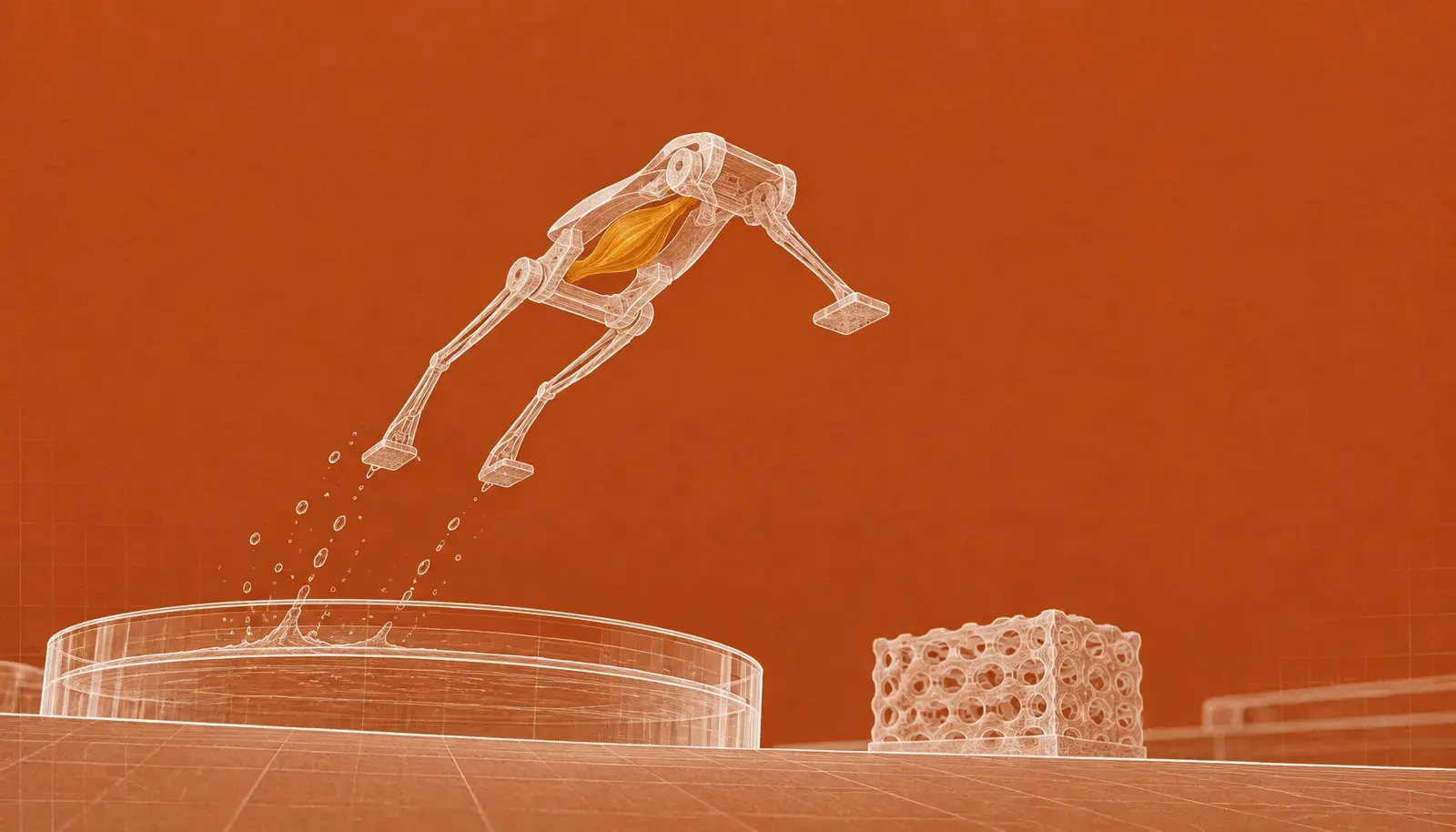
“They achieved up to an eleven-fold increase in range of motion over previous designs of similar muscle volume, powering robots capable of jumping, swimming, walking, and gripping, and scalable into multi-unit systems.”
Aiste Balciunaite et al., Nature Communications
Muscle and scaffold designed as one
ETH Zurich researchers have built small biohybrid robots that jump, swim, walk and grasp using lab-grown skeletal muscle. Their approach starts by designing the living tissue and its soft artificial support together, rather than treating the muscle as a finished part to fit into a robot later. The team’s study appeared in Nature Communications on September 11; ETH Zurich described the work in a news release on October 22.
The actuators combine skeletal muscle grown from mouse cells with a soft, water-rich hydrogel scaffold. A computer-based design process determines where muscle should sit and what properties the scaffold needs so a contraction moves the whole component. The work addresses a familiar limitation in muscle-powered prototypes: cultured muscle can contract, but the resulting movement may be too small to see without magnification.
Up to 11 times the range of motion
The researchers used a soft-body simulation to model the joined muscle-and-scaffold system, then searched for designs that increased its range of motion. The paper describes an evolutionary algorithm and targeted parameter sweeps; the team fabricated the selected scaffolds using xolography, a light-based 3D-printing method that ETH says takes about a minute per scaffold. Experiments then fed measurements of material properties and manufacturing conditions back into the design process.
Each resulting bioactuator measures about 1.5 centimetres long. The researchers report up to eleven times the range of motion of earlier designs with a comparable volume of muscle tissue. Fine grooves in the scaffold help the muscle anchor and align its fibres, supporting the transfer of force from living tissue into the hydrogel.
A five-millimetre hop, a 6.2-millimetre walk
In one demonstration, a single contraction lifts an actuator about five millimetres from the bottom of its dish—roughly a third of its body length. A walking version travels at 6.2 millimetres per second. ETH says that, relative to body length, this is faster than any walking biohybrid robot reported so far.
The work also demonstrates swimming and grasping, extending the actuators beyond a single jumping motion. Those demonstrations show what the engineered muscle can do in a controlled laboratory setup; they do not establish that the robots can operate independently outside it. The study’s central contribution is the joint design process: the shape of the muscle and the structure supporting it are optimized together for motion.
Nutrient solution still sets the limit
The tissue needs nutrient solution to stay alive, and ETH says longer-term use remains a distant prospect. Larger systems would need an artificial vascular network to deliver oxygen and nutrients and remove waste. The researchers also face variability between cultured muscle samples, which do not behave as consistently as manufactured components.
Those constraints keep the results in the experimental stage. For now, the demonstrated machine is a centimetre-scale assembly of living mouse muscle and hydrogel, moving in a dish. Its strongest jump reaches about five millimetres.
Sources
- Original source ETH Zurich ethz.ch
Other pages read
- PubMed pubmed.ncbi.nlm.nih.gov