The Floor
EvoMem-VLA Adds Change Memory to Long-Horizon Robot Policies
A paper posted on October 4 introduces EvoMem-VLA, a robot policy that stores learned representations of how visual observations change over time. Its authors report success rates of 80.7% on RMBench, 82.0% on RoboMME and 83.8% across four real-world tasks on two robot platforms.
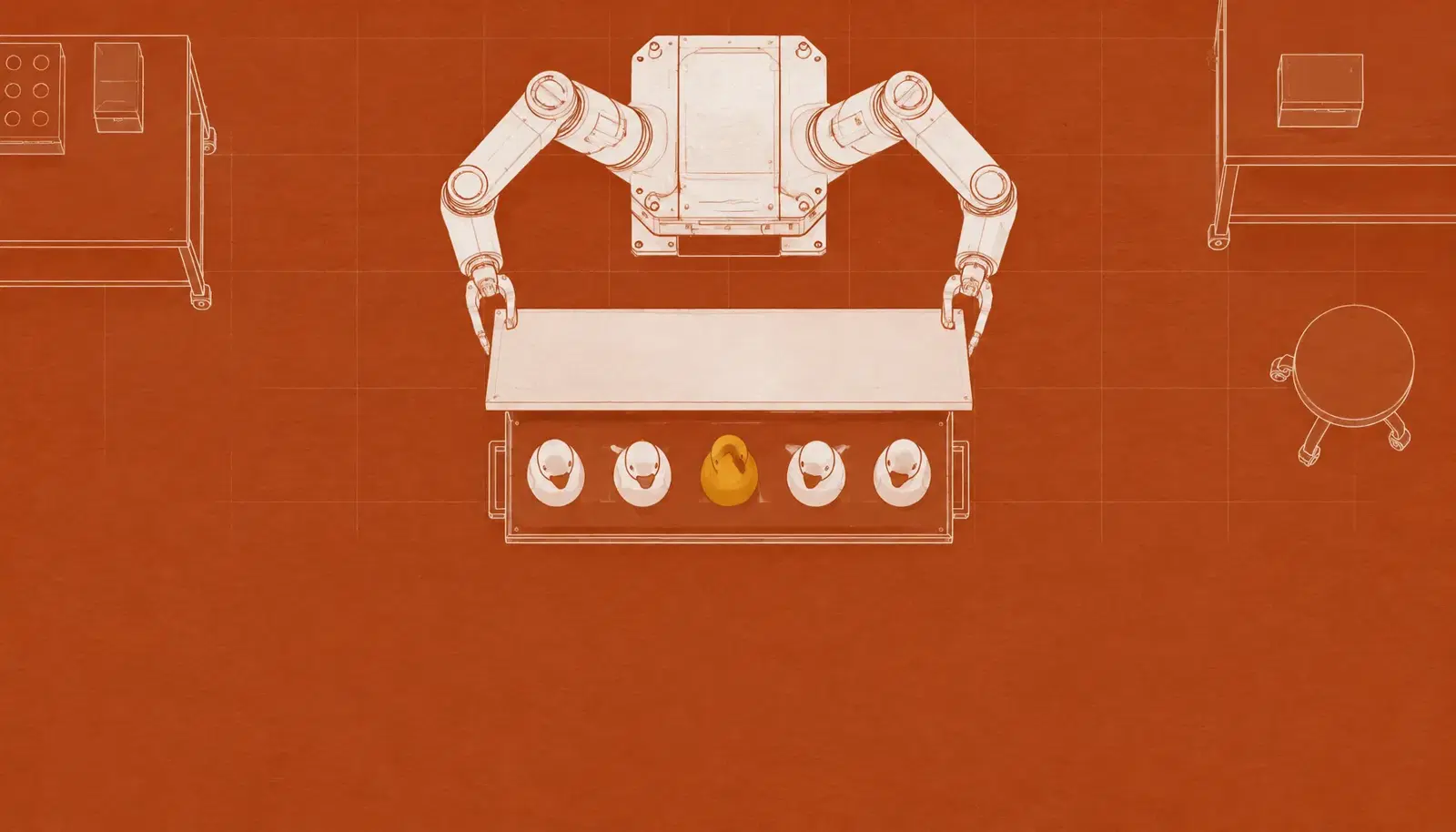
A robot can see a cup in the same pose twice and still fail to know how many times it has lifted it. Vision-language-action policies can retain past images or compressed histories, but Yuheng Na and nine co-authors argue those records may not show what changed between interactions. Their paper, submitted to arXiv on October 4, introduces EvoMem-VLA, which pairs remembered visual states with learned tokens representing changes between them.
The distinction matters in long tasks where a robot must remember an action after the evidence has left its current camera view. In the authors’ real-world “Lift Cup” task, for example, the cup returns to a similar pose after each lift; its present position does not reveal how many repetitions remain. EvoMem-VLA’s reported results are strong across two simulation benchmarks and four physical tasks, though the real-world evaluation covers only two robot platforms and a limited number of trials.
One token records what changed
EvoMem-VLA encodes an ordered pair of images—a source frame and a later target frame—into a learned “delta token.” The token is conditioned on the source frame, so it represents the target’s change relative to what came before, rather than a raw pixel subtraction or optical-flow field. A frozen DINOv3 image encoder supplies the visual features used to form each pair.
The policy places these tokens beside the visual states they describe. Its memory includes an initial observation and recent observations, with three groups of change tokens tracking recent intervals; selected keyframes can preserve older state-and-change evidence. The exact memory setup differs by benchmark: the RMBench policy uses no keyframe memory, while RoboMME and the real-world configuration enable it.
“These change representations preserve evidence of interaction outcomes, allowing the policy to track task progress beyond isolated snapshots,” the authors write.
“These change representations preserve evidence of interaction outcomes, allowing the policy to track task progress beyond isolated snapshots.”
Yuheng Na, Zhide Zhong, Junjie He, Junfeng Li, Haodong Yan, Jiaan Wang, Jiaguan Zhu, Yangyang Zheng, Tianyu Huang and Haoang Li, “EvoMem-VLA: State-Evolution Memory for Long-Horizon Robot Manipulation”
Subtask routing lifts the multi-stage score
A shared vision-language-model backbone handles two routes. For tasks without multi-stage planning, it predicts actions directly; for tasks with subtask supervision, it first generates an executable subtask and then uses that text to guide action generation. The paper says the route is set by task-level configuration, rather than selected by a learned classifier.
On RMBench, a set of nine bimanual manipulation tasks, one policy trained jointly across the tasks achieved an 80.7% overall success rate. The authors compare that with 67.8% for EventVLA, a 12.9 percentage-point gap; they note that EventVLA’s score comes from its published report. On the four tasks requiring information from multiple past observations, EvoMem-VLA scored 76.5%, compared with EventVLA’s 54.0%.
On RoboMME, which contains 16 tasks testing counting, permanence, reference and imitation memory, the jointly trained policy scored 82.0%. The strongest baseline listed, FrameSamp, scored 44.5%. The paper reports 100 evaluation episodes per task on both simulation benchmarks, with RoboMME’s episodes split among easy, medium and hard settings.
Real-world tests cover two robot platforms
The physical evaluation uses a Franka single-arm robot and an AgileX COBOT dual-arm platform. The researchers trained a separate policy for each embodiment and collected 50 demonstrations per task per robot, or 400 demonstrations across four tasks and both platforms. Each robot ran 10 evaluation episodes per task, for 80 episodes total.
Across the four tasks, EvoMem-VLA averaged 83.8% success. The tasks tested counting repeated lifts, remembering duck identities after they were covered, recalling a demonstrated route and returning a cup to its original location. The authors report 30.0% for the real-world baseline πMEM and 5.0% for π0.5; each task’s result is averaged across the two robot embodiments.
Ablations isolate the memory’s contribution
The authors tested the components on RMBench under the same training and evaluation protocol. Removing delta tokens lowered overall success from 80.7% to 52.3%; removing subtask routing lowered it to 61.3%. Replacing the learned tokens with direct feature subtraction performed worse still, at 47.1%.
That pattern points to the paper’s central claim: storing a sequence of visual states is not the same as preserving evidence of the interaction between them. The results remain benchmark findings, not evidence of broad performance across everyday settings. The physical study’s 80 total trials span just four tasks on two robot platforms, and its authors report success rates for those specific tests.
Sources
- Original source · Preprint EvoMem-VLA: State-Evolution Memory for Long-Horizon Robot Manipulation arXiv:2610.05418