The Floor
Facet-SLAM paper reports sensor-rate mapping on Jetson
A paper introduces Facet-SLAM, a triangle-splatting SLAM system the authors say runs at sensor rate on a Jetson AGX Orin. In reported tests, it reached an average of 36 FPS on the embedded platform and produced a Delaunay mesh with a 0.86 cm chamfer distance on the Replica dataset.
Triangle maps at sensor rate
A preprint introduces Facet-SLAM, a triangle-splatting system for simultaneous localization and mapping (SLAM) that its authors say can run at sensor rate on a Jetson AGX Orin. The preprint, submitted on November 18, names Edward Beng Wai Tan and Siew-Kei Lam as authors. It also reports around 100 frames per second on a desktop GPU.
The authors describe Facet-SLAM as the first real-time triangle-splatting SLAM system for RGB-D cameras. Triangle splatting represents a scene with surface triangles; the paper says their vertices can be triangulated into a connected mesh without an intermediate representation or separate fusion stage. The system is designed to build a map while estimating the camera’s position.
Tracking separated from mapping
The method divides tracking and mapping into separate roles. Tracking sets each triangle’s centroid using fused depth measurements, then registers incoming frames to those centroids with generalized iterative closest point, or GICP. The mapper optimizes other triangle properties while restricting updates that would move the centroids away from their depth-based positions.
The paper says this constraint addresses a problem with using geometric registration alone: mapping optimization can shift triangles from observed surfaces, making them less reliable as registration targets. The authors use a change of variables to restrict the mapper to non-translating updates. Tracking and mapping run in parallel, with the tracker on the CPU and the mapper on the GPU.
Reported benchmark results
Tests covered TUM RGB-D, Replica and ScanNet datasets. The hardware included a desktop computer with an RTX 4090 GPU and an i9-13900KF CPU, plus a Jetson AGX Orin in MAXN mode. The authors say they ran each measurement five times per sequence and reported the average.
In the TUM RGB-D comparison, Facet-SLAM averaged 113 FPS on the desktop and 36 FPS on Jetson; the paper also describes the embedded system as running at sensor rate. On the Replica dataset, the reported Delaunay-mesh chamfer distance was 0.86 cm, against 1.55 cm for TS-SLAM. The paper reports that comparison as an improvement in surface accuracy, while noting that the rendering quality is on par with triangle-splatting methods.
On-device demonstration and limitation
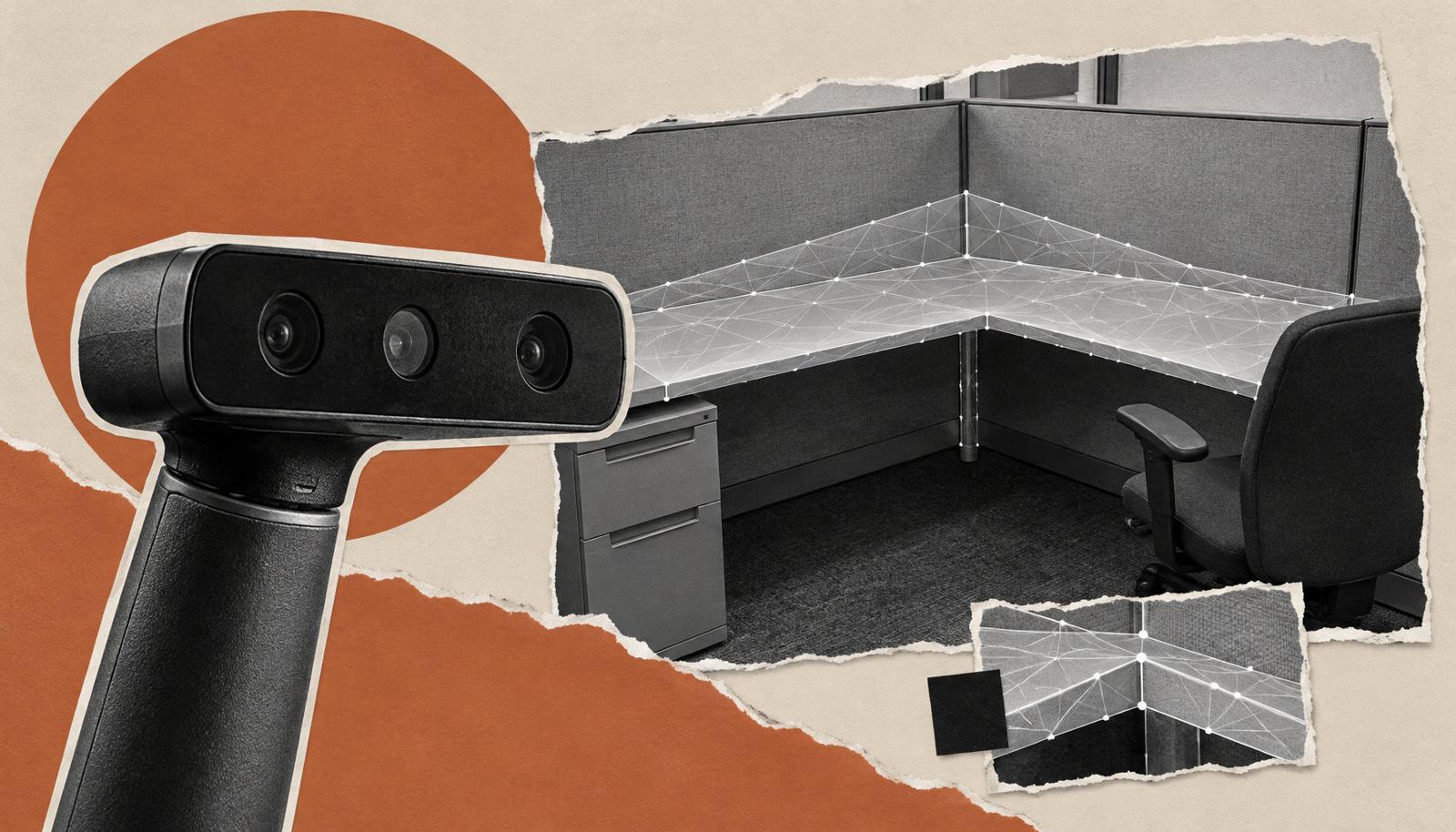
The paper also describes a real-world mapping demonstration in an office cubicle area. A handheld D435 RGB-D camera was moved around to capture desk structures, with mapping performed online on the Jetson AGX Orin; the authors extracted a colored Delaunay mesh from the resulting map.
The authors identify lower mapping quality than 3D Gaussian splatting methods as a limitation. They say this is partly tied to computational-efficiency choices, including using zero-degree spherical harmonics and more conservative densification behavior, and partly to triangle splatting being a newer representation for SLAM.
Sources
- Original source · Preprint Facet-SLAM: Real-Time Triangle Splatting SLAM arXiv:2611.23935