The Floor
NC State’s Feather Star Robot Swims in 3D With Two Actuators
A feather star-inspired soft robot uses two pneumatic inputs to switch among three swimming modes and move in three dimensions. The researchers report a top swimming speed of 1.64 body lengths per second and rotation of up to 90 degrees per second.
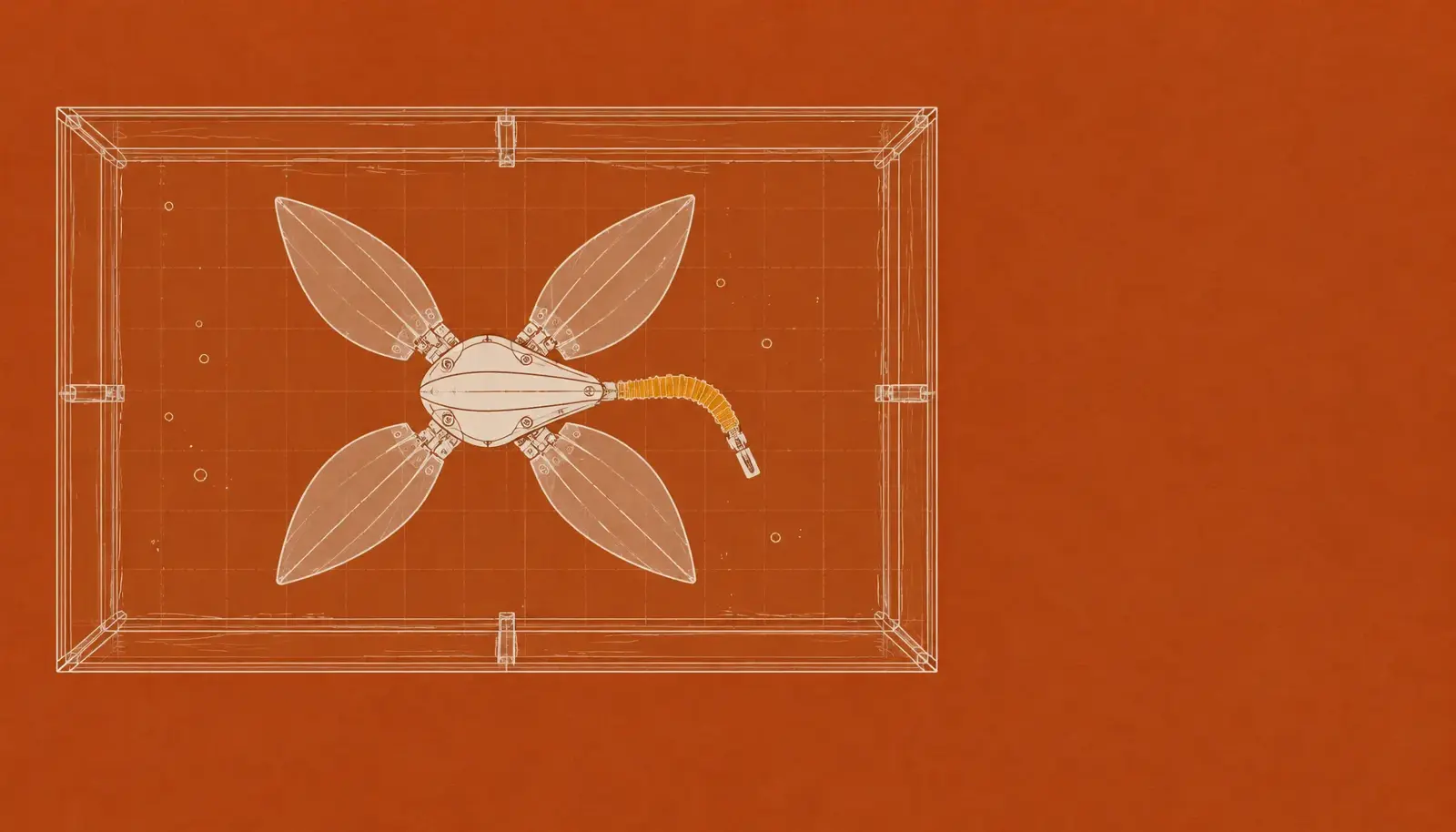
Two pneumatic inputs give a 55-millimeter feather star-inspired robot three swimming modes and control over movement in all three dimensions. In tests reported October 7 in Science Advances, the soft swimmer reached 1.64 body lengths per second, rotated at up to 90 degrees per second and could hover underwater by changing its flapping rate.
The design comes from researchers at North Carolina State University and the University of Virginia, with a co-author from the University of California, Riverside. Rather than assigning a separate actuator to each moving arm, the team shaped the robot’s elastic frame so its structure helps produce different motions from a small number of inputs.
Four elastic arms, two air channels
A central soft pneumatic actuator connects to a frame of four paired ribbon arms. The arms bend under pressure and snap back when pressure is released; their elastic response turns the actuator’s input into coordinated flapping. The paper describes the design as mechanical intelligence: the robot’s structure contributes to how it moves, rather than leaving every motion to a larger array of independently controlled actuators.
Activating both pneumatic channels together makes the arms flap in sync. The researchers call this “jelly” mode: faster cycles drive the swimmer upward, while slower flapping can hold it at a depth. With actuation stopped, it sinks. The paper reports ascent approaching 90 millimeters per second at the highest tested frequency, while the 1.64-body-length-per-second peak is the robot’s top relative swimming speed.
Changing the input changes the gait
For forward or backward travel, one channel moves a single arm like a tailfin, producing what the team calls “fish” mode. Alternating the two channels instead creates “rotor” mode, spinning the robot so it can change its heading. Switching between these motions lets the swimmer combine vertical movement, translation and turning, rather than being limited to travel in a single plane.
“The robot achieves a maximum swimming speed of 1.64 body lengths per second, minimum cost of transport of 17.6, and peak rotation speed of 90° per second.”
The authors of the Science Advances paper write
The study compares the swimmer with earlier soft robotic designs, many of which use more independent inputs for three-dimensional motion. The researchers attribute their reduced input count to the frame’s elastic behavior and the timing of the two channels. Their flow measurements and simulations also examine how each gait generates thrust or rotational torque.
Potential underwater uses
The paper lists waste collection, underwater exploration and environmental monitoring among potential capabilities of the platform. NC State’s announcement identifies a fully wireless version as future work. The study reports laboratory swimming results; it does not establish field performance.
The air supply is still part of the system
That distinction matters for deployment: a robot that can steer in three dimensions still needs its actuation and supporting equipment integrated into a practical platform. The researchers’ results show swimming under test conditions, not autonomous operation in open-water environments. A wireless design, along with further testing outside the laboratory, would be needed to establish how far the platform can work beyond the tank.
Sources
- Original source · Paper Science Advances pmc.ncbi.nlm.nih.gov
Other pages read
- NC State News news.ncsu.edu
Related stories
- Researchers Demonstrate a Bistable Origami Robot for Multimodal Motion and Grasping in Nonuniform Magnetic Fields
- ETH Zurich Co-Designs Living Muscles for Jumping Robots
- A Humanoid Planner Generates Feasible Movements Without Predefined Contact Sequences
- Oxford researchers report agent-designed soft robots in preprint
- Flexible TeCoBot modules join to move and manipulate together